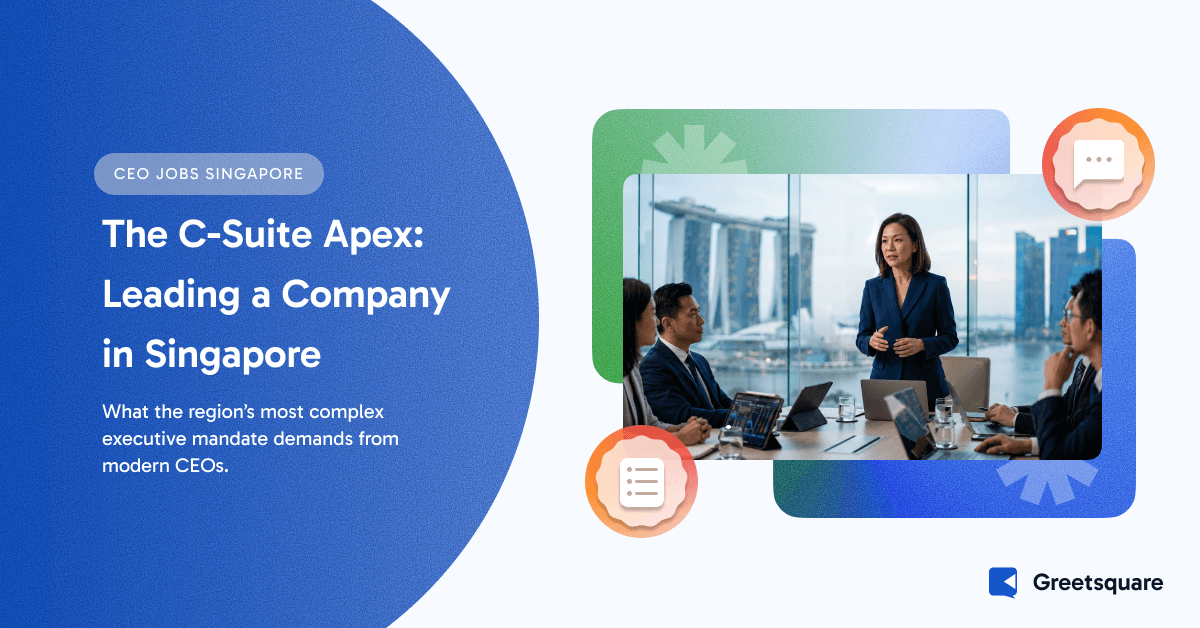
The CEO job description in Singapore reflects one of the most complex and high-stakes executive mandates in the Asia-Pacific region. Chief executive officers operating within Singapore’s sophisticated corporate ecosystem must navigate stringent governance frameworks, manage diverse stakeholder expectations, and drive financial performance while maintaining strategic clarity across multinational operations. The role demands mastery of corporate governance, investor relations, and organizational leadership within a market characterized by longer CEO tenures and heightened transparency requirements. Understanding what defines effective CEO leadership in Singapore requires examining how regulatory expectations, board dynamics, and market conditions shape the responsibilities and capabilities required at the top of an organization.
Key Takeaways
- CEOs hold ultimate accountability for vision, governance, financial stewardship, and stakeholder relations
- Singapore’s governance framework mandates detailed executive compensation disclosure under SGX rules
- Average CEO tenure in Singapore reaches 8.8 years, significantly above global benchmarks
- The role varies substantially across multinationals, listed companies, and private enterprises
Introduction to CEO Job Description
The chief executive officer role in Singapore represents the apex of corporate leadership responsibility within organizations ranging from regional headquarters of global corporations to homegrown listed entities and privately held enterprises. A comprehensive CEO job description encompasses strategic vision, operational execution, financial oversight, and governance accountability that extends across multiple dimensions of organizational performance. The c-suite executive landscape in Singapore operates within one of Asia’s most transparent and regulated corporate environments, where executive jobs in Singapore demand both regional perspective and deep understanding of local governance standards.
Singapore’s corporate governance framework explicitly delineates CEO responsibilities through codes such as those maintained by the Singapore Institute of Directors, which require clear separation between the Board Chair and CEO to ensure effective oversight. This structural clarity shapes how the CEO role functions within Singapore’s corporate landscape, distinguishing executive authority from board-level governance and establishing accountability boundaries that protect both shareholder interests and organizational integrity.
Core Purpose of the CEO Role in Singapore
The fundamental purpose of a CEO centers on establishing and executing the company vision and mission while maintaining ultimate decision-making authority across all strategic and operational domains. This executive accountability extends beyond quarterly financial targets to encompass long-term value creation, competitive positioning, and organizational resilience in dynamic market conditions. The CEO serves as the primary bridge between board expectations and management execution, translating governance priorities into operational reality while ensuring that strategic direction aligns with shareholder interests and stakeholder expectations.
Singapore’s corporate environment intensifies this accountability through regulatory requirements that mandate transparency in executive compensation and performance linkages. When examining managing director versus CEO distinctions, the CEO typically holds broader strategic scope and external-facing responsibilities, particularly in organizations with separate operational leadership structures.
Key Responsibilities of a Chief Executive Officer
Vision and Strategy Ownership
The CEO maintains singular ownership of business strategy development and strategic planning processes that determine competitive positioning and market approach. This responsibility involves synthesizing market intelligence, competitive dynamics, technological disruption, and regulatory shifts into coherent strategic frameworks that guide resource allocation and organizational priorities. Strategic planning under CEO leadership must balance short-term performance imperatives with long-term capability building, ensuring that quarterly execution does not compromise sustainable competitive advantage.
Company vision and mission articulation represents a distinctive CEO responsibility that cascades throughout organizational culture and decision-making frameworks. In Singapore’s context, where CEO tenures average 8.8 years compared to the global average of 7.2 years, this strategic continuity enables deeper institutional knowledge but also demands sustained innovation capacity to prevent strategic stagnation.
Corporate Governance and Board Relations
Corporate governance oversight represents a fundamental CEO responsibility within Singapore’s regulated corporate environment. The CEO must ensure organizational compliance with statutory requirements, listing rules, and governance codes while maintaining productive board relations that support effective oversight without constraining operational agility. This dual accountability requires CEOs to provide boards with transparent risk assessments, strategic alternatives, and performance data while executing board-approved strategies with appropriate autonomy.
Research indicates that while 84% of C-suite executives perceive their boards as understanding corporate strategy, only 19% rate overall board performance as good, suggesting gaps in communication effectiveness and board preparedness that CEOs must actively manage. Executive accountability within this dynamic requires CEOs to educate boards on industry developments, facilitate robust strategic debate, and ensure governance structures evolve alongside business complexity.
Financial Performance and Stewardship
Financial performance oversight constitutes a non-delegable CEO responsibility encompassing revenue growth, profitability management, capital efficiency, and shareholder value creation. The CEO must ensure financial strategies align with strategic objectives while maintaining the operational discipline required to deliver consistent results across economic cycles. This stewardship responsibility extends to capital structure decisions, dividend policies, investment prioritization, and the performance metrics that drive executive compensation and organizational incentives.
Executive compensation in Singapore reflects this accountability through performance-linked structures that tie CEO remuneration to financial outcomes and strategic milestones. The DBS Group CEO’s total remuneration reached S$17.6 million in 2024, representing a 14.3% increase correlated with strong earnings performance. Understanding managing director salary structures in Singapore provides additional context on senior executive compensation frameworks and performance accountability mechanisms across different organizational levels.
Risk management represents an integral dimension of financial stewardship, requiring CEOs to define organizational risk appetite, oversee enterprise risk frameworks, and ensure adequate controls protect against operational, financial, regulatory, and reputational threats.
Operational Management and Execution
Operational management under CEO leadership focuses on organizational effectiveness, resource optimization, and execution excellence across functional domains. While CEOs typically delegate day-to-day operational decisions to functional leaders, they maintain ultimate accountability for operational performance and must ensure management systems deliver consistent results aligned with strategic priorities. This organizational leadership responsibility includes talent deployment, capability development, technology infrastructure, and process effectiveness that collectively determine competitive performance.
The relationship between CEO strategic oversight and COO operational execution varies significantly across organizational structures. Examining COO job scope clarifies how operational accountability can be structured beneath the CEO level, enabling chief executives to maintain strategic focus while ensuring operational excellence through dedicated operational leadership.
Stakeholder, Investor, and Public Relations
Stakeholder management represents an increasingly complex CEO responsibility encompassing investor relations, regulatory engagement, customer relationships, employee communications, and public relations across multiple constituencies with potentially divergent interests. The CEO serves as the primary organizational voice to external audiences, shaping corporate reputation, managing crisis communications, and articulating strategic direction to investors, analysts, media, and regulatory authorities.
Investor relations demand particular attention within Singapore’s market, where SGX listing rules require public companies to disclose detailed executive remuneration including base salary, bonuses, stock options, and long-term incentives. Despite these requirements, only 37.5% of SGX-listed companies fully disclosed detailed CEO pay in 2023, with 14.2% making no disclosure, reflecting ongoing governance challenges that CEOs must navigate.
Corporate Culture and Leadership Influence
Corporate culture leadership represents perhaps the most intangible yet consequential CEO responsibility, shaping organizational values, behavioral norms, ethical standards, and employee engagement that collectively determine organizational effectiveness. The CEO sets cultural tone through personal example, reinforces desired behaviors through recognition and consequences, and ensures cultural attributes align with strategic requirements and competitive positioning.
Leadership skills required for effective culture stewardship include emotional intelligence, communication excellence, authenticity, and the capacity to inspire commitment across diverse employee populations. Organizational leadership at the CEO level must balance consistency in core values with cultural evolution as organizations scale, enter new markets, or navigate strategic transformations that demand behavioral change.
CEO Job Requirements and Leadership Capabilities
Strategic and Analytical Competencies
Strategic planning capabilities represent foundational CEO requirements, encompassing analytical rigor, market insight, competitive assessment, and the conceptual clarity required to synthesize complex information into actionable strategic frameworks. Effective CEOs combine quantitative analysis with qualitative judgment, balancing data-driven decision making with intuitive understanding of market dynamics and technological disruption.
Decision-making authority at the CEO level demands comfort with ambiguity, capacity to make consequential choices with incomplete information, and accountability for outcomes that may only become apparent years after initial decisions. This requires intellectual courage, analytical discipline, and the wisdom to distinguish between decisions requiring immediate resolution and those benefiting from additional data or market development.
Governance, Ethics, and Risk Oversight
Corporate governance expertise represents an essential CEO capability within Singapore’s regulatory environment, requiring fluency in listing requirements, statutory obligations, fiduciary responsibilities, and evolving governance standards that shape board effectiveness and shareholder protection. CEOs must understand governance principles sufficiently to design organizational structures, reporting frameworks, and control environments that satisfy regulatory expectations while enabling operational effectiveness.
Risk management capabilities extend beyond compliance orientation to encompass strategic risk assessment, scenario planning, crisis preparedness, and the organizational resilience required to navigate market disruptions, competitive threats, regulatory changes, and operational failures. This demands both analytical frameworks for risk quantification and leadership judgment for risk acceptance decisions.
People Leadership Across the C-Suite
Organizational leadership capabilities determine the CEO’s effectiveness in building, developing, and retaining the c-suite executive team and broader leadership population required to execute strategy and sustain organizational performance. This includes talent assessment, succession planning, leadership development, performance management, and the interpersonal effectiveness required to build cohesive executive teams.
Understanding relationships with functional leaders such as CHRO roles in Singapore and chief technology officers enables CEOs to leverage specialized expertise while maintaining strategic integration across the executive team.
CEO Role Variations by Company Type in Singapore
CEOs in Multinational Corporations
Multinational corporation CEOs operating within Singapore typically manage regional headquarters responsibilities, balancing global corporate alignment with local market adaptation and APAC regional coordination. These roles demand cultural fluency across diverse markets, matrix organization navigation, and the diplomatic skills required to influence without formal authority. The complexity of country manager roles in Singapore illustrates how regional leadership structures create both collaboration opportunities and potential conflicts that multinational CEOs must actively manage.
CEOs in Listed Companies
Listed company CEOs face heightened governance scrutiny, quarterly earnings pressure, analyst engagement, and the transparency requirements that accompany public market accountability. Investor relations consume significant CEO time and attention, requiring effective communication of strategic direction, performance context, and future outlook that shapes market valuation. The regulatory framework governing listed entities in Singapore creates structural accountability that distinguishes listed company CEO roles from private company counterparts.
Corporate governance in listed contexts emphasizes board independence, audit committee rigor, remuneration transparency, and shareholder rights protection. PwC’s Corporate Governance Report highlights detailed remuneration breakdowns and performance indicator linkages that illustrate how governance frameworks shape executive accountability in Singapore’s listed company environment.
CEOs in Private and Founder-Led Companies
Private company CEOs often operate with greater strategic flexibility, longer investment horizons, and reduced quarterly earnings pressure compared to listed company counterparts. This can enable bolder strategic moves, patient capital deployment, and organizational transformations that might face market skepticism in public contexts. However, private company CEOs may also face concentrated ownership dynamics, family governance complexity, or founder influence that creates different accountability patterns.
Decision-making authority in founder-led private companies particularly reflects the balance between professional management and entrepreneurial ownership, requiring CEOs to navigate founder vision while respecting legitimate shareholder prerogatives.
Relationship Between the CEO and Other Executive Roles
CEO vs Managing Director
The distinction between CEO and managing director roles varies across organizational contexts, with some companies using titles interchangeably while others maintain distinct role definitions. Detailed exploration of managing director versus CEO differences clarifies how these roles can diverge, particularly in organizations where managing directors focus on operational execution while CEOs maintain primary board accountability and external stakeholder engagement.
CEO and Functional Leaders (CIO, CTO, HR, Operations)
Organizational leadership effectiveness depends substantially on how CEOs structure relationships with functional executives who bring specialized expertise in technology, finance, human resources, operations, and other domains. Understanding distinctions such as CIO versus CTO roles enables CEOs to design executive structures that leverage specialized capabilities while maintaining strategic integration.
The CEO’s role in orchestrating c-suite collaboration includes establishing shared objectives, facilitating cross-functional problem solving, managing competing resource demands, and ensuring functional strategies collectively advance organizational priorities rather than optimizing individual domains at enterprise expense.
CEO Jobs and Career Pathways in the Singapore Job Market
The Singapore job market for CEO positions reflects both local corporate demand and regional headquarters concentration that positions Singapore as a hub for APAC leadership roles. Career pathways to CEO positions typically progress through functional leadership, general management, or P&L accountability that develops the breadth required for enterprise-wide responsibility.
Executive search for CEO positions increasingly emphasizes not only functional expertise and industry knowledge but also leadership capabilities, cultural fit, stakeholder management skills, and the strategic thinking required to navigate market complexity. Understanding how headhunters evaluate executive candidates provides insight into the assessment frameworks and selection criteria that shape CEO hiring decisions.
How Greetsquare Supports Executive Leadership Hiring and Career Growth
Greetsquare serves as a specialized platform connecting professionals across all career levels with opportunities throughout Singapore and the Asia-Pacific region. The platform enables companies seeking CEO talent and other c-suite positions to access qualified candidates through comprehensive professional profiles that extend beyond traditional credentials. For executives pursuing CEO jobs in Singapore, Greetsquare provides visibility into leadership opportunities while offering companies enhanced candidate assessment tools that support more informed hiring decisions.
Conclusion
The CEO job description in Singapore encompasses strategic vision, governance accountability, financial stewardship, stakeholder management, and organizational leadership within one of Asia’s most sophisticated corporate environments. Effective CEOs balance regulatory compliance with competitive agility, shareholder interests with stakeholder obligations, and operational execution with strategic transformation. For professionals exploring executive leadership opportunities or companies seeking to understand what defines effective CEO capability in Singapore’s market, register at Greetsquare to access specialized resources and connections within the senior executive community.
FAQ
What are the primary responsibilities in a CEO job description?
CEOs hold ultimate accountability for strategic direction, corporate governance, financial performance, operational effectiveness, stakeholder relations, and organizational culture across the enterprise.
How does the CEO role differ across company types in Singapore?
Multinational CEOs manage regional scope and matrix complexity, listed company CEOs face heightened governance and investor scrutiny, while private company CEOs operate with greater flexibility but navigate ownership dynamics.
What qualifications and capabilities do CEO positions require?
CEO roles demand strategic thinking, governance expertise, financial acumen, risk management capability, stakeholder communication skills, and the people leadership required to build effective executive teams.