

To turn internships and projects into job experience on an application, explain the work you performed, the decisions you made and the outcome you can support. Connect those details to a responsibility in the target job. You are demonstrating relevant capability, not relabelling every assignment as professional employment.
The hardest part is often recognising the value of work that felt ordinary at the time. Cleaning records, checking calculations or coordinating a handover can show useful judgement when you explain why the task mattered.
What the Research Says About Experience and Skills
NACE’s 2026 explanation of the skills-based hiring process reports that 88.1% of respondents to its 2025 Student Survey participated in projects, internships or volunteer work that helped develop career-relevant skills. That is a US student survey finding, not a measure of Singapore employer preferences or a guarantee of employment.
The useful question is what the experience lets you demonstrate. A project name establishes context, but the employer still needs to understand your skill and contribution. Build that explanation before deciding whether the example belongs in a resume, portfolio or interview.
Start with an Evidence Inventory
List your internships, major assignments, practical modules, volunteering and personal projects. For each, record the original task, your responsibilities, tools used, important decisions and available outputs. Include work you supported as well as work you led.
Then compare this inventory with the target vacancy. A data-cleaning assignment may fit an analyst application better than a leadership award. A student event may provide a stronger coordination example than a technical project where you worked alone.
Keep a private master record so you can select examples without rewriting your history each time. The fresh graduate job hunting guide explains how this evidence supports the wider search. Start with a role target so your portfolio does not become a collection of unrelated work.
Turn Internships and Projects into Job Experience Clearly
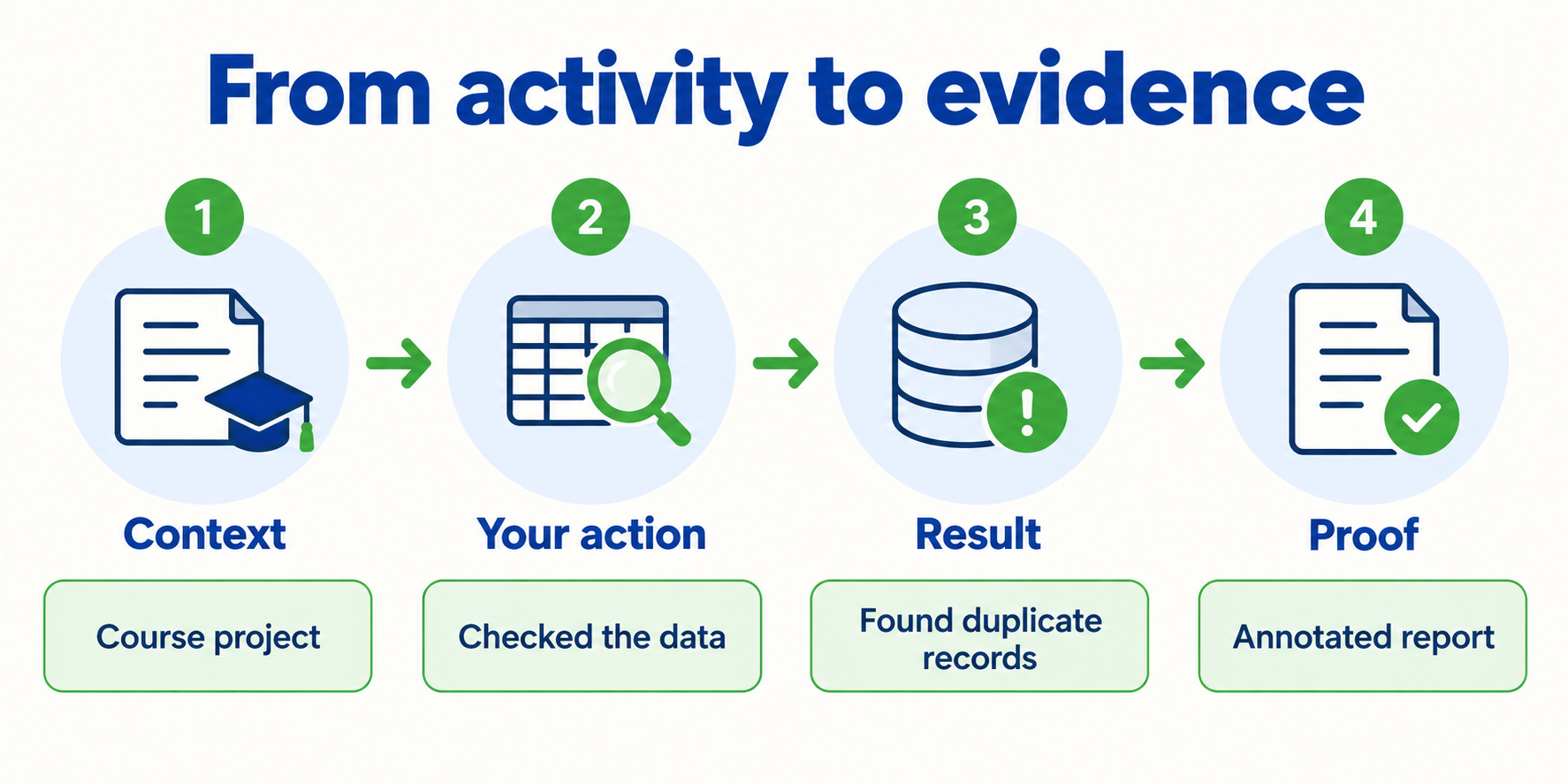
Use four questions to develop each example: what was the context, what did you do, what happened, and what could support your account? This keeps an application specific without requiring a dramatic success story.
Describe the Context Briefly
Identify whether the work was an internship, academic project or independent exercise. Explain the practical problem in ordinary language. “University logistics simulation” is more informative than a module code that an employer cannot interpret.
If you used fictional or public data, say so where it affects the claim. A simulated recommendation is not the same as a change implemented in a real company. Accurate context makes your analytical work easier to trust.
Explain the Actions You Owned
Use verbs that describe the actual work: compared, checked, interviewed, drafted, tested or coordinated. Avoid “managed” if you only attended meetings, and avoid “built” if you mainly followed an existing template. You can still explain what you learned or improved while working within a template.
Make decisions visible. Why did you choose that method, and how did you know whether it worked? These details help an interviewer assess judgement beyond the name of the tool.
Use Results Without Manufacturing Numbers
A result may be a completed report, an error identified, a process documented or a recommendation tested. Revenue, time saved and percentage improvements are useful only when measured credibly. Never add a plausible number because a resume template suggests every bullet needs one.
Suppose, in a hypothetical internship, you identified duplicate customer records. If no one measured the time saved, write that you flagged duplicates and documented a review process. Do not convert that work into “improved efficiency by 30%” without evidence.
Scope can make an example concrete without claiming impact. You might accurately describe the number of records reviewed, interviews conducted or weeks covered. Keep the underlying source in your private notes so you can explain the figure later.
Separate Your Contribution from the Team’s Result
Team outcomes need careful attribution. A useful description might say, “Prepared the interview guide and analysed responses for a four-person research project.” If the team won an award, state that separately instead of implying you produced the entire project.
In an interview, explain where your work connected with other people’s tasks. Describe how you resolved a disagreement or handled a dependency. Teamwork becomes visible through those interactions, not through repeated use of “we” with no identifiable contribution.
If your role was small, keep the claim small and precise. Checking references for a report can demonstrate care and reliability. Inflating the role creates a problem when the interviewer asks a basic follow-up question.
Build a Portfolio That a Reviewer Can Use
Choose a few relevant pieces rather than publishing every assignment. Each needs a short introduction, your role, a visible output and an explanation of its limitations. Make the main point understandable without requiring someone to download a large folder.
For a spreadsheet project, an annotated screenshot and a concise description may be enough to start a discussion. For writing, explain the audience and purpose before sharing a sample. For code, provide setup instructions and identify what works, what is incomplete and which parts you wrote.
Share only material you are allowed to disclose. Ask permission before using internship documents, and remove confidential information from approved samples. When necessary, create a clearly labelled independent example that demonstrates the same skill using public or fictional data.
Adapt One Example for Different Formats
The resume version should be concise. The portfolio can show the output and method. The interview version can explain choices, obstacles and learning. All three should tell the same factual story even though their level of detail differs.
Use the guide to writing a resume with no experience when selecting section order and bullets. Avoid pasting an entire case study into the resume. Give the reviewer enough information to understand relevance and find the supporting work.
A short spoken walkthrough can also demonstrate how you explain a project. If that format suits the application, explore Greetsquare’s video resume option. Keep it to a useful example and do not display confidential screens or imply that video proves every technical claim.
Improve One Example Before Collecting More
Choose your strongest relevant project and write a six-sentence account: context, goal, action, decision, result and lesson. Ask a reader to identify your contribution without prompting. If they cannot, improve the explanation before adding more projects.
Then test every claim against what you can actually show or discuss. This creates a reusable account for applications and interviews while keeping your experience accurate. Depth in a few relevant examples is often more useful than a long list of unexplained activity.
Frequently Asked Questions
Does Coursework Count as Experience?
Coursework can demonstrate relevant skills, but it should remain labelled as academic work. Describe the task, your contribution and the output. Do not imply a simulated project was paid employment or a live client engagement. Its usefulness depends on how closely it relates to the role you want.
What If My Project Did Not Succeed?
Explain the goal, what happened and what you learned without presenting failure as a hidden success. A well-examined unsuccessful approach can demonstrate judgement and learning. Identify what you would change and which evidence informed that conclusion. Avoid blaming teammates or inventing a later outcome that never occurred.
Can I Show Internship Work in a Portfolio?
Only share work you have permission to disclose. Check confidentiality obligations and obtain approval where needed. Removing a company name may not make a document safe to publish. If sharing is not possible, explain your responsibilities generally or create a clearly labelled independent sample using suitable non-confidential information.
How Do I Describe Impact Without Figures?
Describe the output, the problem addressed and how the work was used, if known. A completed handover guide or documented error can be meaningful evidence. Use accurate scope details where available. Do not invent time savings, revenue or percentage improvements simply to make the bullet sound more impressive.



