

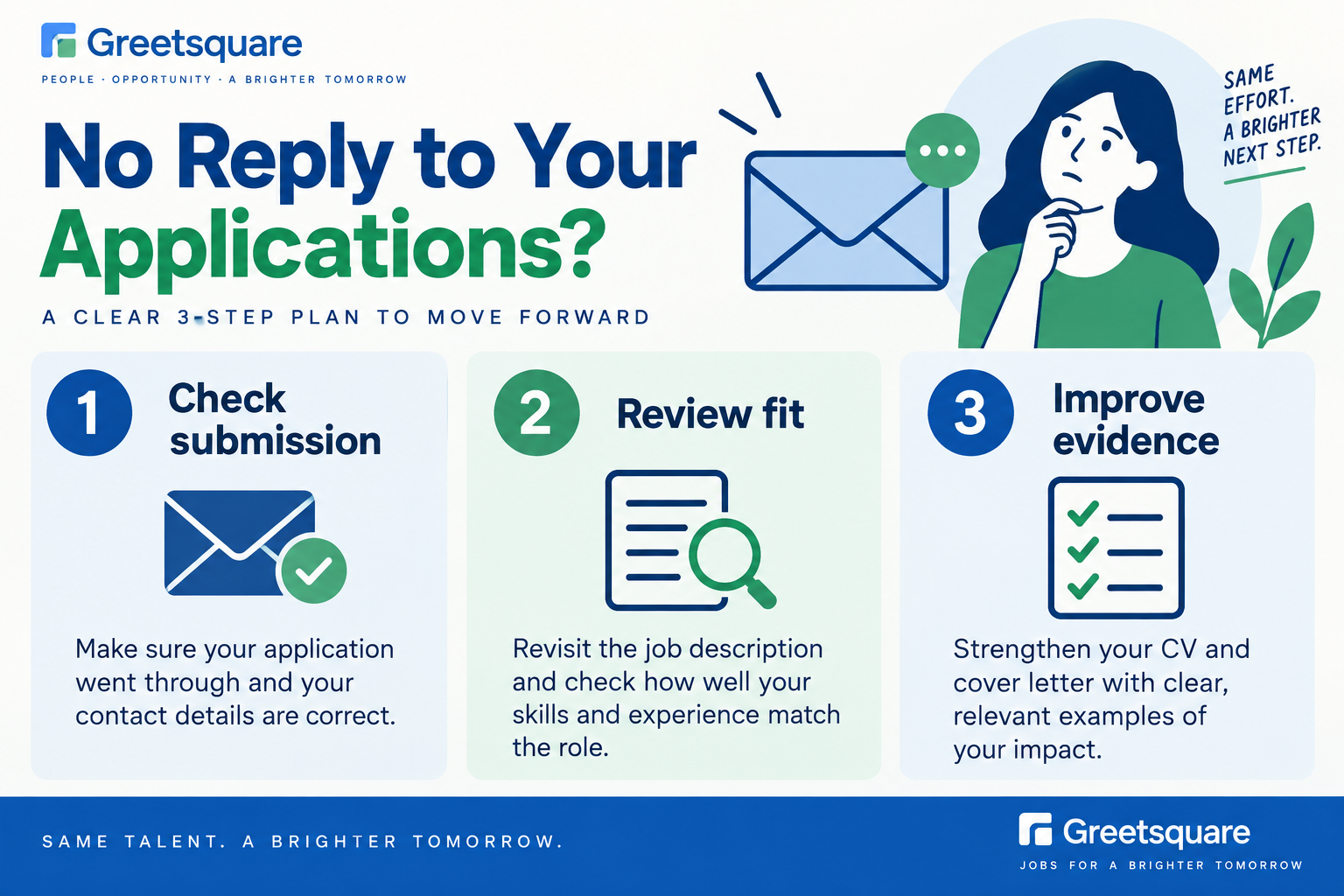
If you never hear back from job applications, review whether you are applying to suitable roles, submitting complete information and making your fit easy to see. Employer delays, changed hiring plans and competition can also explain silence. No response alone cannot tell you which explanation applies.
Repeated silence is frustrating because it gives you little information to act on. The aim is to replace guesses with checks you can perform, then improve the parts of the application you control.
What Official Guidance Says About Unclear Vacancies
In its October 2025 answer on ghost jobs, Singapore’s Ministry of Manpower explains that advertising a position across multiple portals does not necessarily indicate a fictitious vacancy. A repeated advertisement is therefore a reason to investigate, not proof that you wasted your time.
The same care applies to an unanswered application. You can observe the lack of a response. You usually cannot observe the employer’s headcount approval, review queue or discussion with another candidate.
Diagnose Why You Never Hear Back from Job Applications
Separate three outcomes in your tracker: no acknowledgement, acknowledgement without contact, and silence after a conversation. They point to different questions. Treating all three as identical rejection hides information that could help you improve.
No acknowledgement should prompt a submission check. An acknowledgement confirms receipt more than interest. Silence after a recruiter conversation may justify a timeline follow-up, particularly if the recruiter invited contact or promised a decision date.
Review a group of similar applications rather than comparing an entry-level operations role with a senior specialist vacancy. Our guide to a stuck job search helps you decide whether the issue begins with targeting, applications or later stages.
Check Whether the Application Was Complete
Open the confirmation message and the portal, if one is available. Check that the submission is complete rather than saved as a draft. Confirm that the correct document was attached and the email address and phone number are accurate.
Look for a separate assessment, portfolio request or screening question. It is easy to upload a resume and overlook a required second step. Check spam folders, but do not assume that every missing message is hidden there.
Keep a copy of what you submitted. A beautifully updated resume on your laptop tells you nothing about the older version sent last week. Record the document filename and job reference so your review uses evidence rather than memory.
Distinguish Essential Requirements from Preferences
Read the vacancy again and identify requirements that are genuinely necessary for the work. Examples may include a professional registration, a specific shift pattern or experience with responsibilities at a particular level. Answer screening questions honestly.
Preferences are different. You may be able to show relevant capability through adjacent experience even if you have not held an identical job title. Explain that connection rather than expecting the reviewer to infer it from a list of unrelated duties.
A useful check is to write the role’s three main responsibilities and place one credible example beneath each. If every example requires a long explanation to become relevant, the vacancy may be a weak target. If the examples are strong but absent from your resume, presentation is the more actionable problem.
Make the Strongest Evidence Easy to Find
Your opening summary should identify your relevant work, not describe you as an enthusiastic professional who can do anything. Follow it with experience or projects that address the employer’s likely questions.
Consider this illustrative change: “Responsible for customer service” becomes “Resolved delivery enquiries, checked order records and coordinated replacement arrangements with the warehouse team.” The second version gives a reviewer something concrete to assess. Add a result only when you can support it.
Avoid hiding useful evidence beneath long lists of minor duties. A recruiter should not have to reach the final page to discover that you have done the central task in the vacancy. Relevance determines prominence, while dates and job titles remain accurate.
Understand What an ATS Can and Cannot Explain
An applicant tracking system stores and helps manage applications. Some hiring workflows use screening questions, search functions or additional assessments. The mere presence of an ATS does not prove that a universal robot score determined your outcome.
Use ordinary section headings and check any information extracted into the application form. Our ATS formatting and keyword guide explains practical checks without treating an online match score as an employer’s actual decision rule.
Keyword alignment should describe real experience. Repeating the job description, adding invisible text or claiming tools you cannot use can make your application less credible when a person reads it. Technical readability and suitability are separate questions.
Replace Volume Alone with a Useful Comparison
Sending a large number of near-identical resumes can repeat the same weakness. Instead, compare the roles most closely aligned with your experience and look at what you showed those employers.
For your next small group of suitable applications, change one meaningful feature. You might move a relevant project higher, clarify a transferable skill or replace vague duties with specific actions. Keep the rest of your process reasonably consistent so you can understand what changed.
This is a practical review, not a controlled scientific experiment. Small samples, different employers and different hiring timelines limit what you can conclude. Use responses as feedback while also asking whether the revision makes your evidence objectively clearer.
Add Supporting Evidence Selectively
A work sample can help when it answers a real question about your ability. For example, a fictional customer-response exercise can show how you organise an answer without exposing a former employer’s records. Label demonstrations and hypothetical work accurately.
The guide to standing out from other applicants explains how to choose a proportionate sample. Do not turn every application into an unpaid consulting project, especially when the vacancy itself remains unclear.
If the employer welcomes a short introduction, Greetsquare’s video resume option may help you explain one relevant example. It supplements the required application. It does not bypass the hiring process or ensure that a recruiter will watch.
Follow Up Without Freezing Your Search
Follow the employer’s stated timeline and contact instructions. If no timeline is given and a suitable contact exists, one concise enquiry after a reasonable interval can be appropriate. Identify the position and submission date, then ask whether further information would help.
Do not send daily reminders or contact several people with the same demand. If you receive no answer, record the follow-up and redirect your effort. A lack of closure is disappointing, but it does not require you to keep investing in that vacancy.
Continue interviewing and applying elsewhere until you have an outcome you can rely on. An encouraging conversation, a portal status or a friendly message is not the same as a confirmed offer.
Use Silence as a Review Trigger
Choose one unanswered application today. Verify submission, check the essential requirements and ask whether your strongest relevant example is immediately visible. Fix any clear problem before changing the entire resume.
Then choose the next suitable opportunity. A useful response to silence combines better evidence with a search that keeps moving, rather than waiting for one employer to provide a complete explanation.
Frequently Asked Questions
Does No Response Mean My Resume Failed the ATS?
No. Silence does not identify the reason an application stopped progressing. Formatting problems, eligibility questions, competition, delayed reviews and changed hiring plans are all possible. Check the submitted document and any populated fields, but avoid assuming that an unknown software score explains every unanswered application you have sent.
Should I Apply Again to the Same Vacancy?
Check the employer’s instructions and whether the vacancy is genuinely new. Repeated submissions to the same open position may add little value. If you have substantial new experience or the requirements have changed, a fresh application may make sense. Explain the relevant improvement rather than repeatedly sending an unchanged resume.
How Long Should I Wait for a Response?
Use the employer’s stated schedule where available. Some review applications after a closing date, while others assess them as they arrive. If no schedule exists, allow a reasonable interval before a concise enquiry. Continue pursuing other suitable roles instead of treating one unanswered application as a commitment from the employer.
Is Employer Ghosting a Reflection of My Ability?
Not necessarily. Poor communication can happen for reasons unrelated to your ability, and silence gives you limited evidence. Review your process for clear improvements without turning the missing response into a judgement of your worth. Specific feedback and patterns across comparable applications are more useful than one unexplained outcome.



