

To tailor your resume quickly, identify the role’s main responsibilities, select matching examples from a prepared evidence bank and move the strongest evidence into prominent positions. Adjust your summary, skills and relevant bullets without rebuilding the whole document. Keep every version truthful and check it before submission.
Speed comes from preparation and clear decisions. It does not come from replacing a few words in a generic document and assuming that the result now fits every employer.
What Resume Guidance Supports
The US Department of Labor-sponsored CareerOneStop work experience guide recommends identifying the role, organisation and dates while describing relevant experience and accomplishments. It also suggests supplying context when an organisation’s work would otherwise be unclear.
These are practical writing principles, not evidence of a universal callback increase. The useful application is to preserve the facts of your work while choosing details that answer the current employer’s questions.
Build a System to Tailor Your Resume Quickly
Create a master record that is longer than any resume you will submit. For each job or project, capture responsibilities, tools, decisions, collaborators and outcomes. Include the source of any metric so you do not later confuse an estimate with a measured result.
Tag examples by capability, such as reporting, coordination, analysis, customer service or process improvement. The tags help you find evidence. They do not all need to appear in the final document.
Keep a plain, readable base template alongside that record. The template handles formatting; the evidence bank handles substance. This separation prevents you from repeatedly redesigning the document when the real task is deciding what to include.
Read the Vacancy Before Editing
Identify the Main Work
Write a short description of what the person will actually do. “Support monthly reporting and explain exceptions to team leads” is more actionable than “excellent communicator.” Look for repeated responsibilities and the outcomes the employer wants.
Choose three or four central requirements. Do not assign equal space to every phrase in the advertisement. Some wording describes the organisation’s culture rather than a task you need to demonstrate in detail.
Check Essential Constraints
Review location, working hours, required registrations and other stated conditions. If you cannot meet a genuine requirement, polishing the resume may not be the best use of your time. Clarify ambiguity where an appropriate contact exists.
The stuck job search guide can help you reconsider your targeting before you invest in repeated applications with the same mismatch.
Create a Small Evidence Match
For each central responsibility, choose an example that shows a relevant action. A simple working note can pair “resolve delivery problems” with “checked order records, contacted dispatch and explained revised options to customers.”
Mark gaps honestly. You may have adjacent experience rather than direct experience, or you may need to learn something. The purpose is to reveal what you can credibly offer, not to force a perfect match where none exists.
If two examples demonstrate the same skill, prefer the one that is more recent, more relevant or easier to explain. A prestigious project is not automatically better than a modest task with a clear personal contribution.
Edit the Parts That Affect Understanding
Start with the summary. State your relevant background and the kind of contribution you can make. Avoid a long string of adjectives, and do not claim seniority simply because the vacancy uses a more impressive title.
Next, reorder or refine bullets within relevant roles. Keep employment history understandable and dates accurate. Emphasise the responsibilities that matter most to this vacancy without deleting so much context that the work becomes misleading.
Finally, review the skills section. Include tools and capabilities supported by your experience. If the employer uses a term you know by another name, use its wording only when the meanings genuinely align.
Use a Worked Example to Check Relevance
Imagine a fictional applicant applying for an operations coordinator role. Their original bullet reads, “Helped with office tasks and spoke to different teams.” It is truthful but too broad to show what they contributed.
A clearer version might read, “Maintained the weekly delivery tracker, checked missing updates with warehouse colleagues and summarised unresolved orders for the supervisor.” This connects coordination, record accuracy and communication to observable work.
If the applicant also reduced overdue orders, they should add that result only when they can explain the measurement and their role. A specific action without an invented percentage is stronger than a polished number they cannot defend.
The example demonstrates selection and explanation. It does not suggest that every operations vacancy wants the same experience or that this wording guarantees an interview.
Set a Time Budget Without Turning It into a Rule
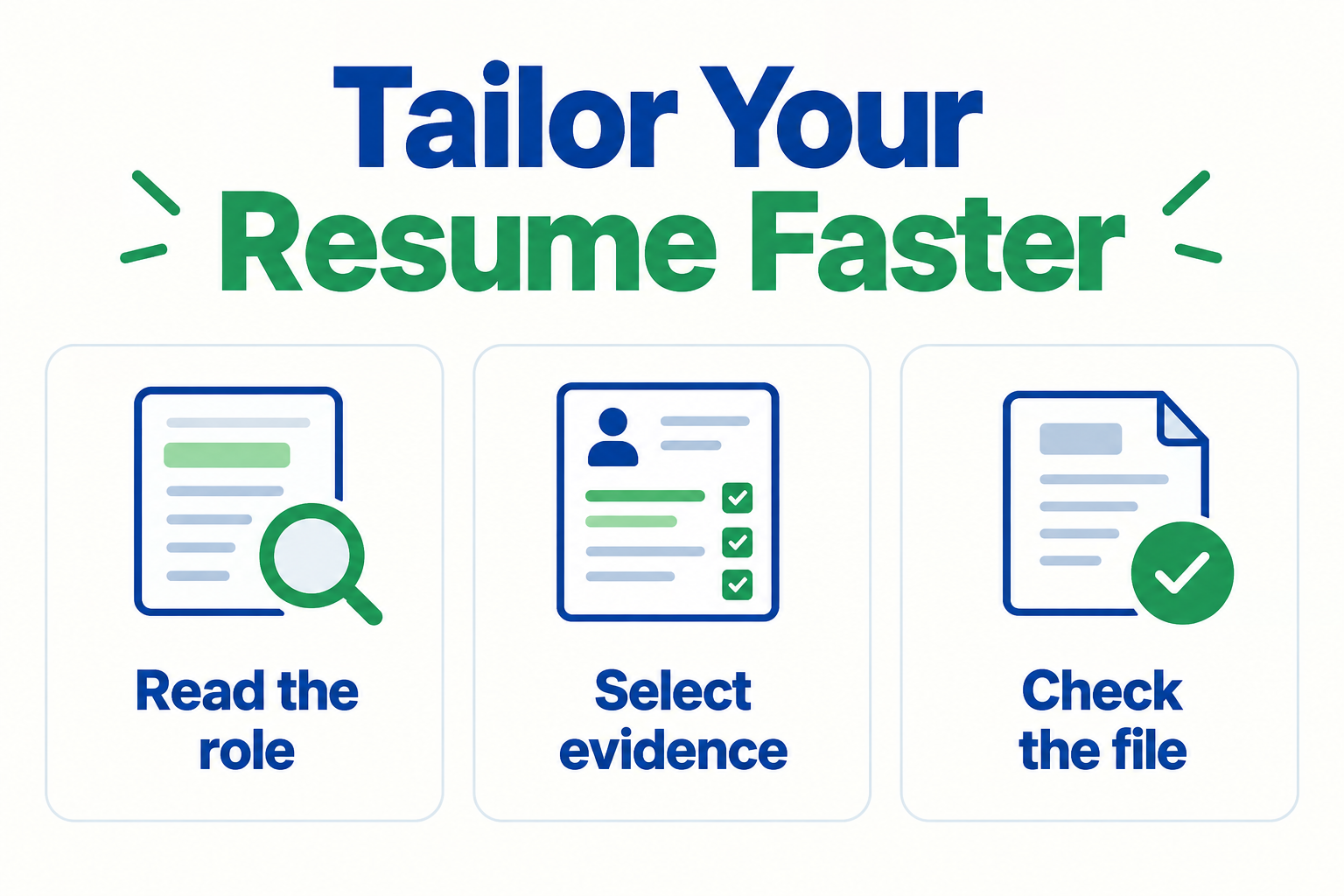
You might allocate a short session to reading the vacancy, another to selecting and editing evidence, and a final session to checking the application. The first few applications may take longer while you build your evidence bank.
Use the time budget to prevent endless cosmetic changes. If you are still changing fonts after the content is clear, stop and review the employer’s requirements instead. If the application needs a substantial statement or portfolio, allow more time.
The right stopping point is when your relevant evidence is accurate, easy to find and sufficient for the requested application. Perfect wording is not a substitute for submitting before the deadline.
Use AI as an Editor, Not a Source of Experience
An editing tool can help shorten a sentence or suggest clearer wording. Supply only information you are comfortable sharing and remove confidential employer or customer details. Check the output against your actual history.
Watch for inflated verbs, invented results and tools you never used. “Led” and “supported” describe different contributions. A fluent sentence can still be inaccurate, and you remain responsible for what the application says.
Keep a record of your original evidence. If a suggested revision changes its meaning, reject the revision rather than trying to remember a new story for the interview.
Check Readability and Version Control
Follow the employer’s file instructions and inspect the exported document. Our ATS resume guide explains why simple formatting and reviewing populated fields are useful safeguards.
Name the file clearly and record which version went to which employer. Check the company name in any summary or accompanying letter. An otherwise strong application can look careless if it refers to a different organisation.
Where additional introductions are welcomed, Greetsquare’s video resume option can complement your written evidence. Tailor the example you discuss to the role, but do not create a new video merely to repeat the entire resume aloud.
Improve the System After Each Application
Add useful refinements back to your evidence bank. If you found a clearer way to explain a project, save it with the facts that support it. Keep role-specific details separate so they do not accidentally appear in unrelated applications.
Over time, the work becomes selecting and checking rather than starting from an empty page. For your next application, prepare the three strongest evidence matches before opening the resume template.
Frequently Asked Questions
Do I Need a Different Resume for Every Job?
You usually need a relevant version rather than an entirely new document. Similar roles may share a strong base resume, while different responsibilities require changes in emphasis. Review the vacancy each time and select appropriate examples. Keep the underlying facts, dates and job titles consistent across all versions you submit.
How Long Should Resume Tailoring Take?
There is no fixed duration that suits every application. A prepared evidence bank can make routine tailoring faster, while unfamiliar roles or detailed statements require more work. Set a practical time budget and reserve time for checking. Stop when the application is accurate, relevant and complete, not merely visually polished.
Can I Use AI to Tailor My Resume?
Yes, as an editing aid, provided you protect confidential information and verify every sentence. Do not accept invented achievements, tools or responsibilities. Ask for clearer wording based on supplied facts, then compare the output with your actual experience. You should be able to explain and defend every claim in an interview.
What If I Do Not Meet Every Requirement?
Distinguish essential conditions from preferences and assess the actual responsibilities. Relevant adjacent experience may support an application even when your background is not identical. Explain that connection honestly. Do not claim qualifications or skills you lack, and avoid spending extensive time on vacancies with clear requirements you cannot meet.



