

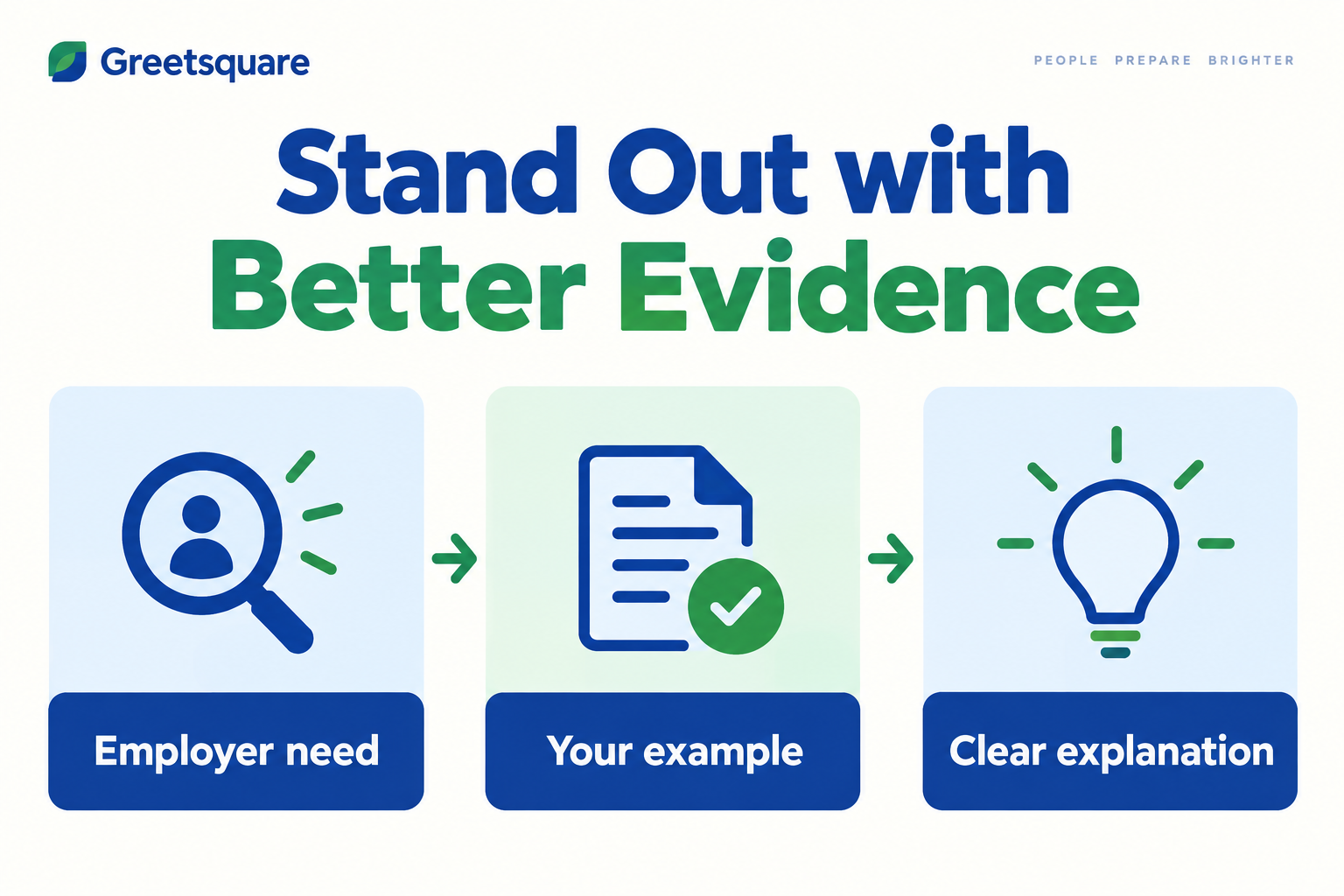
To stand out from other job applicants, make it easy for the employer to understand how your experience connects to the role. Show a specific example, explain your contribution and provide supporting work where appropriate. Being memorable helps only when the employer can also see why you are suitable.
You do not need to be the loudest applicant or produce the most elaborate presentation. A clear, credible application can distinguish you by reducing uncertainty about what you can actually do.
What Career Guidance Says About Demonstrating Ability
CareerOneStop’s interview preparation guidance recommends practising answers and researching the employer before a conversation. These are preparation principles, not proof that a particular presentation style increases offers.
Apply the same principle before the interview: know the work being discussed and choose evidence that supports your answer. An attractive portfolio is useful only if the employer can understand the problem, your decisions and the resulting work.
Stand Out from Other Applicants Through Relevance
Read the vacancy and identify the question the employer is trying to answer. For a coordinator, that might be whether you can keep work organised across several people. For a support role, it might be whether you can explain an unfamiliar process clearly.
Select an example that addresses that question directly. A large project with an unclear personal role may provide less evidence than a small task you handled from beginning to end. Explain the conditions under which you worked and what you personally decided.
If applications are not reaching conversations, first review the guide to a stuck job search. Adding creative material will not repair a missing qualification, an incomplete form or a poorly chosen vacancy.
Turn Claims into Examples
“Strong communicator” is a claim. “Explained a revised delivery process to customers and checked that colleagues used the same information” is an example. The second statement gives the employer something to question and evaluate.
Use a simple structure: the problem, your action and what happened next. Include the result when you know it. If you cannot measure the outcome, describe an observable change without inventing a percentage.
For a fictional applicant moving from retail to customer operations, an example might explain how they checked an order discrepancy, coordinated with another team and kept the customer informed. The transfer lies in the work process, not in pretending the two jobs are identical.
Choose a Work Sample That Answers a Real Question
Match the Sample to the Role
A short process note may suit an operations role. A small analysis with assumptions and limitations may suit an analyst role. A written response to a fictional customer scenario may suit service work. Each should demonstrate something the employer needs.
Label self-initiated samples clearly. A hypothetical exercise is not client work, and an adapted public dataset is not evidence that you delivered a commercial result. Accurate labels make the sample easier to trust.
Keep the Investment Proportionate
Choose a small, reusable demonstration rather than completing a large unpaid project for every application. If an employer requests extensive work, clarify the purpose, expected time and how the output will be used before deciding how much effort to invest.
You can demonstrate judgement by defining scope. A focused sample that explains one decision may be more useful than a long presentation with little connection to the role. Include enough context for the reader to assess it independently.
Explain Your Contribution Without Overclaiming
Team projects require precise language. State what the team was trying to accomplish, which part you owned and how your work interacted with others. Avoid attributing the whole team’s achievement to yourself.
For example, “Prepared the status report used in weekly project meetings” is different from “Led the project.” Both may be valuable, but they describe different responsibilities. Use the version that reflects what actually happened.
If the outcome depended on several changes, explain that limitation. Credibility improves when you can distinguish your contribution from factors you did not control. The ability to make that distinction is itself evidence of sound judgement.
Make Supporting Material Easy to Review
Put the essential evidence in the application itself. A reviewer should not need to open five links to discover your relevant experience. Supporting material should deepen a clear point, not rescue an otherwise empty resume.
Check that shared links work for someone who is not signed into your account. Use descriptive filenames and a short explanation of what the reader will find. Remove unnecessary navigation, requests to register and large downloads where possible.
Protect confidential information. Use fictional records or public data instead of customer names, internal screenshots and sensitive employer documents. An example that breaches trust can undermine the very professionalism you hoped to demonstrate.
Use Video When Speaking Adds Value
A short video can be useful when it lets you explain a decision, introduce a relevant project or demonstrate clear communication. It is less useful when it simply repeats every line of your resume or adds production effects without substance.
If the application process welcomes it, Greetsquare’s video resume option offers an additional format for an introduction. Keep the employer’s required documents complete and follow any instructions about length or submission.
Build the explanation around one relevant point. Introduce your background briefly, describe an example and connect it to the role. Use clear audio and a simple setting. Expensive equipment is not necessary to explain your work accurately.
Do not assume that an employer will watch an unsolicited video. Some hiring processes restrict additional material or use a standard assessment. Respect that process and avoid presenting video as a way around formal screening.
Personalise Outreach Without Becoming Intrusive
Where an appropriate contact is available, write a short message that identifies the role and one relevant connection. Ask a concrete question that the advertisement does not already answer. Keep the message easy to respond to.
Do not contact multiple employees with identical requests or demand that someone review your application immediately. A relevant conversation can provide context, but it does not entitle you to special treatment or replace the required application route.
If silence is the main difficulty, read why applicants never hear back. It helps you separate useful application improvements from employer behaviour you cannot control.
Check Whether Your Application Is Distinct for the Right Reason
Ask a reader to answer three questions after reviewing it: What role are you pursuing? Which example best supports your fit? What did you personally contribute? If the answers are unclear, simplify the application before adding another format.
Then check consistency across the resume, profile, sample and interview notes. Dates, responsibilities and results should agree. Distinctive presentation cannot compensate for contradictory facts.
Make One Useful Improvement Today
Choose a suitable vacancy and identify one responsibility you can demonstrate well. Rewrite the relevant example so that the problem, action and outcome are clear. Add a small supporting sample only if it improves understanding.
That gives the employer a reason to remember your application: a credible connection between the work they need and the work you can explain.
Frequently Asked Questions
How Can I Stand Out Without More Experience?
Use the strongest relevant evidence you already have, including projects, volunteering or adjacent work. Explain your own contribution clearly and label the context honestly. A focused example can show judgement or communication without implying senior experience. Choose suitable roles and identify genuine skill gaps you can work on next.
Should I Send a Portfolio for Every Job?
No. A portfolio is useful when it demonstrates skills relevant to the vacancy and the employer accepts supporting material. Some roles need only the requested application. Keep essential evidence in your resume, and add a sample when it answers a practical question rather than merely making the application longer.
Will a Video Resume Guarantee More Interviews?
No. A video is one possible supporting format, and employers differ in whether they accept or review it. Its usefulness depends on relevance, clarity and the hiring process. Complete the required written application and avoid treating recording quality, personality or a platform choice as a guarantee of an interview.
How Much Unpaid Work Should I Do for an Application?
There is no universal amount. Clarify the purpose, expected time and intended use of any requested task, then decide whether the commitment is reasonable for you. Prefer focused demonstrations of relevant ability. Protect confidential information and avoid assuming that extensive speculative work will produce a stronger hiring outcome.



