

Ghost jobs are generally described as job advertisements for positions that an employer does not currently intend to fill. You cannot reliably identify one from an old posting date or a missing reply alone. Verify the opportunity, ask practical questions where possible and limit extra work when the hiring situation remains unclear.
The goal is not to prove that an employer acted badly. It is to decide how much of your limited search time an opportunity deserves.
What Singapore’s Ministry of Manpower Says
MOM’s October 2025 parliamentary reply on ghost jobs says reported vacancies are validated and checked against other data sources. It also notes that employers may advertise across several portals as part of normal recruitment.
This does not verify every advertisement an applicant sees. It does explain why duplicate postings alone are insufficient evidence of a fictitious opening. Assess the specific vacancy rather than applying a blanket label to every repeated advert.
Distinguish Ghost Jobs from Other Situations
An employer may actively recruit for a position, maintain an ongoing candidate pool or pause a role after advertising it. A job board may also retain an outdated copy after the employer closes the original. These situations can look similar from outside.
A fraudulent job advertisement is another category. Its purpose may be to obtain money or personal information rather than recruit. Do not treat suspected fraud as merely an inefficient application worth one more follow-up.
The distinction changes your response. An unclear hiring timeline calls for clarification and limited effort. A suspicious request for payment or sensitive information calls for independent verification before you engage further.
Look for Evidence Before Labelling Ghost Jobs
Start with the organisation’s official website and careers page. Check whether the title, location and vacancy reference align with the advertisement you found. If the employer directs applicants to a recognised recruitment system, use the route linked from its official site.
An absent careers-page listing does not prove the job is false. Agencies and smaller employers may use different arrangements. It does mean that you should seek a clearer explanation before investing in a lengthy assessment or sharing unnecessary information.
Record the source and date you checked. This prevents repeated investigation of the same advert and helps you distinguish a genuinely updated vacancy from an unchanged copy on another portal.
Treat Warning Signs as a Pattern
Repeated Listings Without Clear Changes
A role advertised repeatedly over a long period may deserve questions about whether recruitment is ongoing. It may also reflect multiple openings, a difficult-to-fill position or continuous hiring. The advert alone rarely tells you which explanation is correct.
Compare the responsibilities and reference number rather than the headline alone. Similar titles can represent different teams or locations. Avoid assuming that a new posting date means a new approved position.
Vague Responsibilities and an Unclear Process
An advertisement with little detail about the work, reporting line or next step gives you less basis for a strong application. That uncertainty is a reason to limit bespoke effort until you understand the role better.
If the employer asks for an extensive project before answering basic questions, pause to evaluate the request. A clear assessment purpose, reasonable scope and credible contact make the opportunity easier to assess, even though they do not guarantee an offer.
Ask Questions That Help You Decide
Where a legitimate contact is available, ask whether the position is currently accepting applications and what the expected next stage is. You can also ask whether it is a specific opening or an ongoing expression of interest.
Keep the tone neutral. For example: “I am interested in the operations coordinator vacancy, reference 123. Is this an active opening, and is there an expected review timeline?” This seeks useful information without making an accusation.
If the answer is that hiring is paused, ask whether the employer expects applicants to take any action. You can keep the contact in your records while directing current effort elsewhere. A possible future opening should not occupy the same priority as an active process.
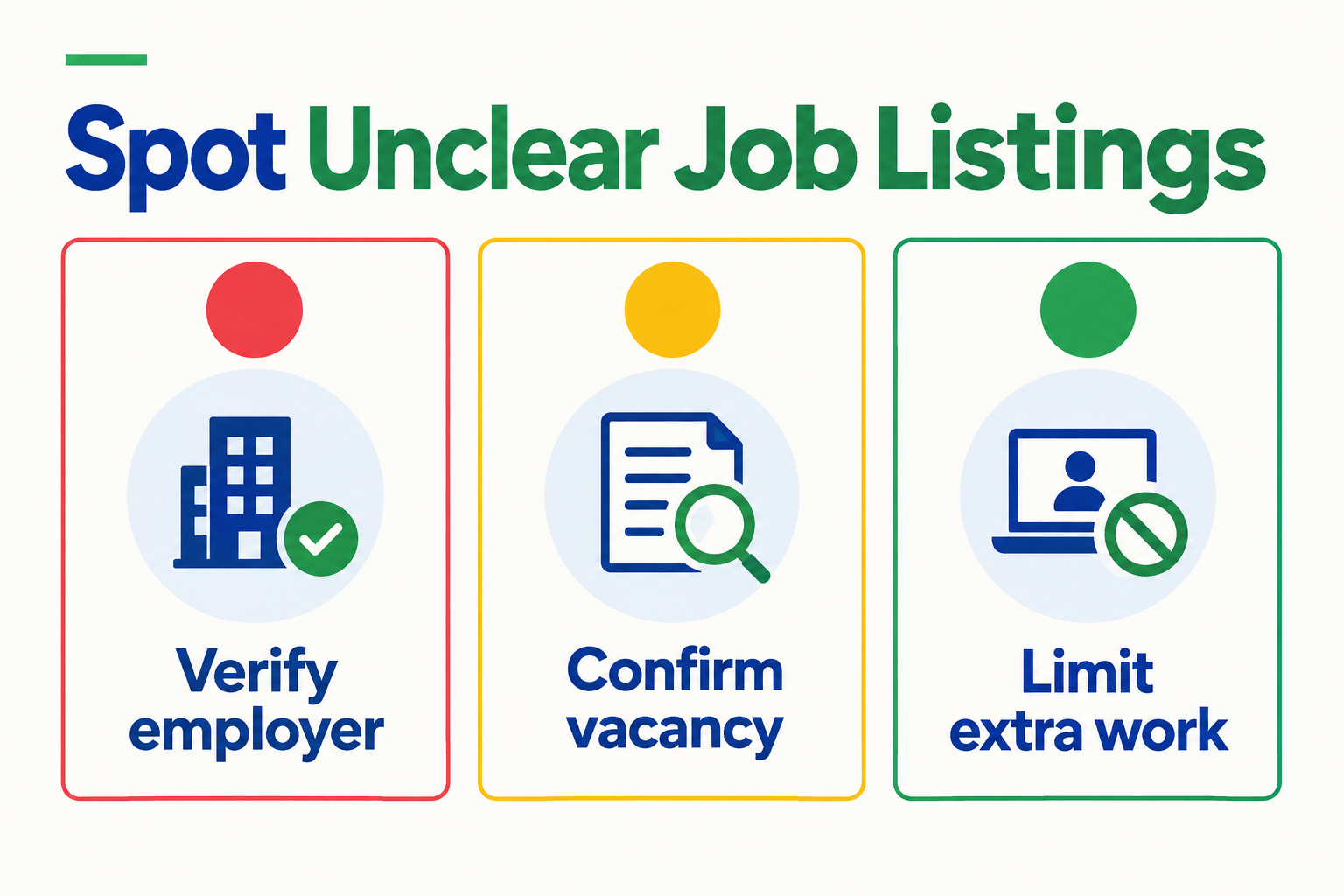
Use an Effort Budget for Uncertain Vacancies
Think of opportunities in terms of confidence and cost. A clear, suitable vacancy on an official site may justify a carefully tailored application. A poorly defined advert with no verifiable contact may justify only a brief check or no further action.
This is a personal allocation method, not a scoring system that proves legitimacy. You are deciding what to do next with incomplete information. Reassess if the employer supplies new details.
For example, a fictional applicant might submit a standard relevant resume to a plausible ongoing talent pool but reserve a bespoke sample for a confirmed interview process. The difference is proportional effort, not a judgement that the first employer is dishonest.
Protect Your Information While Checking
Use contact details obtained independently from the organisation’s official channels when you need to verify a recruiter or vacancy. A professional-looking email signature or copied company logo is not enough by itself.
Share only information appropriate to the application stage. A resume can usually describe your work without customer records, identity-document copies or internal employer files. If a request seems unrelated to assessing your suitability, ask why it is needed before sending it.
Do not pay someone merely to secure consideration for a purported role without understanding and independently checking the arrangement. If you suspect a scam, stop the exchange and use the relevant official reporting route rather than continuing to test the sender.
Do Not Let One Unclear Advert Dominate Your Search
Record the uncertainty and move on to other suitable vacancies. Rechecking the same posting every day rarely gives you enough new information to justify the time. Set a review point only if there is a concrete reason to expect an update.
Our guide to job searching when stuck helps you keep opportunity checks within a wider routine. Verification matters, but it should support applications and conversations rather than replace them.
If you have already applied and received nothing, the guide to unanswered job applications explains other possible causes. Silence and a repeated advertisement together still do not reveal the employer’s internal decision.
Keep a Useful Record of What You Know
Write observations separately from conclusions. “Advert still visible on 12 September” is an observation. “Employer never intended to hire” is a conclusion you may not be able to support.
A useful tracker can record the official source, vacancy reference, contact, last confirmed status and next action. Keep notes brief enough that you will actually maintain them. You do not need a private investigation file for every application.
Decide on the Next Step, Not a Final Verdict
Choose one uncertain vacancy and verify its official route. If possible, clarify whether hiring is active. Then decide whether it deserves a tailored application, a limited expression of interest or no more time for now.
That decision is enough. You can protect your effort without claiming certainty about motives you cannot observe, and you can revise your decision if credible new information appears.
Frequently Asked Questions
Does a Reposted Job Mean It Is a Ghost Job?
No. Reposting may reflect ongoing recruitment, several openings, a changed requirement or an advertisement renewed by a platform. Compare the vacancy reference and details, and check the employer’s official route. Treat repetition as a reason to clarify the opportunity rather than conclusive evidence that no genuine hiring is taking place.
Are Ghost Jobs the Same as Job Scams?
No. A ghost job generally refers to an advert without an immediate intention to fill the position. A scam may aim to obtain money or information through deception. Both can waste your time, but suspected fraud requires independent verification and caution about sharing information, not simply a routine status enquiry.
Should I Apply to an Old Job Advertisement?
Check whether the employer still accepts applications and whether the role fits your experience. An older advertisement can remain active, especially for ongoing or difficult recruitment. Limit extensive custom work when the status is unclear, and prioritise opportunities with a credible application route and enough detail to evaluate your fit.
Can I Know for Certain That a Job Is a Ghost Job?
Usually not from public information alone. You may be able to confirm that recruitment is paused or that a posting is outdated, but employer intentions are often not visible. Focus on verifiable facts and proportional effort. You do not need a definitive label to decide that another opportunity deserves priority.



