
To answer tough interview questions, identify what the interviewer is asking, give a direct answer and support it with a relevant example. For questions about past behaviour, explain the situation, your task, your actions and the result. Keep your contribution clear and acknowledge what you learned or would change.
Preparation should make you more adaptable, not more scripted. You need a small set of well-understood examples that can support different questions without forcing every conversation into the same rehearsed story.
What Interview Preparation Guidance Supports
CareerOneStop’s interview preparation guide recommends practising answers both in writing and aloud, researching the employer and preparing questions. These steps help you organise relevant information before the conversation.
The practical lesson is to test how your answer sounds, not only how it reads. A paragraph can look polished on a page while taking too long to reach the point when spoken.
Start by Understanding Tough Interview Questions
Questions about motivation ask why the role makes sense for you. Questions about experience ask what you have done. Behavioural questions ask how you handled a situation. Hypothetical questions ask how you would approach something that may not have happened yet.
Listen for the distinction. An interviewer asking what you would do next does not necessarily need a five-minute account of a previous project. An interviewer asking for a real example needs more than a general statement about your preferred working style.
If the question is unclear, ask for clarification. A brief pause to choose an appropriate example is better than answering a different question quickly. The stuck job search guide can help you decide whether interview explanations are the stage that needs attention.
Answer “Tell Me About Yourself” with a Clear Direction
Use a short professional introduction: your relevant background, one useful example and why this role is the next logical step. You do not need to narrate your entire life or repeat every item on your resume.
For a fictional applicant: “I work in customer operations, where I coordinate order updates and help resolve delivery exceptions. A recent focus was making our handover notes clearer so colleagues could see the next action. I am now looking for a role with more responsibility for improving those processes, which is why this position interests me.”
The example provides direction without inventing dramatic results. Adapt the structure to your own facts and the vacancy. Stop after the main connection and let the interviewer ask for detail.
Build Behavioural Answers with STAR
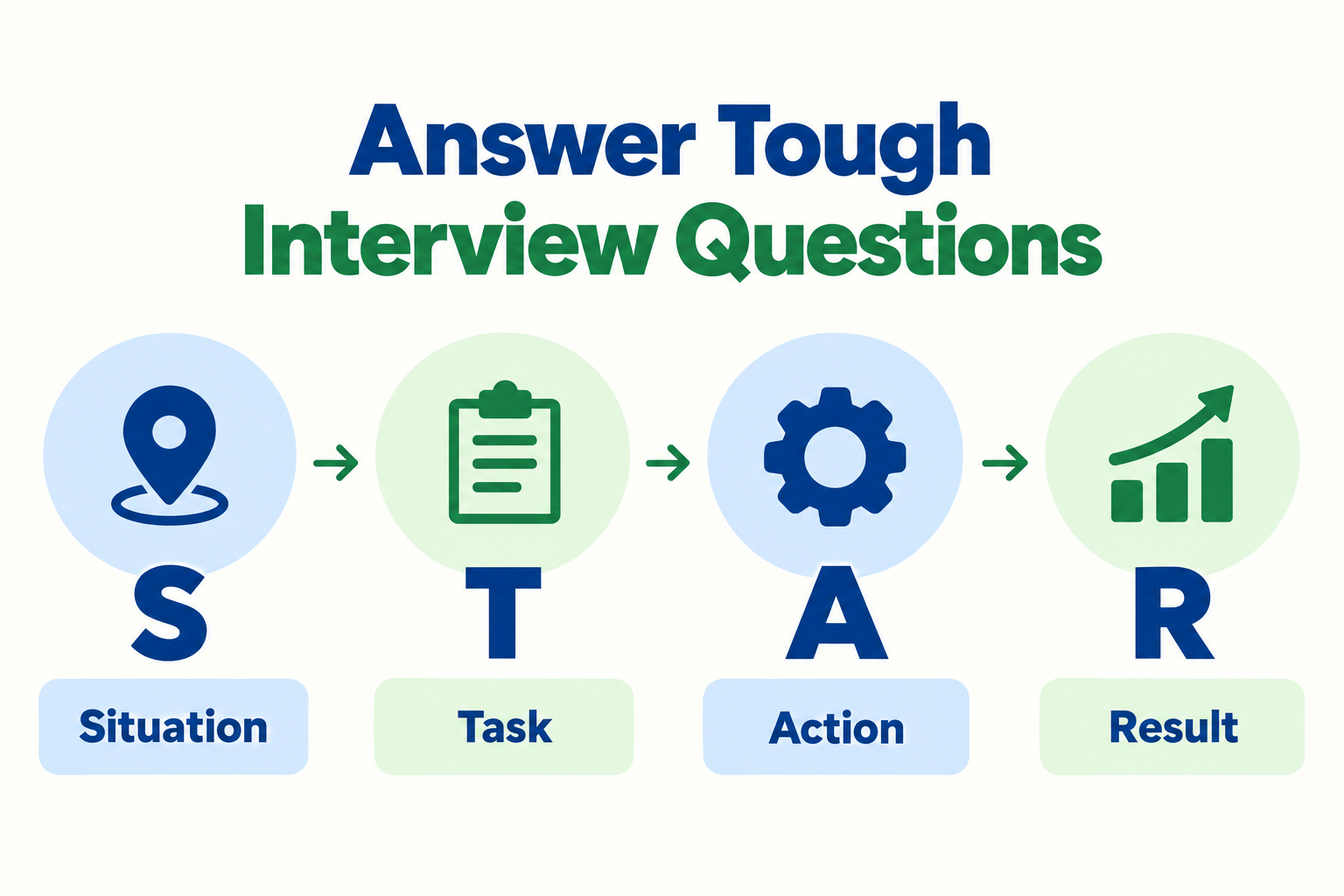
STAR stands for Situation, Task, Action and Result. Use the situation and task to establish context, spend most of the answer on your actions and finish with the outcome. It is an organising tool, not a requirement to announce four headings aloud.
Choose an example where you can explain what you personally did. If the work involved a team, say how responsibilities were divided. “We solved it” leaves the interviewer unsure about your contribution.
For instance, a coordination example might describe a missing delivery update, your responsibility for informing the customer, the checks you made and how the issue was resolved. If the result was incomplete, explain what remained unresolved and what you learned.
Explain Strengths with Evidence
Choose a strength relevant to the role and show it in action. “I organise ambiguous work by clarifying the next decision” becomes more convincing when followed by a specific example of how you did that.
Avoid listing many strengths without supporting any of them. One clear example gives the interviewer something to assess and discuss. It also reduces the chance that the answer sounds like a collection of desirable personality labels.
If you use feedback from a colleague or manager, describe it accurately and without implying a formal evaluation that never occurred. External praise can support an example, but it should not replace explaining the work itself.
Discuss a Weakness Without Performing a Cliché
Choose a genuine development area you can discuss professionally. Explain how it affected your work, what you changed and what you are still improving. Avoid pretending that a strength such as working too hard is your only difficulty.
For example: “I used to spend too long refining reports before checking whether the structure answered the manager’s question. I now agree the outline first and use an earlier review point. I still pay attention to detail, but I am better at checking the purpose before polishing.”
Use your own experience rather than copying the example. The answer should demonstrate self-awareness and a practical response, not claim that the weakness has disappeared completely.
Handle Conflict and Failure with Judgement
Describe the disagreement or problem neutrally. Explain the relevant constraints, what you did to understand the situation and how you communicated. Avoid turning the answer into a case against a former colleague.
For a failure question, acknowledge your part without taking responsibility for everything that happened. Explain the corrective action and the lesson you applied afterwards. A credible answer can include an imperfect outcome.
Do not fabricate a harmless failure simply because you think the interviewer wants a neat ending. A real example with thoughtful reflection is easier to discuss when follow-up questions explore what you considered and why.
Answer Hypothetical Questions Step by Step
Clarify the objective, identify missing information and describe your first actions. If the scenario involves competing priorities, explain how you would compare urgency, impact and available resources. State assumptions rather than presenting guesses as facts.
You can say what you would escalate and why. Knowing when to seek guidance can be part of a strong answer, especially when the situation exceeds your authority or involves information you do not have.
If you have not used a particular tool, be honest. Explain relevant experience and how you would approach learning or checking the task. Do not turn an unfamiliar technical question into a claim of expertise you cannot support.
Practise on Video for Clarity
Record an answer privately and listen for the main point, unnecessary context and vague references to “we.” Check whether you explained your action and result. Review communication rather than judging every facial expression or trying to eliminate a natural speaking style.
Where an employer accepts an introduction, Greetsquare’s video resume option can provide another format for presenting relevant experience. A prepared introduction is different from a live interview, so practise responding to follow-up questions too.
Ask a trusted listener what they understood. Useful feedback includes “I could not tell which decision was yours” or “the result came too late.” Convert that feedback into one revision rather than rewriting every answer after each practice session.
Prepare Your Own Questions and Next Steps
Ask about the work, priorities, supervision and how success will be assessed. Use what you learned in the conversation rather than reading a list of questions already answered. The interview helps you evaluate the role as well as demonstrate suitability.
Clarify the next stage and expected timeline before the conversation ends. If an offer follows, the job offer negotiation guide helps you evaluate the terms and prepare a reasoned discussion.
Practise One Answer Today
Choose one likely question and one relevant example. Write a few factual prompts, answer aloud and check whether the listener can identify the point and your contribution. Shorten unnecessary context and keep useful detail.
Repeat with a different wording of the question. The goal is to understand your evidence well enough to adapt it, not to deliver a perfect speech from memory.
Frequently Asked Questions
How Long Should “Tell Me About Yourself” Be?
Keep it concise enough to establish your relevant background and connection to the role, then allow follow-up questions. There is no universal required duration. Practise a short version with one useful example, and adjust to the interviewer’s instructions rather than using the opening question to repeat your entire resume.
Should I Use STAR for Every Interview Question?
No. STAR is especially useful for questions asking about a past situation or behaviour. Motivation, technical and hypothetical questions may need different structures. Answer the actual question first, then provide the evidence or reasoning it requires. Do not force a detailed story into a question that needs a direct explanation.
What If I Cannot Think of an Example Immediately?
Pause briefly and consider a relevant situation from work, study, volunteering or another appropriate context. You can ask for clarification if needed. Do not invent an experience to fill the silence. If you lack a direct example, explain that honestly and discuss related experience or your proposed approach where appropriate.
Is Practising on Video Worthwhile?
It can help you notice unclear structure, excessive context and missing explanations of your contribution. Focus on whether the answer is understandable and relevant rather than trying to appear perfect. Combine recording with feedback from another person when possible, and practise follow-up questions so your preparation remains flexible rather than scripted.



