

Product manager salary in Singapore varies with experience, product domain and ownership. Morgan McKinley’s 2026 technology guide lists annual product management benchmarks of S$60,000–S$90,000 for 5–10 years of experience and S$90,000–S$170,000 for 10–15 years. These are recruiter benchmarks for a defined technology category, rather than a guaranteed range for every product manager.
A title alone cannot tell you whether an offer is competitive. You need to know which decisions you own, how the company measures success and which parts of the package you can reliably receive.
Product Manager Salary in Singapore: What the 2026 Research Shows
The Morgan McKinley technology salary guide places product management within IT Product & Engineering in technology, telecommunications and fintech. Its permanent-role table provides the following annual figures, checked on 6 October 2026.
| Experience Band in the Source | Annual Benchmark | Monthly Equivalent, Annual Figure ÷ 12 |
|---|---|---|
| 5–10 years | S$60,000–S$90,000 | S$5,000–S$7,500 |
| 10–15 years | S$90,000–S$170,000 | S$7,500–S$14,167 |
| 15+ years | S$140,000–S$240,000+ | S$11,667–S$20,000+ |
The monthly column is our arithmetic conversion, rounded where necessary. It is not a separate monthly salary survey. The source bands overlap, which is a useful reminder that years of experience do not create automatic pay steps.
Morgan McKinley’s salary guide methodology and FAQs say annual figures typically represent base salary, while specific performance-driven roles can use other measures. Confirm the pay basis for the role you are discussing. Do not assume that a quoted range includes equity or that a different sector uses the same benchmark.
Match the Product Before You Match the Pay
A consumer app, an internal enterprise platform and a bank’s cash-management product can all have product managers. Their customer problems, risk exposure and commercial responsibilities differ. Comparing them as one labour market can produce an ambitious salary request with weak evidence.
Start with the product manager job description and identify your closest role family. Then compare employers with similar products, business models and customer groups. Use Greetsquare’s Singapore salary guide by industry to place that role within the wider salary cluster.
Industry is only the first filter. A product manager responsible for one onboarding journey has a different remit from someone owning a regional platform, pricing decisions and several squads. Write down the scope before deciding which published benchmark deserves the most weight.
Separate Product Ownership From Delivery Coordination
Ask who decides the customer problem, prioritises the roadmap and approves trade-offs. If the role mainly schedules releases and maintains tickets, a broad product leadership benchmark may overstate the match. If it owns discovery, commercial performance and investment choices, that responsibility should appear in the comparison.
Reporting lines also matter. Find out whether you report to a head of product, engineering leader or commercial director, and whether the organisation gives you access to customer research and analytics. Accountability without decision rights makes a higher salary harder to evaluate.
Compare Experience Through Evidence of Ownership
Use years of experience as a starting point. The stronger question is what you can independently own today. A career changer with deep domain knowledge may bring valuable judgement, while a long-serving product manager may still have limited commercial authority.
For a first management move, show how you clarified a problem, chose an approach and measured the result. For a senior role, add examples of conflicting stakeholder priorities, portfolio decisions and coaching other product managers. Keep the evidence relevant to the advertised remit.
Avoid treating the 15+ years band as a promise of leadership pay. Establish whether the vacancy is an individual contributor, team manager or portfolio leader. Those paths can have different internal grades even when the external title looks similar.
Separate Base Pay, Bonus and Equity
Annual base salary gives you a clearer starting comparison than an unexplained total-package figure. List target bonus separately, including its formula, performance conditions and first-year eligibility. Ask whether a quoted annual number assumes a contractual additional payment or discretionary award.
For equity, request the instrument, number of units, vesting schedule and valuation basis. Options and restricted stock units are different instruments. An estimated equity value is not the same as cash you can spend, especially if liquidity depends on a future company event.
A signing award also deserves its own line. Check repayment conditions and whether it compensates for something you would forfeit at your current employer. A large first-year payment can make a weaker recurring package look stronger.
A Hypothetical Offer Comparison
Suppose Offer A provides S$9,000 monthly base and a 10% target bonus. Its annual base is S$108,000, and its target cash total is S$118,800 if the bonus pays in full. Offer B provides S$9,500 monthly base, no target bonus and an equity grant quoted at S$20,000 over four years.
Offer B’s annual base is S$114,000. Do not add the entire four-year grant to one year’s cash salary. Even dividing it by four only creates an illustrative annual allocation, not a guaranteed realised value. These invented offers demonstrate the calculation; they are not market salary estimates.
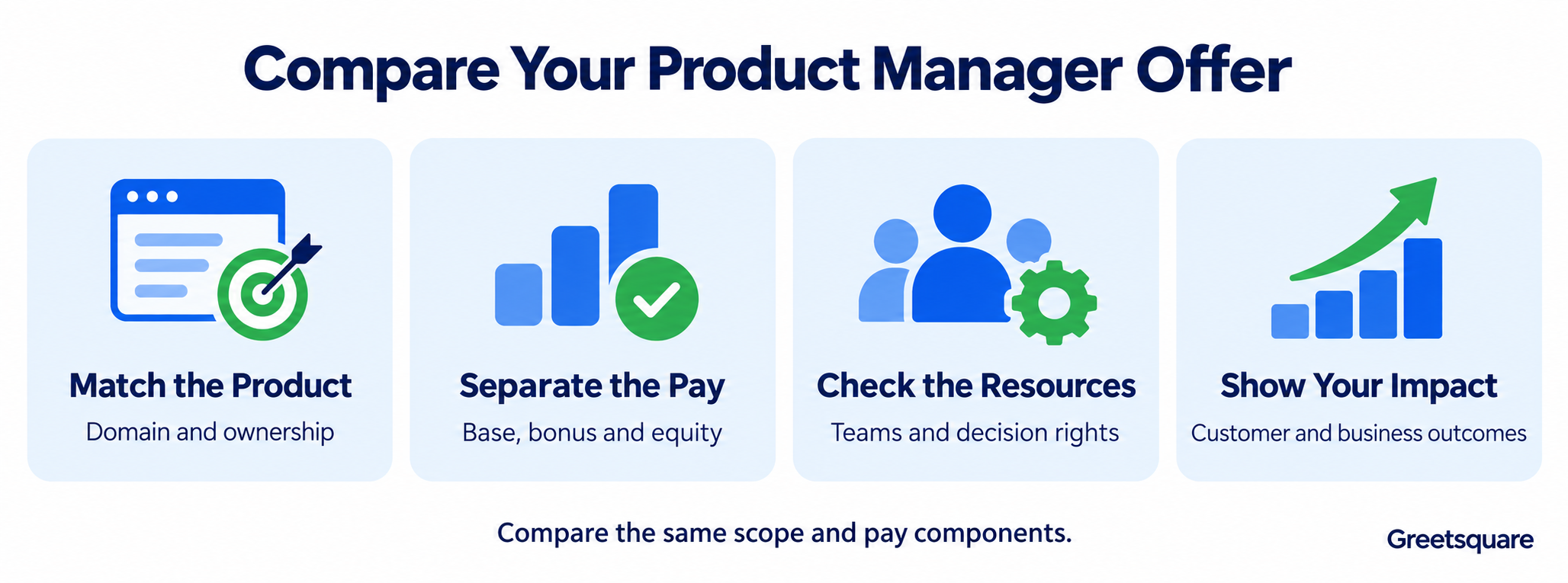
Check the Resources Behind the Roadmap
An offer can pay well and still give you little chance to succeed. Ask how engineering capacity is allocated, whether design and research support are shared, and how frequently priorities change. Confirm which outcomes belong to you and which depend on other teams.
Request a concrete example of a recent product trade-off. How did the team balance customer demand, revenue, technical debt and risk? The answer reveals more about the role than a general statement about being customer-focused.
For regional positions, clarify travel, time-zone expectations and ownership across markets. If the company expects you to support launches outside normal hours, discuss how that work is planned. Assess the operating conditions alongside the compensation.
Build a Salary Case Around Product Outcomes
Select two or three examples that connect your decisions to useful outcomes. Explain the starting situation, the decision you made, the result and the limits of your contribution. Customer activation, retention, conversion or reduced support demand can be relevant, depending on the product.
Use credible measurements. If several teams delivered a result, explain your part rather than claiming the whole gain. When confidentiality prevents sharing a figure, describe the method and relative change without exposing sensitive customer or financial information.
Prepare a short scope statement before using the salary negotiation guide: “This role owns discovery and roadmap decisions for two squads, with regional activation targets. My examples show comparable ownership.” That creates a clearer discussion than requesting a percentage uplift without context.
Choose the Package That Supports Your Next Step
Compare the matched benchmark, recurring cash, uncertain rewards and practical remit on one page. Resolve missing information before accepting. If the employer cannot improve base salary, consider whether a documented review date, stronger resources or clearer progression genuinely meets your priorities.
You can present a concise product outcome story through Greetsquare’s jobseeker and video resume tools. Focus on the problem, your judgement and the result. A clear demonstration of responsibility helps employers assess the role level you are ready to own.
Frequently Asked Questions
How Much Does a Product Manager Earn in Singapore?
Morgan McKinley’s 2026 technology guide lists S$60,000–S$90,000 annually for product management at 5–10 years of experience and S$90,000–S$170,000 at 10–15 years. These figures apply to its technology category. Compare product domain, ownership and pay components before using them to assess your individual offer.
Is Equity Included in a Product Manager Salary Benchmark?
Do not assume equity is included. Check the salary guide’s definition and the employer’s offer breakdown. Compare base salary, target bonus and equity separately. For an equity grant, review the instrument, vesting schedule, valuation basis and liquidity conditions before estimating how much it could contribute to compensation.
Does More Experience Guarantee a Higher Product Manager Salary?
More experience does not guarantee a higher salary. Employers also assess product complexity, decision rights, commercial ownership and the level assigned to the vacancy. Use years of experience to select an initial benchmark, then show evidence that you can own the specific outcomes and responsibilities required by that role.
How Can I Negotiate a Product Manager Offer?
Match the vacancy to relevant salary evidence, then explain your comparable product ownership and results. State the annual base salary you are seeking and separate bonus or equity discussions. Ask about the employer’s approved band, decision process and review timing so you can assess any alternative package clearly.



