
A video resume is not universally better than a paper CV. A written CV is useful for structured facts and required application records; a video can add a concise spoken introduction or explain one contribution. In this comparison, “paper CV” includes a conventional written CV submitted digitally, and the strongest approach often gives each format a clear purpose.
What Career Guidance Says About the Written Resume
Harvard’s guide to creating a strong resume describes the resume as a concise summary of abilities, education and experience, tailored to the position being sought. Its guidance supports specific, clear and factual presentation. Those functions remain useful even when a candidate also provides a video.
The comparison below is a practical application of those principles, not evidence that one format has a universal hiring advantage. It distinguishes the information each format carries and the constraints of the application process. For the broader introduction to the medium, start with Greetsquare’s video resume guide.
Video Resume vs Paper CV at a Glance
| Application need | Written CV | Video resume |
|---|---|---|
| Work history and dates | Structured record that can be scanned | Too much detail can crowd a short recording |
| Qualifications and relevant skills | Searchable, specific information | Can illustrate one skill through an explanation |
| Spoken introduction | Limited to written expression | Can show how you explain a relevant idea |
| Required document submission | Follow the employer’s file instructions | Submit only if requested or accepted |
| Review accessibility | Use readable, accessible document formatting | Provide clear audio and accurate captions |
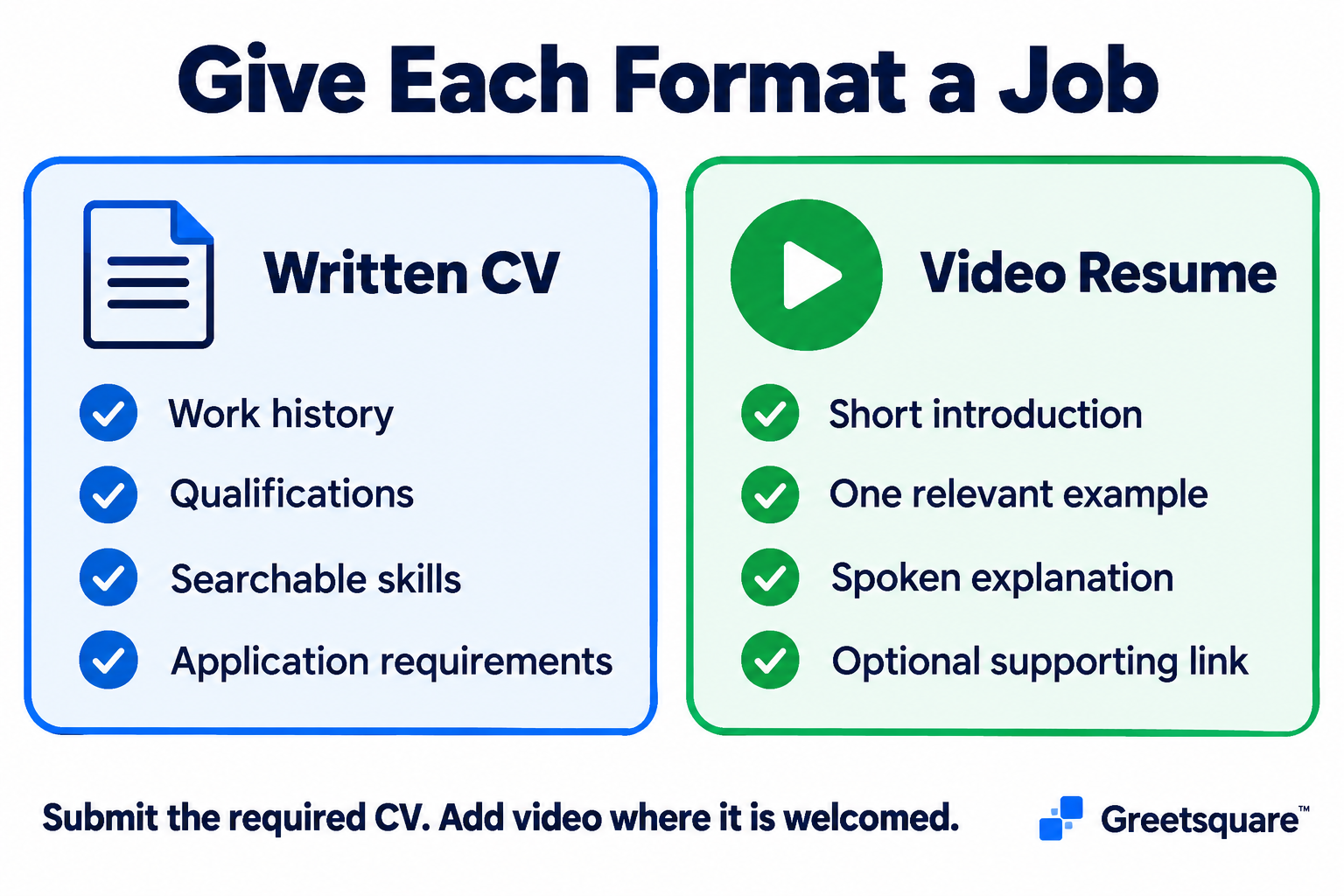
The formats serve different jobs. The written document gives the reviewer facts to check and compare. The video can make one part of your experience easier to understand. Neither format fixes missing qualifications or an unclear match to the vacancy, and neither removes the need to follow submission instructions.
Where the Written CV Matters Most
A written CV is especially useful when reviewers need employment dates, qualifications, certifications or a concise account of responsibilities. They can scan sections, return to a particular detail and compare information with the vacancy. Clear headings and accurate wording help the document do this efficiently.
For applications that require a document upload, provide the requested format. Put essential experience in the CV itself instead of asking the reviewer to watch a recording to discover it. An optional link should add context, not become the only place where your suitability is explained.
Keep a Complete and Consistent Record
Your written CV does not need to contain every task from your career. It should contain the information relevant to the role and a coherent employment record. If a video mentions an achievement, the underlying role and responsibility should remain consistent with the document. Different emphases are acceptable; conflicting facts are not.
Review dates, job titles and qualification names before submitting either format. If you describe team work, distinguish your personal contribution. This keeps the application credible when the interviewer asks for more detail and helps you avoid accidentally turning a concise introduction into an exaggerated version of your history.
Where a Video Resume Can Add Useful Context
A video can help you explain an example that is difficult to capture in one bullet point. You might briefly describe a customer problem, an analytical decision or how you coordinated a project. The value comes from the explanation and its relevance, rather than simply appearing on camera.
This can be appropriate when spoken communication is connected to the job and the employer welcomes the format. A short recording lets you introduce your professional direction in your own words. It should still be supported by written facts and evaluated alongside suitable interviews or work-based checks.
Use One Example Instead of Reading the CV
Reading your entire document aloud gives a reviewer little additional information. Choose an example that benefits from a short explanation. Describe the situation, your action and why the contribution matters. Keep enough context for someone unfamiliar with the organisation to follow the account.
Here is a hypothetical example: a project coordinator’s CV lists scheduling and stakeholder communication. Their video briefly explains how they clarified conflicting deadlines and agreed a workable plan with the team. The recording adds reasoning to the written responsibility without pretending it proves every project-management capability.
Follow the Application System’s Requirements
An applicant tracking system, or ATS, helps employers manage applications. Systems and employer settings vary, so do not assume every system will extract information from a video, follow an external link or accept the same file formats. Check the actual instructions for the role you are applying to.
Keep required keywords and qualifications in an accurate written CV. Use the terminology of the vacancy where it truthfully describes your experience. Avoid keyword stuffing and do not claim a qualification merely to match a filter. Greetsquare’s ATS-friendly resume guide explains this written-document preparation in more detail.
Add a Clearly Labelled Supporting Link
If a video link is accepted, label it so the reviewer knows what it contains. Check that the destination is accessible to the intended viewer. Avoid requiring an unexpected sign-up or sharing permission that prevents review. Test the link from the reviewer’s perspective before submitting the application.
Do not replace an employer’s requested assessment with an unsolicited recording. A one-way interview with set questions is a different task from a self-created video resume. Answer the requested questions in the required channel, and use your separate introduction only when the process allows it.
Compare Effort, Privacy and Accessibility
A video requires preparation, recording and a functional sharing method. Decide whether the additional effort helps communicate something relevant for this application. If it adds no useful information, a strong written CV may be sufficient. Avoid delaying a time-sensitive application while pursuing unnecessary production polish.
Both formats should protect confidential information. A written achievement and a spoken story can disclose sensitive client details just as easily. Check what you are permitted to share, remove unnecessary personal information and consider who can access the recording. Use an example that explains your contribution without exposing internal documents or private data.
For accessibility, use readable formatting in the written CV and accurate captions in the video. Keep spoken content understandable without relying entirely on overlays. The reviewer should be able to access the relevant information through the format provided. Visual polish should not become a substitute for clear communication.
How to Use Both Formats Together
Start by preparing the written CV around the vacancy’s requirements. Identify the contribution that best explains your fit, then decide whether a short video would add context. The recording should complement the document with one focused explanation and a consistent statement of your professional direction.
Use the step-by-step video resume guide when you are ready to record. Afterward, compare the two versions side by side: do the titles, dates, responsibilities and claims agree? Remove repeated information that adds no value, and correct any discrepancy before sharing either version.
If the employer accepts a supporting video, explore Greetsquare’s job-seeker platform to present that introduction. Keep the written CV available as the factual foundation. The decision is about helping a reviewer understand your relevant experience while respecting the application process, rather than choosing a format because it seems more modern.
Frequently Asked Questions
Is a Video Resume Better Than a Paper CV?
Neither format is universally better. A written CV provides structured history, qualifications and required application information. A video can add a concise explanation where accepted. Choose the format according to the vacancy instructions and the information the reviewer needs, and keep your essential evidence in the written document.
Can I Submit Only a Video Resume?
Submit only a video if the employer explicitly requests or allows that format without a written CV. Otherwise, provide the required documents and treat video as supporting material. Do not assume a recording will satisfy a document-upload requirement or that the reviewer will extract your full employment history.
Will an ATS Read My Video Resume?
Capabilities differ by system and employer configuration. Do not assume an ATS can extract your qualifications from a recording or follow its link. Keep relevant skills, work history and required information in the accepted written format, then add video only through a channel the employer permits for that application.
Should the Video Repeat Everything in My CV?
No. Repeating the whole CV usually uses recording time without adding useful context. Introduce your professional direction and explain one relevant contribution that benefits from spoken detail. Keep the facts consistent with the written document and leave the fuller work history available for review and follow-up questions later.



