

Remote and hybrid work remain available in parts of the job market, but access depends on the employer, role and operational needs. A remote role is primarily performed away from the usual office; a hybrid role combines locations. Confirm attendance, working hours and approval rules rather than treating either label as a complete promise.
The better question is whether the arrangement supports the work and your circumstances. A role with occasional office attendance can still require frequent client travel. A home-based position can still involve fixed availability or late meetings with another region.
What Singapore Data Shows About Teleworking
In its November 2025 parliamentary response on work-from-home policies, MOM reported that scheduled teleworking was offered by 38.4% of employers in 2024, compared with 56.5% in 2021 and 6.9% in 2019. These are employer-level historical figures, not the proportion of current vacancies that are fully remote.
The figures show why a simple claim that remote work has disappeared, or become universal, is misleading. Availability varies. Use current vacancies and direct employer answers to assess your options, while keeping survey definitions and reference periods clear.
Compare Remote and Hybrid Work by the Actual Arrangement
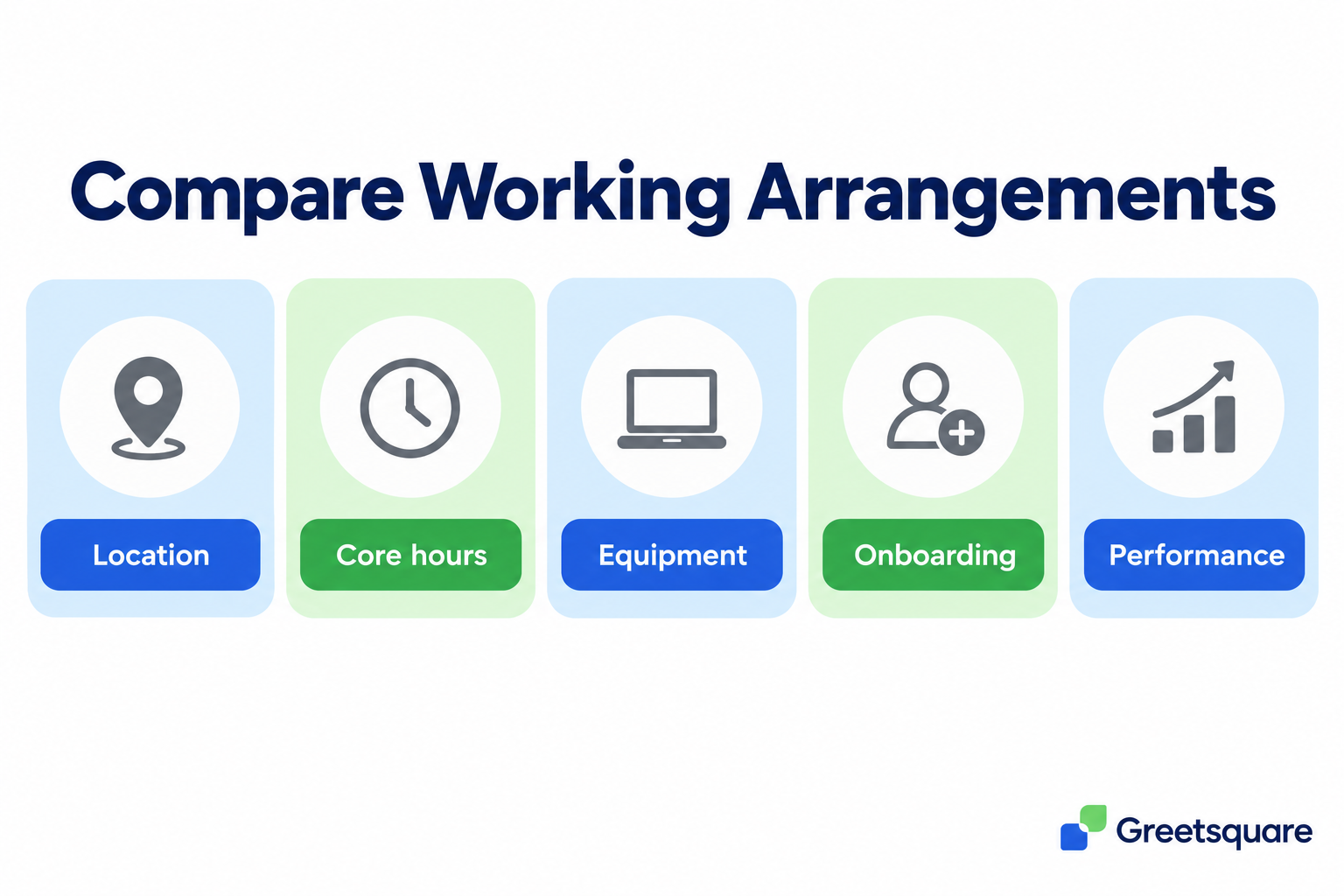
Location and Attendance
Ask where you are permitted to work and whether the arrangement is limited to Singapore or another named location. Working remotely does not automatically mean working from any country. An employer may have tax, immigration, security or client restrictions that require specialist review.
For hybrid roles, confirm the number of office days, who selects them and whether attendance changes during onboarding or busy periods. Find out whether office days involve purposeful collaboration or mainly individual work at another desk.
Hours and Availability
Clarify core hours, response expectations and recurring meetings. Flexible location is different from flexible time. Ask how the team works across time zones and whether evening meetings rotate or consistently fall on the same people.
Use a concrete example: “What would my meeting schedule have looked like last week?” This can reveal recurring patterns that a general promise of flexibility leaves unexplained. Check how urgent issues are distinguished from ordinary messages.
Check Whether the Team Is Set Up to Work Apart
A distributed team needs information that people can find without being in the same room. Ask how decisions are documented, how work is handed over and where priorities are recorded. An informal conversation should not be the only place a critical decision exists.
Find out how someone requests help when a task becomes blocked. Constant video meetings are not the only answer, but complete isolation is not a useful substitute. Clear escalation channels and predictable check-ins can support both autonomy and timely assistance.
Ask how employees who are away from the office participate in decisions and development opportunities. A hybrid policy can exist while important conversations remain accessible only to people physically present. The practical test is whether information and opportunity reach the whole team.
Confirm Equipment, Costs and Information Security
Check what equipment the employer supplies, what software is approved and who provides technical support. Ask about a suitable working environment and any reimbursement policy. Do not assume a laptop allowance or home-office payment is included because the role is remote.
Understand the rules for handling documents, calls and sensitive information. Public Wi-Fi, shared rooms and personal devices may be unsuitable for particular work. Follow the employer’s security requirements and ask before using an unapproved tool for convenience.
These details can affect the practicality of the offer. A position that requires a quiet private workspace may be difficult in a shared home, even if commuting is eliminated. Compare the arrangement against your actual circumstances rather than an idealised home office.
Ask How Onboarding and Performance Work
A new employee needs access, context and feedback, whichever location they use. Ask who owns onboarding, how you will meet colleagues and what support is available during the first weeks. Check whether office attendance is temporarily different while you learn the role.
Then ask how performance is evaluated. Useful expectations describe deliverables, quality, collaboration and deadlines. Merely appearing online is weak evidence of productivity, but a role also needs enough availability for colleagues and clients to coordinate with you.
Prepare an example of documenting progress or resolving a handover issue. Our communication evidence guide helps explain how you keep others informed without filling the day with unnecessary updates.
Understand Singapore’s Flexible Work Request Process
TAFEP’s guidance on formal flexible work requests says employers should communicate a written decision within two months of receiving a formal request. Requests should be considered in relation to the role and business needs. The process does not guarantee approval of the arrangement an employee proposes.
For a prospective job, first clarify the arrangement being offered. Do not accept on the assumption that a different location or schedule will automatically be approved later. If you need a particular arrangement, discuss it clearly before relying on it in your decision.
Compare the Trade-Offs Before Accepting
| Factor | Question to Resolve |
|---|---|
| Travel | Which journeys, client visits and office days remain? |
| Learning | How will I receive feedback and informal context? |
| Boundaries | What availability is expected outside core hours? |
| Visibility | How are contributions and opportunities assessed? |
Consider what you gain and what support you would need. Some people value fewer commutes; others need a separate workspace or more in-person learning. There is no single arrangement that suits every person and every role.
Our Singapore work culture guide helps assess the management practices behind a policy. Use the job offer comparison framework to weigh working conditions alongside responsibilities and compensation.
Prepare for the Hiring Format, Then Confirm the Job
A remote interview does not prove that the eventual job is remote. Ask about the employment arrangement separately. For the interview itself, review our video interview preparation guide and practise explaining a relevant example clearly.
If accepted by the employer, use Greetsquare for a short video introduction that demonstrates clear explanation. Before accepting, record the confirmed location, hours, equipment and performance expectations. Those details are more useful than the remote or hybrid label alone.
Frequently Asked Questions
What Is the Difference Between Remote and Hybrid Work?
Remote work is primarily performed away from the employer’s usual office, while hybrid work combines locations. Exact arrangements vary. Confirm permitted locations, office attendance, core hours and any onboarding exceptions with the employer, because the label alone does not explain travel requirements, availability or approval rules.
Does Remote Work Mean I Can Work From Any Country?
No. Employers may restrict working locations because of immigration, tax, security, client or operational requirements. Get explicit confirmation before planning cross-border work, and seek appropriate advice where needed. A vacancy described as remote may still require you to remain based in a particular country or region.
Can Every Singapore Employee Request Work From Home?
Singapore’s flexible work guidance provides a process for formal requests and their consideration, rather than a universal entitlement to home working. Check the employer’s process and the arrangement suitable for the role. Approval depends on the request and business considerations; do not assume every proposal must be accepted.
What Should I Ask Before Accepting a Hybrid Job?
Confirm office days, permitted locations, core hours, equipment, onboarding and how performance is assessed. Ask who can change the arrangement and what is documented. Also check client travel, time-zone meetings and how remote colleagues receive information and development opportunities, rather than judging the offer only by commuting time.



