
Singapore’s energy and chemicals sector stands as a critical pillar of the nation’s manufacturing economy, employing approximately 27,000 workers and contributing roughly 3% to GDP. For fresh graduates entering chemical engineering roles, this landscape offers structured pathways into refining, petrochemicals, specialty chemicals, and downstream manufacturing. The sector’s evolution toward higher-value products and sustainability-focused operations creates distinct opportunities for entry-level engineers who combine technical rigor with adaptability. Singapore is positioning Jurong Island as a sustainable industrial hub, with growing investments in Carbon Capture, Utilization, and Storage (CCUS) and circular economy initiatives including plastic recycling plants. Fresh graduates should explore Sustainability Engineer roles within traditional energy and chemicals firms on Jurong Island, where decarbonization roadmaps and waste-to-value projects are reshaping operational priorities and expanding entry-level opportunities in environmental engineering and process sustainability.
Understanding how Singapore’s integrated industrial ecosystem operates on Jurong Island, where over 100 global energy and chemical firms have invested more than S$50 billion, helps graduates position themselves strategically within process engineering, plant operations, and consultancy streams.
Key Takeaways
- Chemical engineering roles span process operations, plant management, and consultancy across Singapore’s integrated Jurong Island cluster
- Entry-level salaries average S$83,100 annually with progression toward S$118,000 as experience accumulates
- Government workforce transformation programs support transitions into specialty chemicals and bio-economy segments
- Professional Engineer licensing remains a strategic credential for mid-career advancement and consultancy eligibility
Introduction to Chemical Engineering Jobs in Singapore for Fresh Graduates
Chemical engineering jobs in Singapore for fresh graduates exist within a sector that contributed 15.9% of the manufacturing sector’s nominal value-added in 2022, with petroleum and petrochemicals accounting for roughly 63.7% of that contribution. Fresh graduate chemical engineer roles align closely with Singapore’s position as one of the top 10 largest chemical exporters globally, reflecting the city-state’s strategic role as a petrochemical manufacturing hub in Southeast Asia. Entry-level chemical engineering jobs Singapore typically emerge from integrated facilities on Jurong Island, where refinery operations, petrochemical production, and specialty chemicals manufacturing converge.
Oil and gas jobs Singapore for fresh graduates intersect directly with the petrochemical industry Singapore, given that refining and petrochemical operations share infrastructure and technical competencies. The career path Singapore for university graduates often begins with structured graduate programs that rotate engineers through process units, safety functions, and project management roles. Singapore’s labor market context reinforces this demand, with total employment growing by 25,100 workers in Q3 2025 and PMET vacancies remaining firm. The median gross monthly income of resident employees reached approximately S$5,775 in 2024, underscoring wage gains across skilled segments.
Key Components of Fresh Graduate Chemical Engineering Roles
Process Engineer Roles in Oil and Gas
Process engineer roles form the operational backbone of refinery operations Singapore and petrochemical facilities, where fresh graduates apply thermodynamic principles and reaction kinetics to optimize production streams. In refinery settings, process engineers monitor distillation columns, catalytic crackers, and hydrotreating units to ensure feedstock conversion meets product specifications while maintaining process safety engineering standards. These roles demand continuous engagement with distributed control systems, alarm management protocols, and deviation analysis that enable plant operations engineering teams to sustain throughput targets.
Process safety engineering extends beyond routine monitoring to encompass hazard identification, risk assessment methodologies such as HAZOP, and the implementation of protection layers that mitigate potential incidents. Fresh graduates entering refinery operations Singapore participate in safety reviews, incident investigations, and safety culture initiatives that align with regulatory frameworks. The integration of process simulation software such as Aspen HYSYS into daily workflows allows engineers to model process upsets and validate operating boundaries before implementing changes.
Plant operations engineering for fresh graduates bridges design intent and operational reality, requiring engineers to troubleshoot equipment performance issues and coordinate with maintenance teams. This cross-functional exposure builds competencies in root cause analysis and statistical process control, accelerating progression toward senior process engineer roles within three to five years.
Production and Plant Operations in Chemical Manufacturing
Production engineer roles within chemical manufacturing Singapore emphasize the translation of batch or continuous processes into consistent output volumes that meet market demand. Specialty chemicals industry segments, including surfactants and catalysts, require production engineers to manage complex formulation recipes and ensure batch-to-batch reproducibility. Energy and utilities sector Singapore interfaces directly with chemical manufacturing through steam generation and cooling water networks, creating interdependencies that production engineers must navigate.
Fresh graduates in production roles engage with lean manufacturing principles and total productive maintenance frameworks that enhance equipment effectiveness. The specialty chemicals industry increasingly adopts advanced process control strategies and predictive maintenance algorithms that integrate machine learning models, offering engineers opportunities to develop data analytics capabilities. Chemical manufacturing Singapore also encompasses pharmaceutical intermediates, where Good Manufacturing Practice compliance imposes additional rigor on production documentation and deviation handling.
Energy and utilities sector Singapore employs chemical engineers in cogeneration facilities and waste-to-energy operations, where thermodynamic efficiency and emissions control drive operational priorities. These roles expose fresh graduates to turbine operations and boiler management, broadening technical versatility beyond traditional petrochemical applications.
Engineering Consultancy and Graduate Programs
Engineering consultancy firms Singapore recruit fresh graduates into multidisciplinary project teams that deliver feasibility studies and detailed engineering packages for clients across petrochemicals and pharmaceuticals. Graduate engineer programs within consultancy environments rotate participants through process simulation, piping and instrumentation diagram development, and equipment sizing activities. Project management skills emerge as central competencies in consultancy roles, where engineers coordinate with procurement specialists and construction managers to deliver capital projects.
Engineering employability in consultancy contexts depends on proficiency with industry-standard software tools including AutoCAD and project scheduling platforms, as well as familiarity with international codes such as ASME and API. Fresh graduates benefit from mentorship structures that pair junior staff with senior consultants, enabling knowledge transfer on client engagement protocols and technical report writing. Consultancy pathways also facilitate exposure to emerging sectors such as hydrogen production and carbon capture, where engineering solutions demand innovative problem-solving approaches.
Project management skills cultivated through consultancy roles translate readily into in-house engineering positions, where engineers transition from external advisory functions to asset ownership responsibilities. This mobility underscores the strategic value of consultancy experience for building versatile career foundations.
Safety, Environmental, and Regulatory Considerations
Safety and environmental regulations in Singapore’s chemical sector derive from the Workplace Safety and Health Act and the Environmental Protection and Management Act. Process safety engineering professionals ensure compliance with major hazard installation reporting requirements, conduct quantitative risk assessments, and maintain safety management systems. Fresh graduates entering safety-focused roles participate in process hazard analyses, emergency response drills, and safety audit programs that verify adherence to legislative mandates.
Technical skills for chemical engineers in regulatory domains include dispersion modeling, consequence analysis, and the application of inherently safer design principles that reduce hazard inventories. Environmental compliance extends to air emissions monitoring and hazardous waste management, where engineers interpret analytical data against permit conditions. The Energy and Chemicals Industry Transformation Map 2025 emphasizes decarbonization and higher-value specialty products, signaling that fresh graduates with expertise in carbon accounting and sustainable process design will encounter growing demand.
Salary, Career Progression, and Professional Licensing
Chemical Engineering Salary and Benefits
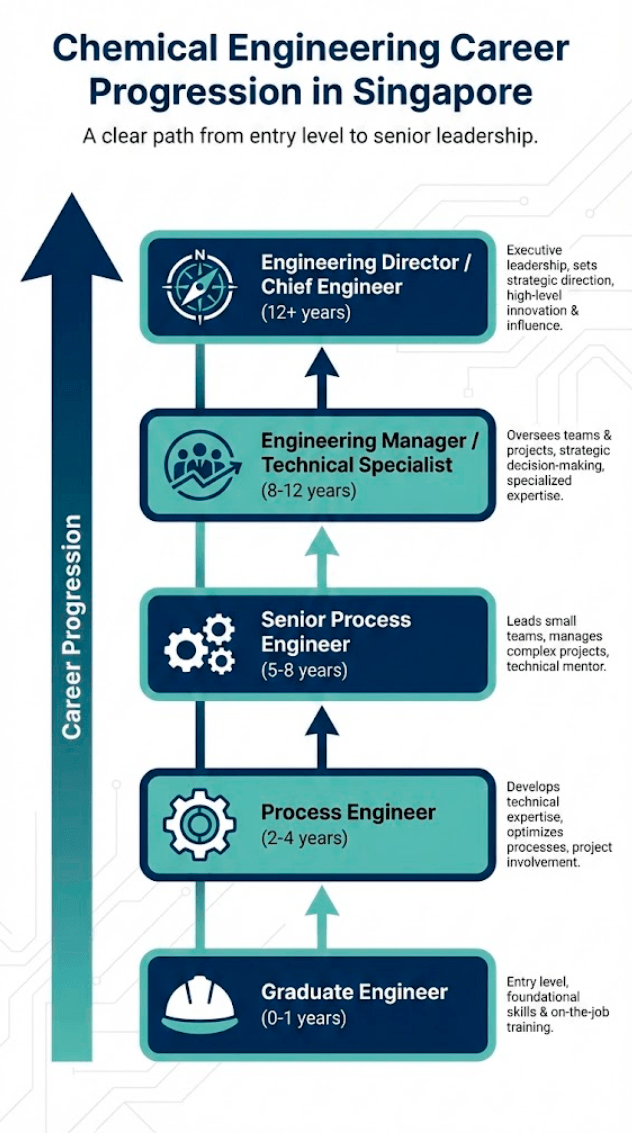
Chemical engineering salary Singapore for fresh graduates averages approximately S$83,100 annually for professionals with one to three years of experience. Mid-career professionals with five to ten years of experience reach base salaries around S$118,000, with incremental gains driven by technical specialization. Career progression chemical engineering trajectories typically advance from graduate engineer to process engineer, senior process engineer, and eventually engineering manager roles, with each transition accompanied by expanded accountability for safety performance and project delivery.
Benefits packages commonly include performance bonuses, medical coverage, continuing education allowances, and employer contributions to the Central Provident Fund. Career progression chemical engineering pathways also incorporate lateral moves into adjacent functions such as supply chain optimization or business development, where technical fluency enhances strategic decision-making. The sector’s emphasis on workforce transformation, supported by career conversion and reskilling programs, creates structured opportunities for engineers to pivot into specialty chemicals or sustainability-focused roles.
Professional Engineer Licensing in Singapore
Professional engineer licensing Singapore operates under the Professional Engineers Act, which establishes competency standards for engineers practicing in chemical engineering. Fresh graduates accumulate practical experience under the supervision of registered Professional Engineers, documenting competencies across design, analysis, and regulatory compliance. Career progression chemical engineering benefits from PE registration, which confers statutory authority to endorse engineering drawings and certify compliance with regulatory codes.
Eligibility for PE registration requires a minimum of four years of relevant post-graduation experience and successful completion of the Professional Practice Examination. Professional engineer licensing Singapore enhances employability in consultancy firms, where client engagements often mandate PE-endorsed deliverables. The credential also facilitates international mobility through mutual recognition agreements with professional engineering bodies in Australia and the United Kingdom.
Career progression chemical engineering for PE-licensed professionals extends into leadership roles such as Engineering Director or Chief Engineer, where strategic oversight of engineering standards and risk governance defines senior accountabilities.
Industry-Specific Opportunities for Fresh Graduates
Oil and Gas Jobs in Singapore for Fresh Graduates
Oil and gas jobs Singapore for fresh graduates concentrate within refinery operations Singapore and integrated petrochemical complexes that convert crude oil feedstocks into fuels, olefins, and aromatics. Refinery process engineers optimize crude distillation units and fluid catalytic crackers to maximize high-value product yields while managing sulfur content and octane ratings. Energy and utilities sector Singapore intersects with refining through hydrogen production and cogeneration systems that supply process heat and electrical power.
Fresh graduates entering oil and gas roles navigate market volatility driven by crude price fluctuations and refining margin compression. The sector’s maturity in Singapore, combined with strategic pivots toward sustainable aviation fuels and renewable diesel, generates demand for engineers who understand both legacy refining operations and emerging low-carbon pathways. Refinery operations Singapore increasingly incorporate digital twins and advanced process control that enhance operational visibility, positioning fresh graduates to develop Industry 4.0 competencies.
Pharmaceutical and Semiconductor Chemicals Sector
Pharmaceutical manufacturing Singapore employs chemical engineers in active pharmaceutical ingredient synthesis and formulation development that adhere to stringent Good Manufacturing Practice standards. Engineers in pharmaceutical roles manage batch reactors, crystallization units, and purification systems that achieve target product purity. Semiconductor chemicals Singapore, including photoresists and ultra-high-purity solvents, demand rigorous contamination control and quality assurance frameworks that exceed general chemical manufacturing standards.
Pharmaceutical manufacturing Singapore intersects with regulatory pathways governed by the Health Sciences Authority, where engineers participate in process validation campaigns and deviation investigations. The sector’s growth trajectory sustains demand for chemical engineers who combine process engineering competencies with regulatory fluency. Semiconductor chemicals Singapore similarly benefits from proximity to fabrication facilities and regional electronics supply chains.
Cross-Industry Comparisons
Fresh graduates evaluating chemical engineering opportunities benefit from understanding how civil engineering jobs in Singapore for fresh graduates emphasize infrastructure project delivery, distinct from process-centric chemical roles. Similarly, mechanical engineering jobs in Singapore for fresh graduates focus on equipment design and thermal systems, creating lateral mobility options for chemical engineers with strengths in thermodynamics. Electrical engineering jobs in Singapore for fresh graduates concentrate on power systems and control instrumentation, intersecting with chemical engineering through distributed control systems.
Environmental engineering jobs Singapore for fresh graduates align closely with chemical engineering competencies in wastewater treatment and air pollution control. Digital economy roles such as computer science jobs for fresh graduates and data analyst jobs for fresh graduates increasingly intersect with chemical engineering through data analytics and machine learning applications for process optimization.
How Fresh Graduates Can Prepare for Chemical Engineering and Oil and Gas Roles
Technical skills for chemical engineers begin with mastery of core principles including thermodynamics, reaction kinetics, and process control. Proficiency with process simulation software such as Aspen Plus or HYSYS enables fresh graduates to contribute immediately to design optimization tasks. Project management skills develop through capstone projects and undergraduate research collaborations, building competencies in stakeholder communication and timeline management.
Engineering internships Singapore provide critical exposure to industrial operations, safety protocols, and professional workplace norms, allowing students to validate career preferences before graduation. Engineering employability also benefits from participation in professional societies such as the Institution of Chemical Engineers Singapore Section, which offer seminars and mentorship programs that connect students with industry practitioners.
Technical skills for chemical engineers increasingly encompass digital literacy, including programming languages such as Python for data analysis and familiarity with industrial IoT platforms. Fresh graduates who combine traditional chemical engineering depth with digital capabilities position themselves advantageously for roles in smart manufacturing and predictive maintenance initiatives.
Conclusion
Singapore’s chemical engineering sector offers fresh graduates structured entry points into a globally significant industrial ecosystem, where refinery operations, petrochemicals, and specialty chemicals converge. Navigating this environment requires technical fluency, regulatory awareness, and adaptability to evolving market dynamics that favor higher-value products and sustainable operations. To explore opportunities and accelerate your career journey in Singapore’s chemical engineering and oil and gas sectors, sign up here to access curated job listings and professional development resources.
FAQ
What is the typical starting salary for chemical engineering fresh graduates in Singapore?
Entry-level chemical engineers earn approximately S$83,100 annually, with progression toward S$118,000 as experience and specialization develop over five to ten years.
How does Professional Engineer licensing benefit chemical engineering careers?
PE registration enables statutory endorsement of engineering work, enhances consultancy employability, and facilitates progression into senior technical leadership roles with expanded professional accountability.
Which industries beyond oil and gas hire chemical engineering fresh graduates in Singapore?
Pharmaceutical manufacturing, semiconductor chemicals, environmental services, and engineering consultancy firms actively recruit chemical engineers for process optimization, quality assurance, and project delivery roles.