
To write a cover letter as a fresh graduate, introduce the role you want, connect relevant projects or activities to its responsibilities and explain why the work interests you. You can do this without a full-time employment history. A useful letter helps the reader understand the connection between your preparation and the employer’s needs.
Start with the vacancy rather than a blank template. When you know which responsibilities matter, it becomes easier to decide what deserves space and what should stay in your resume.
What University Guidance Recommends
The NUS cover letter guide recommends tailoring the letter to the role and organisation, explaining relevant experience and keeping it within one page. This is practical career guidance, not evidence that every employer reads a cover letter or requires one.
Follow the vacancy’s instructions first. When a letter is accepted, use it to explain relevance and motivation. Do not assume that a long letter compensates for missing essential qualifications or an incomplete application form.
Decide What Your Letter Needs to Prove
Read the role description and choose two important responsibilities. Under each, write one example from a project, internship, part-time job or activity. Select evidence you can explain accurately and that adds useful context to the resume.
Next, identify a specific reason the work interests you. This may be a type of task, a customer group or the organisation’s service. Check the facts on an official source before referring to them, and avoid guessing at internal priorities.
The fresh graduate job hunting guide helps you choose your target roles. A cover letter is easier to write when you have a clear reason for pursuing the opportunity in the first place.
Structure a Cover Letter as a Fresh Graduate
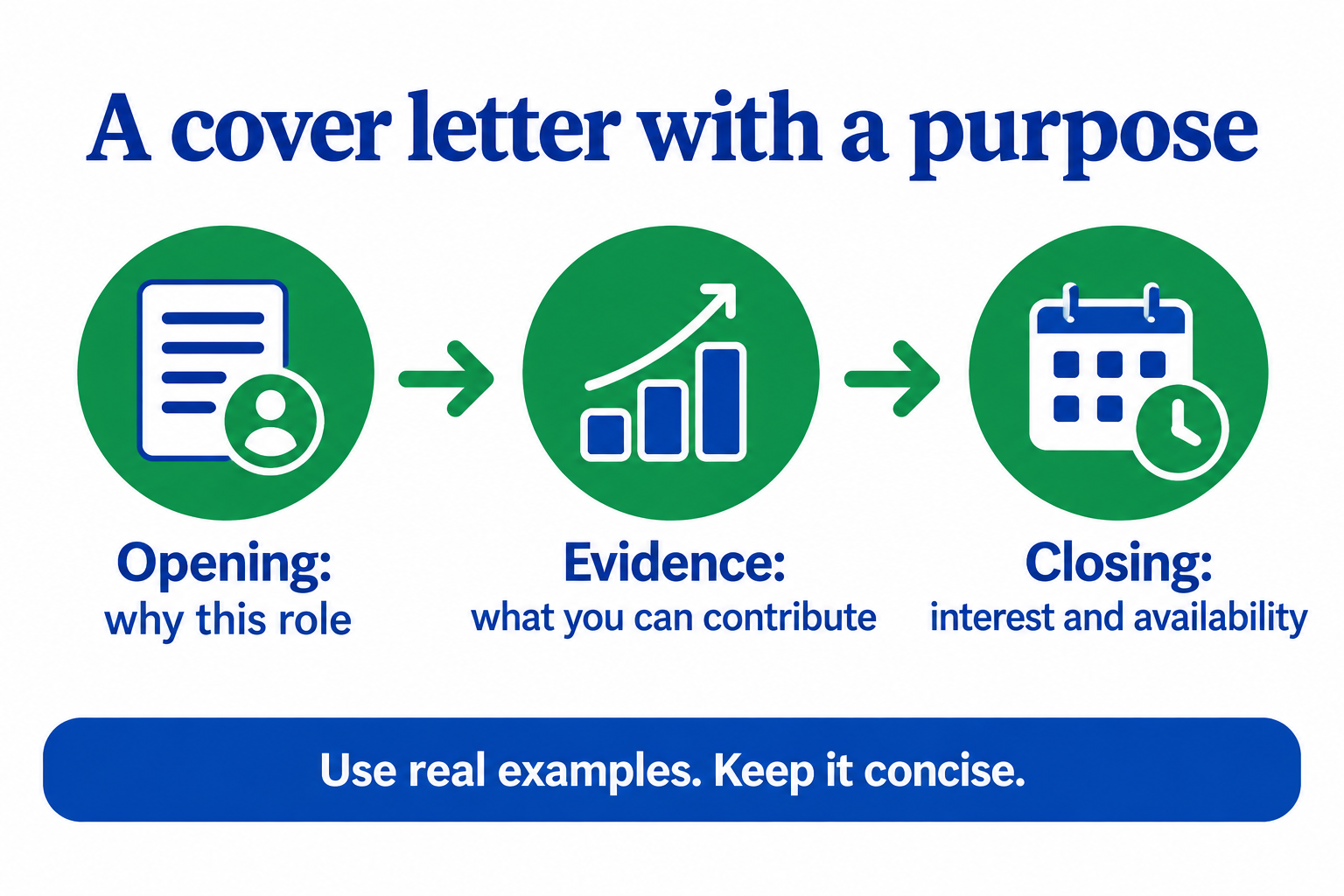
Use an opening that identifies the role and establishes your relevant direction. Follow with one or two short paragraphs developing your strongest evidence. Close with continued interest and any relevant availability information requested by the employer.
Address the hiring manager by name when you can verify it. Otherwise, a neutral greeting such as “Dear Hiring Manager” is appropriate. Do not guess a name, title or preferred form of address.
Keep the layout readable, with short paragraphs and consistent formatting. The letter should look like a professional explanation, not a dense report. If the application uses a text field, adapt to its limit instead of pasting an entire page without checking.
Write an Opening with a Clear Connection
Name the position and explain why your background connects to it. Avoid spending the first paragraph stating that you are writing to apply when the rest of the sentence could provide useful information. A brief introduction is enough.
For example: “I am applying for the Operations Assistant role. My business coursework and student-event coordination have given me practice organising records, checking details and communicating changes, and I would like to develop those skills in a working operations team.”
This is an adaptable example, not a statement to copy regardless of your experience. Replace the role and evidence with accurate details. The opening should create expectations that the next paragraphs can support.
Develop Evidence Instead of Repeating a List
Choose an example and explain the task, your contribution and its relevance. A resume bullet might identify what you did; the letter can explain why that experience prepares you for the vacancy. Do not simply convert every bullet into a longer sentence.
For a hypothetical student event, you might describe maintaining a schedule, checking changes with volunteers and sharing the final version before the event. Connect that to coordination duties in the vacancy. Avoid claiming a commercial impact the activity did not have.
If your best evidence comes from coursework, label it clearly. A simulated analysis can demonstrate reasoning without being presented as a real client project. Use precise verbs and include results only when you can support them.
Explain Why This Employer Interests You
Choose a verified aspect of the organisation that connects to your interests or preparation. Explain the connection in ordinary language. Generic praise about being an industry leader could apply to almost any employer and adds little evidence of thought.
Do not pretend to know the organisation’s internal problems from a quick website visit. You can express interest in its service and ask informed questions later. An accurate, modest explanation is more credible than a confident proposal based on assumptions.
If someone introduced you to the opportunity, mention that only when appropriate and with permission where needed. A contact’s name does not replace your own evidence. The letter still needs to explain why you are suitable for the work.
Use a Short Example as a Starting Point
The following is a fictional example to show how the parts connect. Replace every detail with your own experience and the actual vacancy:
“Dear Hiring Manager,
I am applying for the Junior Operations Coordinator role. I recently completed a business degree and would like to develop my skills in organising information and supporting reliable team processes.
During a student workshop project, I maintained the volunteer schedule and checked changes with the organising team. When two assignments overlapped, I confirmed availability and circulated an updated plan. This gave me practice checking details and communicating changes before they affected other people’s work.
Your role’s emphasis on maintaining records and coordinating with colleagues interests me because those are tasks I have enjoyed and want to develop further. I would welcome the opportunity to explain my project experience and learn more about the team’s priorities.
Thank you for considering my application.
Yours sincerely, Applicant Name”
The example is deliberately narrow. Its purpose is to show a credible connection, not to suggest every graduate should use the same story or paragraph count.
Align the Letter with Your Resume
Check that dates, role names and project descriptions agree across documents. The letter may expand an example, but it should not change your responsibility or result. Inconsistency makes an otherwise useful application harder to assess.
Use the guide to writing a resume with no experience if the underlying evidence is still unclear. Improve the resume and letter together so each serves a distinct purpose while describing the same facts.
Remove the Mistakes That Weaken the Message
Check the employer name, position and greeting separately from grammar. These details are easy to overlook when adapting a previous version. Remove placeholders and make sure every statement about the organisation is accurate.
Read the letter aloud and cut sentences that repeat the same point. Replace exaggerated claims with evidence. Ask a reviewer whether they can identify why you want the role and what preparation you bring without needing further explanation.
Submit a Letter That Earns Its Space
Before submitting, compare the final version with the vacancy and the application instructions. Open any exported file and check readability. If the letter adds nothing beyond your resume, revise the explanation rather than making it longer.
Your next step is to write two sentences connecting one genuine example to one important responsibility. Build the letter around that connection, then add a specific reason for your interest. Keep the message accurate, focused and easy to read.
Frequently Asked Questions
What Should I Say in a Cover Letter with No Experience?
Use relevant projects, coursework, volunteering or part-time work to explain your preparation. Describe your contribution and connect it to the vacancy. You do not need to apologise for being a graduate. Be clear about your career stage and avoid presenting academic work as paid professional experience.
How Long Should a Graduate Cover Letter Be?
Keep it concise and normally within one page, unless the employer gives different instructions. Include enough detail to explain motivation and relevant evidence. A text-field application may have a stricter limit. Remove repetition before shrinking the font or adding another page of general statements.
Is a Cover Letter Always Necessary?
Follow the employer’s instructions. Submit one when requested, and consider it when accepted and it adds useful context. Some applications do not provide a place for a letter. Do not treat an unsolicited document as a substitute for completing required questions, forms or other requested materials.
Can I Reuse the Same Cover Letter?
You can reuse accurate background material, but adapt the explanation to the role and organisation. Check names, responsibilities and reasons for interest each time. Closely related applications may share examples. Tailoring means making the relevance clear, not inventing different experience for every vacancy.



