
Electrical engineers with deep expertise in power system design increasingly need to demonstrate not just what they have built, but how they think. A video resume gives you a direct channel to walk hiring managers through your technical reasoning in a way that a static document simply cannot replicate.
Key Takeaways
- Show your design thinking, not just project outcomes.
- A single line diagram walkthrough is the clearest technical proof of expertise.
- Communication proficiency is now a core hiring criterion alongside technical skill.
Introduction to Electrical Engineer Video Resume
An electrical engineer video resume is a short, structured video presentation where you explain your technical background directly to a hiring audience. On Greetsquare, profiles support videos from 15 seconds up to 3 minutes, with 60 seconds being the sweet spot for most engineering roles. It works alongside your traditional resume, not as a replacement, giving recruiters a richer signal on your communication and problem-solving capabilities before a single interview is scheduled.
Demonstrating Power System Design Expertise Through Video (From Junior Engineer to Senior Leader)
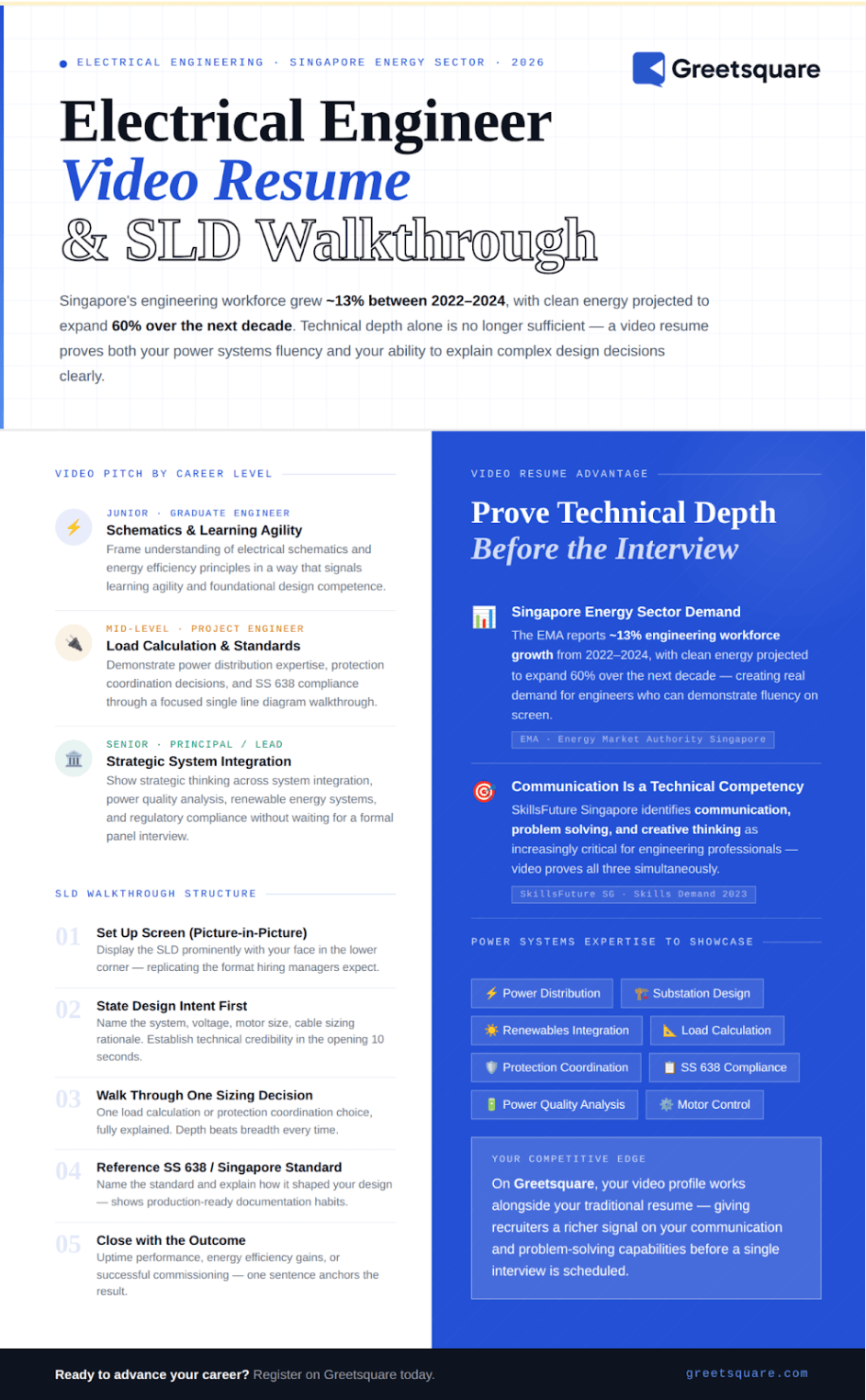
Singapore’s energy sector is expanding fast, and the numbers back this up. According to the Energy Market Authority, the engineering workforce in the sector grew approximately 13% between 2022 and 2024, with the clean energy segment projected to expand by roughly 60% over the next decade. This growth is creating genuine demand for engineers who can demonstrate fluency across power distribution, substation design, renewable energy systems integration, and load calculation.
At the same time, technical depth alone is no longer sufficient. The SkillsFuture Singapore 2023 Skills Demand for the Future Economy report identifies communication, problem solving, and creative thinking as increasingly critical competencies for engineering professionals. A video resume is one of the most direct ways to show both: your grasp of electrical power systems and your ability to explain complex design decisions clearly to a mixed technical and business audience.
For junior engineers, this means framing your understanding of electrical schematics and energy efficiency principles in a way that signals learning agility. For senior professionals, it is an opportunity to demonstrate strategic thinking across system integration, power quality analysis, and regulatory compliance without waiting for a formal panel interview.
How to Structure a Case-Study Style Walkthrough of a Power System (Single Line Diagram Demo)
The most effective format for an electrical engineer video resume is a case-study walkthrough built around a single line diagram. Here is a practical structure that works for video content under 60 seconds.
Set up the screen. Display your single line diagram prominently. This could be a pump and motor system showing the supply path, protection devices, and motor starter. Use a picture-in-picture layout so your face is visible in the lower corner. As you speak, use your cursor or a highlight tool to point directly at the component you are referencing on the diagram, whether that is a protection relay, a bus bar, or a cable run. This keeps the viewer’s eye anchored to the exact element you are explaining.
State the design intent first. Open by identifying the system purpose and the key constraints you were solving for. For example: “This is a 415V motor control circuit for a booster pump. I sized the cable at 16mm2 based on a 37kW motor with a 125% continuous load factor and a 20-metre run.” This immediately establishes technical credibility and grounds the viewer in the power system design context before you go deeper.
Walk through one sizing decision. Pick a single load calculation or protection coordination choice and explain the reasoning step by step. Where relevant, reference the actual industrial components or brands specified in the design, for example a Schneider Electric MCCB, an ABB motor protection relay, or a Siemens variable speed drive. Citing real equipment demonstrates market knowledge and procurement awareness, qualities that distinguish engineers who have worked on live projects from those with only theoretical exposure. Avoid trying to cover the entire diagram. One well-explained decision grounded in real components communicates engineering problem solving far more powerfully than a surface-level summary of five systems.
Connect to standards and compliance. Reference the applicable electrical safety standards or regulatory framework governing your design. In Singapore, this typically means SS 638 or the relevant Singapore Standard for electrical installations. Naming the standard and explaining how it shaped your design choice shows hiring managers that your technical documentation habits are production-ready, not theoretical.
Close with the outcome. End with one sentence on what the system achieved: uptime performance, energy efficiency gains, or successful commissioning. This anchors your technical walkthrough in a real engineering result.
Conclusion
A strong electrical engineer video resume does not just list projects. It shows how you think through power system design, safety, compliance, and performance trade-offs in real scenarios. If you are ready to present your expertise through structured, case-study driven video walkthroughs, create your professional profile on Greetsquare and start reaching engineering hiring managers across Singapore and APAC.
FAQ
Can a junior electrical engineer use this video format effectively?
Yes. Junior engineers can use a simplified single line diagram from coursework or an internship project to demonstrate design thinking and familiarity with electrical schematics and load calculation principles. Hiring managers value clarity and structured reasoning at every experience level.
How long should the power system walkthrough section of my video be?
Keep the technical walkthrough to 30 to 45 seconds within a 60-second video, leaving room for a brief introduction and a closing outcome statement. Focused, well-paced technical communication is itself a demonstration of the skill hiring managers are evaluating.