

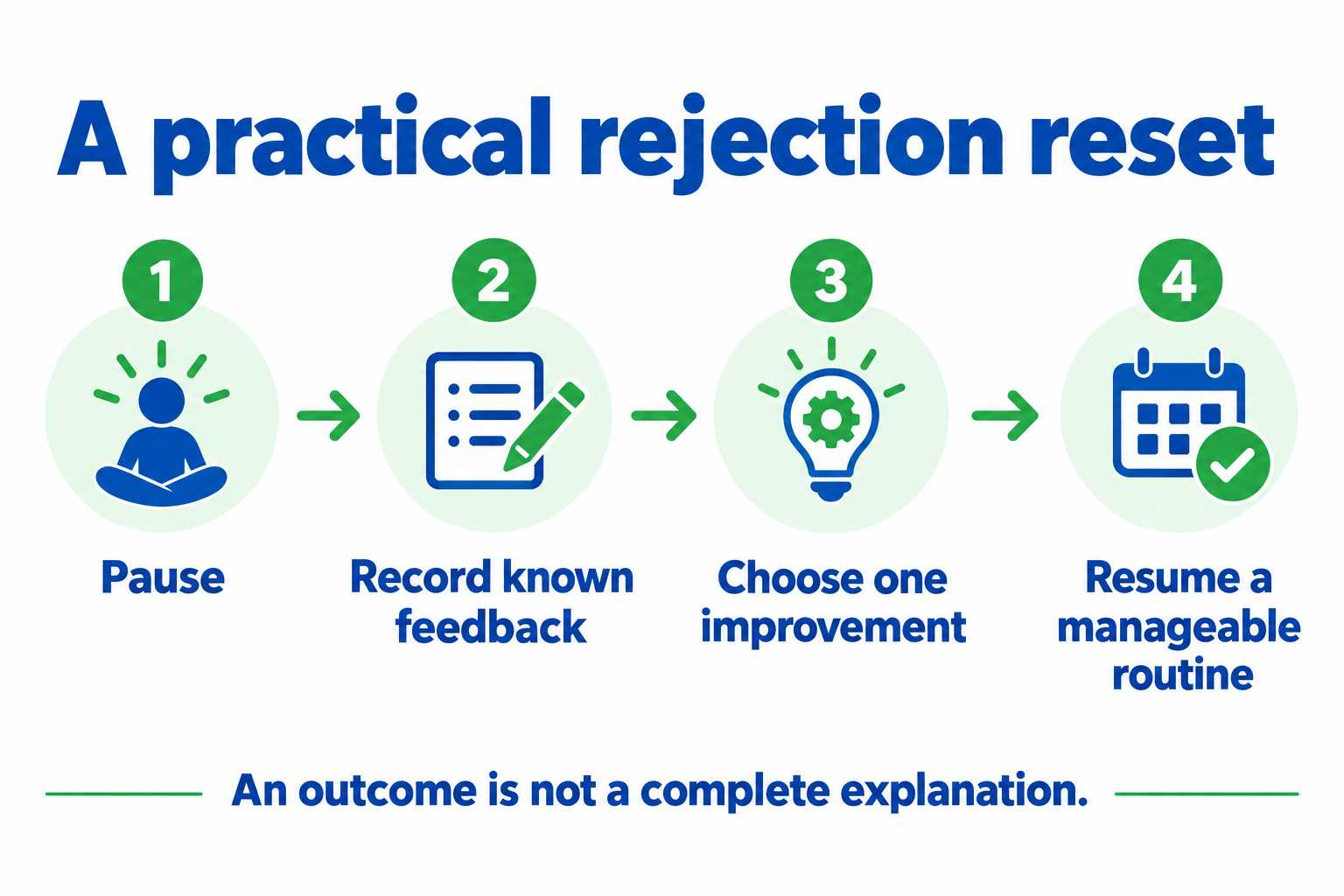
To handle graduate job rejection, give yourself space to absorb the decision, record what you actually know and choose one practical improvement for the next application. An unsuccessful outcome is not a complete explanation of your ability or future prospects. Review the evidence without turning every silence into a personal verdict.
Rejection can be especially discouraging when the role felt like a good match. You can acknowledge that disappointment while building a process that helps you decide what to do next.
What Hiring Timelines Can Tell You
The Careers@Gov early-careers page states that applicants are generally notified about shortlisting within four to six weeks of the listing’s closing date. That is guidance for its recruitment channel, not a rule for all employers.
The useful point is to distinguish waiting from a confirmed rejection. Check the employer’s stated timeline and the closing date before interpreting silence. A survey or another applicant’s experience cannot tell you exactly what is happening with your application.
Separate the Facts from the Story You Are Telling Yourself
Write down the known outcome in neutral language. “The employer selected another candidate” is different from “No employer will hire me.” The first describes a decision; the second makes a prediction that the decision cannot support.
Record any actual feedback separately from your interpretation. If the employer said another candidate had more relevant experience, that is information about this comparison. It does not prove your degree or all your examples are worthless.
When there is no feedback, label the reason unknown. You can still review your application, but treat possible explanations as hypotheses. This prevents a guess from becoming the basis for a complete and unnecessary change of direction.
Review the Stage Where the Process Stopped
An application rejected before a conversation suggests different review questions from an unsuccessful final interview. Before changing your approach, identify the stage and the evidence available. Look for patterns across comparable roles rather than relying on one outcome.
If applications rarely produce initial conversations, review role fit, eligibility and whether your strongest evidence is visible. If interviews happen but progress stops, examine the relevance and clarity of your answers. Neither pattern proves a single cause, but it helps you focus a useful review.
The fresh graduate job hunting guide connects these stages and the preparation each needs. Return to the relevant step instead of assuming that every part of your search has failed.
Handle Graduate Job Rejection with a Brief Debrief
Set aside a limited period to review the application or interview. Note what went well, what was difficult and what you would change. Keep the review specific enough to produce an action rather than an extended replay of the whole experience.
For a hypothetical interview, you might notice that your teamwork answer described the project but never your own contribution. The next action is to revise that example and practise follow-up questions. Rewriting your entire resume would not directly address that issue.
Also record successful preparation. If your technical example was clear, keep it. A useful debrief preserves what worked while improving a genuine gap.
Ask for Feedback Without Demanding an Explanation
After an interview, a brief request may be appropriate if you have a suitable contact. Thank them for the conversation and ask whether there is one area you could strengthen. Keep the tone professional and make the request easy to decline.
For example: “Thank you for letting me know and for the opportunity to meet the team. If you are able to share one area I could improve for similar roles, I would appreciate the feedback.” Adapt the wording to the relationship and process.
The employer may be unable or unwilling to provide detailed feedback. Do not repeatedly pursue an explanation or challenge the decision through multiple contacts. You can seek independent feedback on your materials or interview examples instead.
Decide Which Feedback Deserves Action
Look for advice that is specific, relevant and within your control. “Your example did not explain the analysis” suggests a clear improvement. “Be more confident” needs clarification about what was difficult to understand or assess.
Compare feedback with the role and other evidence. One interviewer may prefer a style that does not fit every context. Avoid changing factual content or adopting a false persona to satisfy a vague comment.
Ask a career adviser or knowledgeable reviewer to examine a concrete item, such as one resume section or recorded practice answer. A focused request is easier to act on than asking whether your entire career plan is wrong.
Restart with a Manageable Task
Choose a task small enough to finish: review one suitable vacancy, improve one project example or practise one answer. Completing a defined task helps restore a sense of direction. It also gives your next application a specific improvement to test.
Avoid responding to disappointment by setting an extreme application quota. If the pace prevents thoughtful role selection or preparation, the additional volume may create more frustration. Choose a routine you can sustain alongside the rest of your responsibilities.
For an extended search, use the guide to staying consistent during a long job search. It focuses on a practical rhythm for applications, review and recovery so you can keep moving without treating every day as an emergency.
Keep Your Progress Visible
Track more than offers. Useful progress includes clearer role targets, improved examples, completed conversations and interview invitations. These do not replace employment, but they help you see whether preparation is becoming more effective.
Keep a record of application dates, stages and changes made. Compare similar roles and allow for response timelines. Small samples are noisy, so avoid treating a short run of outcomes as a reliable forecast.
Also maintain ordinary routines and contact with people you trust. A practical conversation with a friend or adviser can help you assess the next step. You do not need to turn every social interaction into an update on your job search.
Adjust Direction When the Evidence Supports It
If repeated review shows a gap in an essential skill, decide whether to practise it or target a more suitable role. If you discover that the day-to-day work does not interest you, revise the target deliberately. Changing direction can be sensible when it responds to information.
Distinguish that decision from reacting immediately to one rejection. Write down what you have learned and which alternative fits better. A reasoned adjustment gives the next stage a clearer purpose.
Choose Your Next Step Before Ending the Review
Finish with one action and a realistic time to do it. For example, revise your problem-solving example tomorrow and use it in a practice interview. Then close the review rather than returning to it throughout the day.
A rejection is an outcome you did not want, but it can still be followed by a useful decision. Keep your account of it accurate, preserve what is working and make the next improvement specific.
Frequently Asked Questions
Does Rejection Mean I Am Not Good Enough for the Role?
Not necessarily. Hiring compares candidates within a particular process, and the reasons may be only partly visible. Review any actual feedback and your relevant evidence. Avoid turning one result into a broad conclusion about your ability. Use patterns across comparable applications to guide practical improvements.
Should I Ask for Feedback After Rejection?
After an interview, a short and polite request can be appropriate when you have a suitable contact. Ask for one area to improve and accept that feedback may be unavailable. Do not demand an explanation or repeatedly challenge the decision. Independent feedback on your examples can also help.
How Do I Stay Motivated After Several Rejections?
Reduce the next step to a manageable task and keep a realistic routine. Track improvements and conversations as well as final outcomes. Review comparable applications for useful patterns, and make one justified change at a time. Keep space for ordinary activities and support from people you trust.
Can I Apply to the Same Employer Again?
Check the employer’s instructions and any stated reapplication policy. A different suitable vacancy may be worth considering, especially if your evidence has improved. Tailor the application to the actual role. Do not repeatedly submit the same materials to the same vacancy in an attempt to force a response.



