

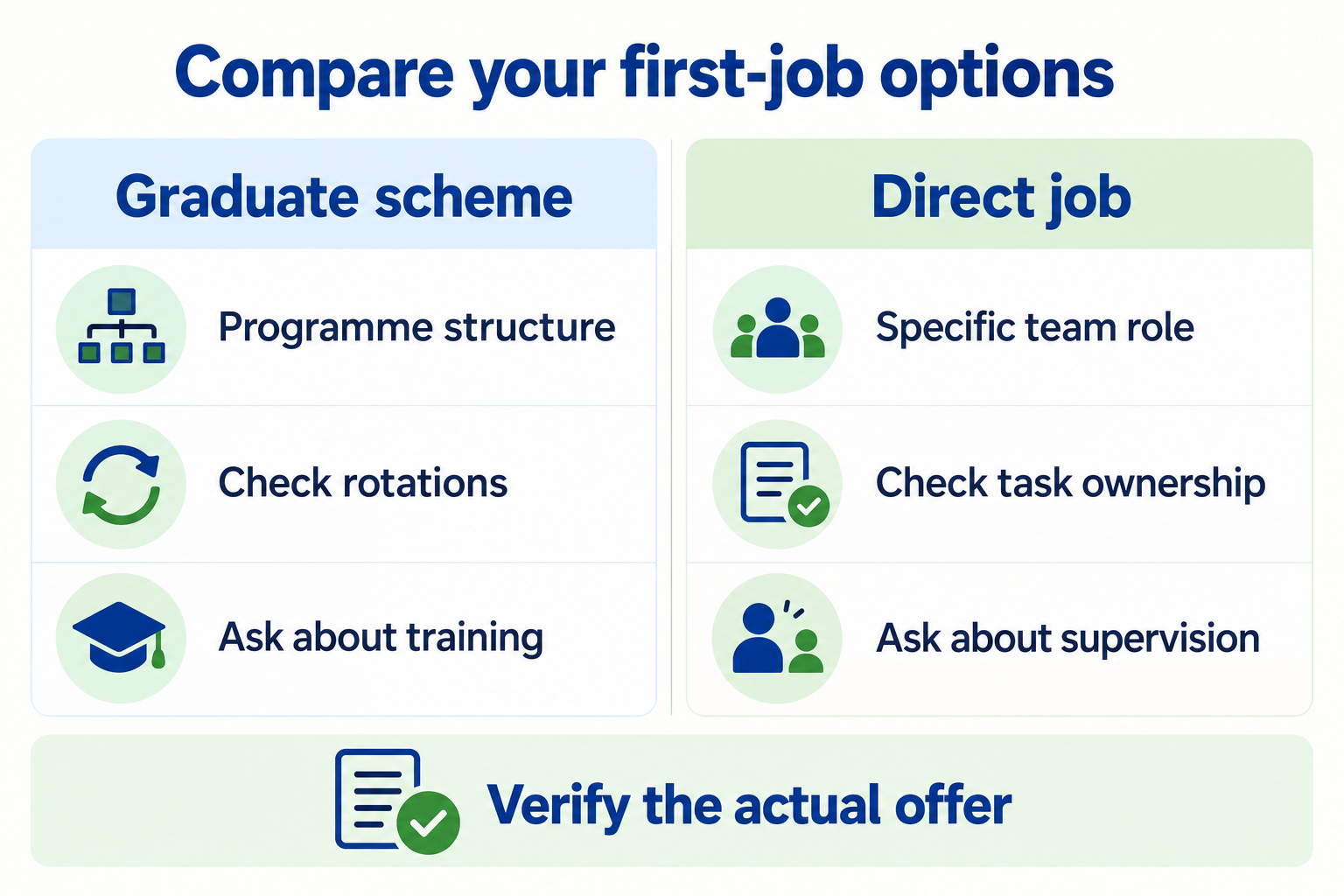
Choose a graduate scheme when its development structure fits your goals, and consider a direct job when you want to build skills in a specific team or responsibility. Graduate schemes versus direct jobs is a comparison of actual opportunities, not a universal ranking. The work, manager and terms matter more than the label.
You can apply to both routes while learning what each offers. A useful decision starts with the tasks you want to learn and the support you need to perform them well.
What Official Recruitment Information Shows
Singapore’s Careers@Gov early-careers page distinguishes full-time roles, internships and traineeships and states that applications for full-time positions and internships are accepted year-round. This describes that recruitment channel, not a timetable shared by every graduate employer.
The practical lesson is to check each opportunity’s category and instructions. Do not assume every first job requires joining an annual graduate intake. Equally, do not treat a traineeship and permanent employment as interchangeable because both welcome graduates.
Understand the Two Routes
A graduate scheme groups early-career hires within a planned development programme. Depending on the employer, it may include training, rotations, mentoring or cohort activities. Confirm the features instead of assuming that the word “scheme” guarantees them.
A direct-entry job recruits you for a particular position in a team. Learning may happen through supervised tasks, feedback and formal courses. The absence of a graduate programme label does not tell you whether that learning will be effective.
For the broader process of selecting roles and preparing applications, use the fresh graduate job hunting guide. Keep this decision connected to your skills and circumstances rather than the prestige of a route.
Compare Graduate Schemes Versus Direct Jobs on Daily Work
Ask what you would actually do during the first months. A broad programme might expose you to several functions while limiting depth in each placement. A direct role may provide ownership of a narrower set of tasks and less exposure outside the team.
If you are exploring related functions, meaningful rotations may help you understand the differences. If you already know the work you want, a specific role with good supervision may offer a more direct learning path. Neither preference is inherently more ambitious.
Look for concrete tasks, outputs and relationships. “Support business transformation” needs clarification: does it mean checking data, coordinating meetings, interviewing users or maintaining project records? You cannot assess an opportunity well until the language describes recognisable work.
Examine the Learning Support
Supervision and Feedback
Find out who reviews your work, how questions are handled and how often you receive feedback. A named mentor is useful only if you understand that person’s role and availability. Your day-to-day manager still matters.
Ask for an example of how a recent graduate learned an unfamiliar task. A concrete account of instruction, practice and review is more informative than a promise of a steep learning curve. Check whether support continues after initial onboarding.
Rotations and Placement
If rotations are advertised, ask which teams participate and how placements are allocated. Find out whether preferences are considered and what each placement expects you to deliver. Moving between teams does not automatically mean developing useful depth.
Clarify what happens when the programme ends. Distinguish an opportunity to apply for a role from a guaranteed placement. Record uncertain information as a question rather than filling the gap with an optimistic assumption.
Check the Practical Fit
Review location, working arrangements, start date, responsibilities and duration using the written opportunity details. Ask the employer to clarify unclear terms. A recruitment presentation may describe possibilities more broadly than an individual offer.
Consider travel, study completion and your own availability. A highly regarded programme may be impractical if its schedule conflicts with a commitment you cannot change. A less familiar organisation may offer work that fits your direction well.
Do not predict rapid promotion from general marketing language. Ask how performance is assessed and how progression works, while recognising that another employee’s history cannot guarantee your outcome. Assess the role you are being offered now.
Use a Consistent Comparison
Create five headings: tasks, supervision, learning, practical fit and next-stage clarity. Under each opportunity, write the evidence you have and what remains unknown. Use the same questions for both so that a polished presentation does not substitute for information.
Consider a hypothetical choice. Scheme A offers several placements, but its final team is undecided. Direct Role B provides a specific first project and a named manager. A graduate seeking breadth might favour A, while someone committed to B’s work might prefer depth.
Avoid assigning precise scores to uncertain information. One important constraint can outweigh several small benefits. If two options remain close, identify the unanswered question most likely to change your decision and ask it directly.
Prepare for the Application Process
Some schemes recruit around a cohort start date and use several assessment stages. Direct jobs may follow a team-specific process. Verify deadlines, eligibility and stages for each vacancy rather than relying on a general graduate recruitment calendar.
For a broad programme, explain why its structure fits your interests and how you learn across unfamiliar tasks. For a specific job, emphasise evidence related to its responsibilities. Both require accurate examples and a clear explanation of your contribution.
Keep applying to suitable roles while awaiting decisions. Do not postpone every application for one preferred intake unless you have a deliberate reason. Track closing dates and the materials submitted so you can prepare consistently if an interview follows.
Learn from People Who Have Done the Work
Ask recent participants or employees about ordinary tasks, supervision and what surprised them. Listen for examples rather than broad recommendations. One person’s experience may differ from another team, so compare it with the official information.
The guide to networking as a fresh graduate explains how to request these conversations respectfully. A question about learning a particular task is easier to answer than asking someone to choose your career for you.
Make a Decision You Can Explain
Choose your three most important criteria before comparing employer names. Then identify what still needs confirmation. This keeps the decision focused on work and support instead of the appeal of a familiar label.
Your next step is to compare one programme and one direct role using the same headings. Explain which fits better and why, using facts about the opportunity. That explanation can also become the foundation of a more convincing application.
Frequently Asked Questions
Is a Graduate Scheme Better Than a Direct Job?
Neither is universally better. Compare the actual tasks, supervision, training and terms. A scheme may provide breadth, while a direct role may offer depth in one team. The stronger option depends on your goals and circumstances, and on whether the advertised support exists in practice.
Can I Apply for Both Routes?
Yes, if you meet the requirements and both routes suit your goals. Tailor each application and track deadlines carefully. Use interviews to clarify differences before evaluating an offer. Applying to both can help you learn about the work without committing prematurely to one type of opportunity.
Do All Graduate Schemes Include Rotations?
No. Programme structures vary, so verify what is included. Ask which teams participate, how placements are assigned and what graduates deliver. If final placement is mentioned, clarify how it is decided. Do not assume a particular role or progression outcome is guaranteed without clear confirmation.
What Should I Ask About a First Job?
Ask about initial responsibilities, supervision, feedback and how progress will be assessed. Clarify practical arrangements and any uncertainty in the written offer. For a programme, ask what happens after completion. Use the actual opportunity as your reference rather than treating general recruitment language as a promise.



