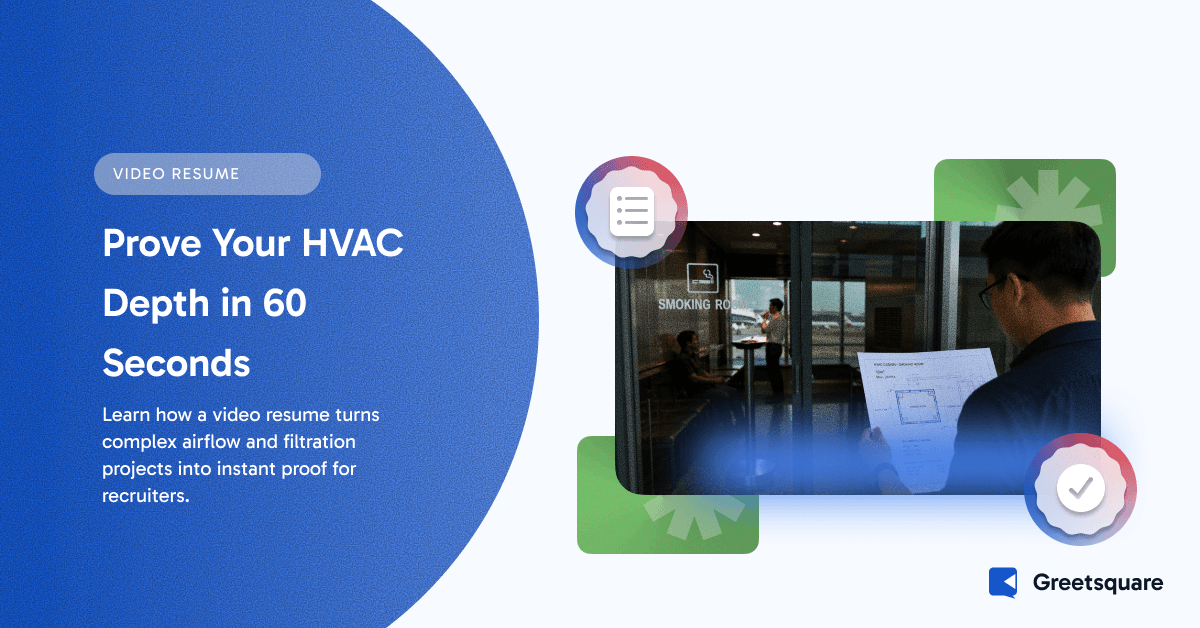
An HVAC design engineer video resume turns a niche project, like designing an airport smoking room, into clear evidence of applied problem-solving. With nearly 80% of Singapore vacancies de-prioritising academic qualifications, a focused video pitch lets technical professionals show competence faster than a text-only engineering portfolio.
Key Takeaways
- A video resume converts complex HVAC case studies into recruiter-ready proof.
- ISO 16890 filtration logic and cooling load math signal real engineering depth.
- Concise on-camera communication strengthens problem-solving skills as a hiring signal.
Introduction to HVAC Design Engineer Video Resume
A standard text resume lists projects; a video resume explains how an engineer thinks through them. For HVAC professionals, this format pairs an engineering portfolio with a short video pitch that demonstrates problem-solving skills under real constraints.
This matters because Singapore’s hiring market increasingly rewards applied capability. Engineering job postings have surged, with civil engineering roles up nearly 19% amid strong technical demand, making differentiated portfolio signalling more valuable for both junior and senior candidates.
A 60-second video sits on a Greetsquare profile alongside a traditional resume, complementing rather than replacing it. The goal is to give recruiters a clearer first impression of how a candidate approaches a real engineering brief.
Showcasing Airflow Design, Cooling Load, and ISO 16890 Expertise Through Video
Pick one technically rich project and walk through it on camera. An airport smoking room is ideal: a 10m² enclosed space designed for up to 20 simultaneous smokers, where HVAC air flow calculation, exhaust ventilation, and cooling load must work together without compromise.
Start with the airflow logic. Explain how negative pressure was maintained so smoke never migrates into adjacent terminal areas, and how exhaust ventilation rates were calculated to clear contaminants while keeping air changes per hour within comfort thresholds. State the numbers briefly, then move on.
Next, address the cooling load. With a high occupant density and continuous heat gain from lighting and equipment, the cooling calculation is non-trivial in a tropical climate. Describe the assumptions, the sensible-versus-latent split, and how equipment sizing balanced energy efficiency against peak demand.
Then explain ISO 16890 air filtration. Walk recruiters through how the standard’s ePM1, ePM2.5, and ePM10 efficiency classes informed filter selection for tobacco smoke particulate, and why a layered approach, including activated carbon for gas-phase contaminants, fits the use case. This level of specificity is what separates a generic claim of “HVAC experience” from demonstrated airport smoking room design competence.
Using a Video Pitch to Communicate Technical Decision-Making to Recruiters
Recruiters reviewing engineering candidates increasingly screen for hybrid skill sets. Communication and problem-solving rank among the top five most demanded cross-cutting skills for engineers in Singapore, so a video pitch directly addresses what hiring managers already weigh.
Structure the pitch in three beats: the constraint, the decision, the outcome. Spend roughly 15 seconds framing the brief, 30 seconds explaining the technical reasoning across airflow, cooling load, and filtration, and the final 15 seconds summarising results and what you would refine next. This rhythm keeps the video under the ideal 60-second mark.
Speak as you would in a design review, not a sales pitch. Confident, plain-language explanation of trade-offs, such as why a higher MERV-equivalent filter was rejected in favour of an ISO 16890 ePM1 selection, signals professional positioning more credibly than rehearsed taglines. Junior engineers benefit because applied reasoning compensates for limited work history, while senior candidates use the format to evidence leadership-grade decision-making.
On-camera presence is a learnable skill. Record several takes, watch for filler words, and treat clarity as part of engineering communication, not a separate soft skill.
Conclusion & CTA
A focused HVAC video resume turns one complex case study into compounding proof of technical competence, clear communication, and leadership potential, all within a minute. Engineers ready to elevate their profile in Singapore’s competitive technical hiring market can register on Greetsquare and build a video pitch that recruiters can evaluate alongside their traditional resume.
FAQ
How long should an HVAC engineer’s video resume be?
Aim for around 60 seconds, with Greetsquare supporting durations from 15 seconds to 3 minutes. This is enough time to explain one project’s airflow, cooling load, and filtration logic without losing recruiter attention.
Do I need polished video production for a technical pitch?
No, clear audio, steady framing, and confident explanation matter far more than production value. Recruiters are evaluating engineering reasoning and communication, not cinematography.