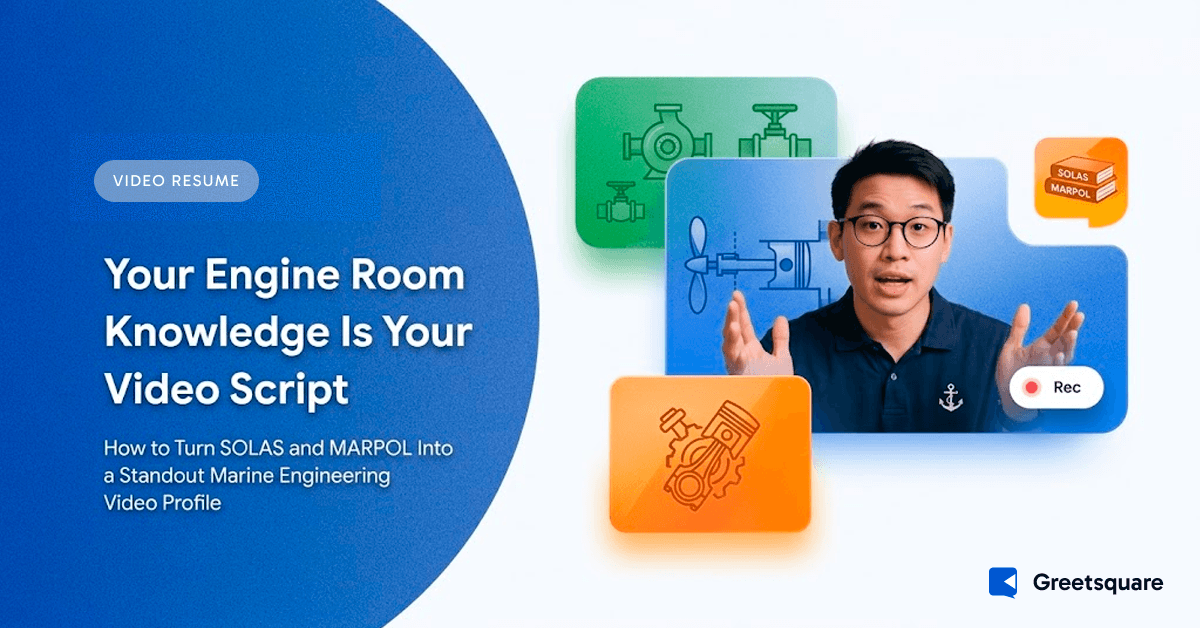
A marine engineer video resume is one of the most underutilised tools for fresh graduates looking to stand out in Singapore’s competitive maritime sector. Rather than sitting in front of a camera and reading off a script, the most effective marine engineering video profiles show technical thinking in action. This article explains how diploma graduates can turn classroom subjects like SOLAS and MARPOL into compelling video content that impresses maritime recruiters.
Key Takeaways
- Use simulation labs and mock engine rooms as your video backdrop
- Explain one subject clearly to showcase analytical thinking
- SOLAS and MARPOL knowledge signals compliance-readiness to employers
Introduction to Marine Engineer Video Resume
Greetsquare is a Singapore-based professional profile platform where candidates present themselves through short video profiles ranging from 15 seconds to 3 minutes, with 60 seconds being the ideal length. For marine engineering graduates, this format is particularly powerful because it enables technical demonstration rather than passive credential-listing. Singapore’s maritime sector supports over 170,000 jobs and contributes more than 7% of GDP, making differentiation critical for entry-level candidates looking to break into one of Singapore’s most strategically important industries.
The International Maritime Organization sets the global regulatory framework that governs careers in this field, and Singapore Polytechnic’s Marine Engineering programme already trains graduates in the exact systems recruiters care about. The gap is not knowledge. It is demonstration. A video profile closes that gap by letting you show what you understand, not just claim it.
How a Marine Engineering Video Profile Demonstrates SOLAS and MARPOL Knowledge Across Career Levels
Pick one subject and own it.
The most common mistake fresh graduates make is trying to cover everything. Instead, select a single topic from your coursework and walk through its real-world application in under 60 seconds. SOLAS (Safety of Life at Sea) and MARPOL (Marine Pollution) are two of the strongest choices because they are internationally recognised and directly tied to operational and environmental compliance roles that employers are actively hiring for.
SOLAS: Explain Machinery Space Design
SOLAS regulations define and categorise machinery spaces, distinguishing them from accommodation areas and governing how these spaces must be designed for fire safety and emergency response. In your video profile, use your school’s simulation centre or mock engine room setting as the backdrop. Walk the viewer through the physical layout, explain why boundaries between machinery and accommodation spaces matter, and describe what happens during an emergency drill. This approach transforms a classroom topic into a live demonstration of systems thinking.
MARPOL: Break Down Garbage Management and Pollution Control
MARPOL governs how ships manage waste, discharge, and emissions. For a fresh graduate, the MARPOL garbage management annex is an accessible entry point. In your video, explain how garbage categories are separated onboard, what records must be kept, and how this prevents marine pollution. Adding your own opinion, for example, commenting on how ballast water management challenges will intensify under decarbonisation pressure, signals analytical maturity beyond rote knowledge. Global shipping decarbonisation is projected to support up to 4 million green maritime jobs by 2050, making environmental compliance fluency a genuine long-term career asset.
STCW Certification as Supporting Context
Weaving in a brief reference to your STCW training, specifically how it underpins your understanding of emergency response procedures, adds regulatory credibility to your video profile. This is especially useful if you are applying for cadet or junior engineer roles where employers are assessing baseline compliance awareness alongside technical aptitude.
Senior Engineers and Chief Engineer Applicants
For those at mid to senior level, a marine engineering video profile can reframe SOLAS and MARPOL knowledge in terms of fleet-wide implementation, crew training responsibility, and audit readiness. Rather than explaining what a regulation means, demonstrate how you have applied it operationally and what decisions you made as a result. Singapore authorities are actively emphasising data analytics, AI, and sustainability training as core growth areas for the next generation of maritime professionals, and senior candidates who show cross-disciplinary awareness will benefit from that momentum.
What Makes the Format Work
The simulation centre or mock engine room is your set. Use it. Standing in a realistic technical environment while explaining a system tells a recruiter far more than a static headshot and spoken credentials. Keep your explanation structured: define the regulation, explain the real-world function, offer a brief personal observation. That structure, completed in 60 seconds, demonstrates communication skills, technical literacy, and professional confidence simultaneously.
Conclusion
Your diploma in marine engineering already contains the technical substance that maritime recruiters are looking for. The opportunity is to make that knowledge visible through a focused, walkthrough-style video profile that uses your school’s simulation facilities as proof of environment rather than just background. Create your marine engineering video profile on Greetsquare and position yourself for remote and in-person maritime hiring across Singapore and APAC.
FAQ
Can I record my SOLAS walkthrough video on a phone?
Yes, a modern smartphone is sufficient provided the environment is well-lit and your audio is clear. The content and clarity of your explanation matters far more than production quality.
Is a video profile useful if I have no work experience?
Absolutely. A video profile demonstrating SOLAS or MARPOL systems knowledge from your diploma coursework shows analytical ability and communication skills that a text resume cannot convey on its own.