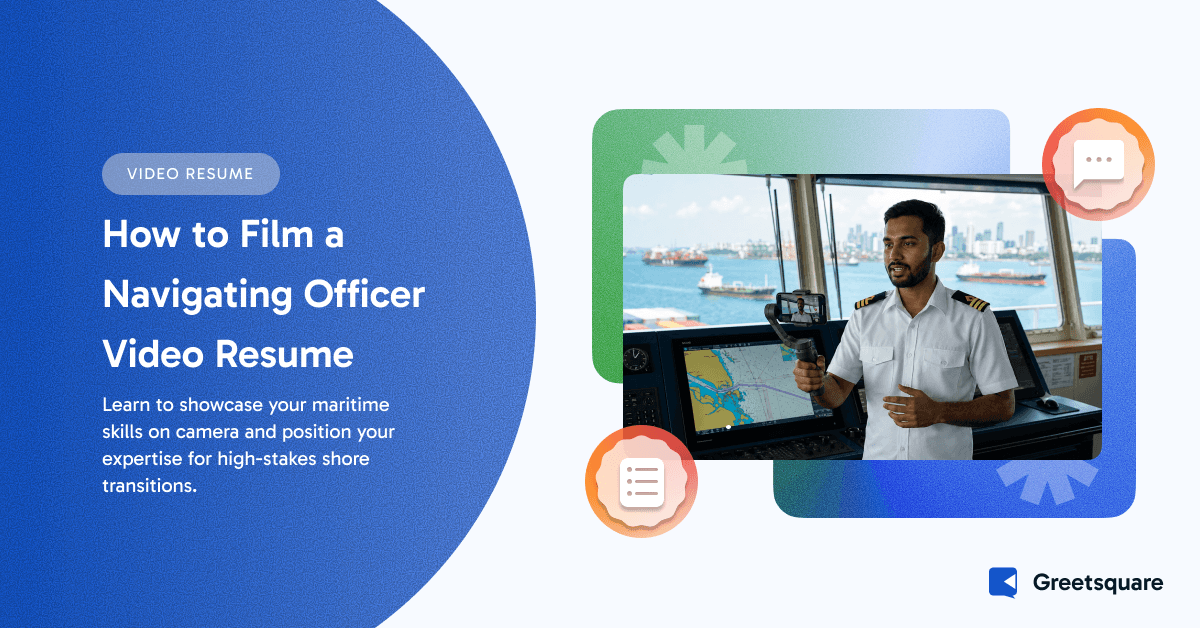
A navigating officer video resume is a short, structured on-camera presentation that communicates your bridge competencies, operational judgment, and seamanship directly to hiring managers. With Singapore’s maritime sector contributing approximately 7% of national GDP and supporting over 170,000 jobs, the competition for maritime roles is real and visibility matters. A well-executed video resume on Greetsquare elevates your professional profile beyond a text-based CV.
Key Takeaways
- Lead with your watchkeeping grade, vessel type, and trading area.
- Demonstrate situational awareness through a real scenario, not a list.
- Frame navigational skills as transferable to shore-based and adjacent roles.
Demonstrating Ship Navigation Skills for Operational, Tactical, and Strategic Impact
Bridge watchkeeping forms the operational core of your video resume. State your watch grade, vessel type, and the trading routes you have managed. Hiring managers evaluate whether you can own a watch independently, so be direct about the scope of your responsibility.
Voyage planning and collision avoidance reveal your tactical decision-making. Describe how you apply COLREG compliance under real traffic conditions, referencing a specific scenario where your navigational risk assessment prevented an incident. This approach converts regulation knowledge into demonstrated professional seamanship.
Your fluency with radar, ARPA, and electronic chart display systems signals technology competence. Over 80% of global trade by volume moves by sea, meaning maritime safety and ECDIS-enabled voyage execution are not niche skills but globally critical capabilities. Mention the ECDIS systems you have operated by name if possible.
GPS navigation and situational awareness work together under pressure. Use your video to narrate a specific moment where real-time data interpretation and calm decision making at sea led to a safe outcome. Concrete examples outperform abstract claims every time.
From Bridge to Tower: Ship Navigation Skills as a Transferable Path to Air Traffic Control
Navigating officers operate in one of the most demanding decision-making environments in any profession, and those skills translate directly into air traffic control competencies. Situational awareness, real-time risk assessment, multi-vessel traffic management, and strict adherence to international regulations mirror the core requirements of an air traffic controller role. The cognitive framework is the same: maintain separation, anticipate conflict, and act decisively under pressure.
The World Economic Forum identifies analytical thinking, decision-making, and resilience as top future-of-work capabilities, and a career at sea builds all three systematically. Civil aviation authorities and air traffic control training programmes increasingly recognise structured maritime watchkeeping as evidence of the discipline and procedural rigour required for the transition. Your video resume is the right place to make this connection explicit, framing your bridge experience in the language of high-stakes operational control rather than limiting it to shipping alone.
When positioning this transition in your video resume, reference your COLREG compliance experience as procedural rule-following under dynamic conditions, your radar and ARPA competency as active surveillance and conflict detection, and your voyage planning skills as structured airspace-equivalent route management. Hiring managers and training assessors respond to candidates who can articulate why their background qualifies them, not just that it does.
Structuring a High-Impact Video Resume for Career Mobility
Keep your video resume between 60 and 90 seconds. Open with your rank, certificate of competency level, and the vessel types you have served on. This anchors your credibility before you go deeper into ship navigation skills.
Structure your content in three beats: role context, a key navigational scenario, and your career intent. The scenario beat is where situational awareness and decision making at sea become tangible for hiring managers reviewing your profile. A short, specific story is more persuasive than a full watch schedule.
Close by stating the type of role you are targeting, whether that is a senior shipboard position, a maritime safety consultancy, an air traffic control pathway, or a shore transition. Navigating officers who clearly articulate their career direction are easier to place and faster to shortlist. On-camera presence is a learnable skill, and a confident, focused delivery reinforces the same composure you bring to the bridge.
Video resumes complement your full application profile. They do not replace your certificates, discharge book, or formal interview. They give hiring managers a reason to open your profile first and a reference point for the conversation that follows.
Conclusion
Your ship navigation skills represent a unique intersection of regulatory mastery, operational precision, and transferable decision-making that shore-based roles and adjacent high-stakes industries increasingly value. A structured navigating officer video resume makes that expertise visible in a competitive market before a recruiter reads a single line of your CV. Register on Greetsquare today and build the profile that gets your bridge experience in front of the right hiring managers.
FAQ
Can a navigating officer transition into air traffic control?
Yes. Core bridge competencies including situational awareness, radar operation, real-time risk assessment, and procedural compliance align directly with air traffic control training requirements. Frame these skills in your video resume using operational control language to connect with aviation hiring assessors.
How long should a navigating officer video resume be?
Sixty seconds is the ideal length on Greetsquare. Use the time to cover your watchkeeping grade, one concrete navigational scenario, and your target role so hiring managers have everything they need to act.