

Sales manager salary in Singapore depends on the sales model, territory and leadership responsibility. Michael Page’s current comparison tool reports an average of S$120,000 annually, excluding bonuses and benefits. That equals S$10,000 monthly when divided by 12, but it is a recruiter benchmark rather than a guaranteed offer for every sales manager.
The larger question is what you can actually earn under the proposed incentive plan. A competitive base salary and a credible target are easier to assess when you understand the accounts, team capacity and commission rules behind them.
Sales Manager Salary in Singapore: Current Research and Pay Definitions
The Michael Page sales manager salary tool, checked on 6 October 2026, reports S$120,000 annually. It explicitly excludes bonuses and benefits. Its comparison tool methodology uses placements and advertised roles from the previous 12 months, with annual updates.
| Measure | What It Means | What to Confirm |
|---|---|---|
| Annual salary benchmark | S$120,000 in the current recruiter tool, excluding bonuses and benefits | Whether the vacancy matches the source’s role category |
| Monthly equivalent | S$10,000, calculated as S$120,000 ÷ 12 | Actual contractual monthly base and number of payments |
| On-target earnings | Base salary plus incentive at the defined target | Target assumptions, eligibility and payment rules |
The monthly equivalent is our calculation, not another survey result. The source does not provide a universal experience ladder for this title. Avoid creating unsupported junior, senior or industry ranges from a single average. Use matching vacancies and recruiter discussions to refine the comparison.
Match the Sales Role Before Comparing Salary
Sales manager can mean leading a team, owning a territory or managing important accounts as an individual contributor. Some vacancies combine all three. These distinctions affect the work, performance measures and suitable compensation evidence.
Use the sales manager job description to clarify the leadership remit. Then consult the Singapore salary guide by industry for broader context. Keep your pay comparison tied to the actual vacancy rather than treating every commercial title as equivalent.
Ask whether the role focuses on new customers, renewals, channel partners or existing-account growth. Selling a recurring software subscription differs from securing project-based contracts or supplying distributors. Compare roles with similar deal cycles, customer groups and responsibility for revenue.
Separate Team Leadership From Personal Quota
Find out how much of the target belongs to your own selling and how much depends on the team. Confirm the number of representatives, open vacancies and your hiring authority. A management title can still require a substantial personal account portfolio.
If you inherit a team target, establish whether you can influence territory allocation, account coverage and performance support. Accountability for a number is more meaningful when you have the resources and decision rights to affect it. Discuss those boundaries before judging the package.
Assess Experience Through Revenue and Leadership Evidence
Years in sales provide context, but they do not establish readiness for every management role. Employers also need to understand the complexity of the deals and teams you have managed. Explain the territory, product, sales cycle and support available in your previous role.
For a first management move, demonstrate coaching, reliable forecasting and coordination across functions. For a senior vacancy, add examples of building a team, changing account strategy or managing several territories. Describe your contribution to the result without taking credit for work delivered by the whole organisation.
Industry comparisons should stay specific. A regulated enterprise sale can require different knowledge and approvals from a retail distribution role. That difference helps you select relevant evidence; it does not justify inventing a fixed salary premium for one sector.
Separate Base Salary From On-Target Earnings
On-target earnings, often called OTE, combine base salary with incentive at the specified performance target. OTE is not automatically guaranteed cash. Ask the employer to show the base, target incentive and assumptions separately in the written offer or compensation plan.
Clarify what triggers payment. The plan may measure booked revenue, collected revenue, gross margin or another defined outcome. These are different measures, and timing can affect when a sale contributes to your incentive. Check how cancellations, refunds and shared accounts are handled.
Ask about thresholds, caps and accelerators. A threshold may mean no incentive is payable until a defined level is reached; an accelerator may increase the rate above target. Read the actual formula rather than assuming that earning half the target incentive follows automatically from achieving half the quota.
A Hypothetical Sales Offer Calculation
Suppose Offer A provides S$8,000 monthly base and S$48,000 annual target incentive. Its annual base is S$96,000 and OTE is S$144,000. Offer B provides S$9,000 monthly base and S$30,000 annual target incentive, giving S$108,000 base and S$138,000 OTE.
Offer A has the higher target figure; Offer B has the higher base. You cannot determine which produces more actual cash without understanding the plan and likely attainment. These invented examples illustrate the arithmetic, rather than representing current market packages or a recommendation to choose one pay mix.
Check Whether the Target Has a Credible Operating Plan
Ask what proportion of comparable team members achieved their targets in the last completed period. Request context about territory changes, vacancies and unusually large deals. Historical attainment is useful evidence, but it does not guarantee your future performance.
Understand the pipeline you will inherit and how the business defines a qualified opportunity. Discuss lead generation, marketing support, sales engineering and customer success where relevant. A target built around resources that have not yet been approved deserves closer examination.
For a new territory, clarify ramp-up expectations and how incentive eligibility works during that period. Ask whether any initial payment is guaranteed, recoverable or conditional. The label used by the recruiter is less useful than the written terms explaining how it affects your pay.
Review Commission Timing and Contract Changes
Check how frequently incentives are calculated and paid. A monthly salary with quarterly or annual incentive payments creates a different cash-flow pattern from a fully monthly package. Understand any delay between the commercial event and the payment date.
Ask how the plan handles a mid-year territory change, role transfer or departure. Confirm who resolves disputes about account credit and which document governs the calculation. If the employer can revise the plan, understand the process and when changes take effect.
Keep joining awards and benefits separate from recurring earnings. A signing bonus may have repayment terms, while travel reimbursement covers business expenses. Compare what you can retain and under what conditions, instead of adding every line into a headline package.
Negotiate With a Matched Scope and Measurable Results
Prepare two or three examples that explain how you improved revenue quality, forecasting or team performance. Give the starting point, action, measurement period and result. If a market rebound or product change contributed, include that context rather than presenting the gain as entirely personal.
Use the salary negotiation guide to state your requested annual base and discuss incentive design separately. Connect the request to relevant salary evidence, the vacancy’s scope and your readiness to own it. A larger OTE alone does not resolve an unclear or difficult plan.
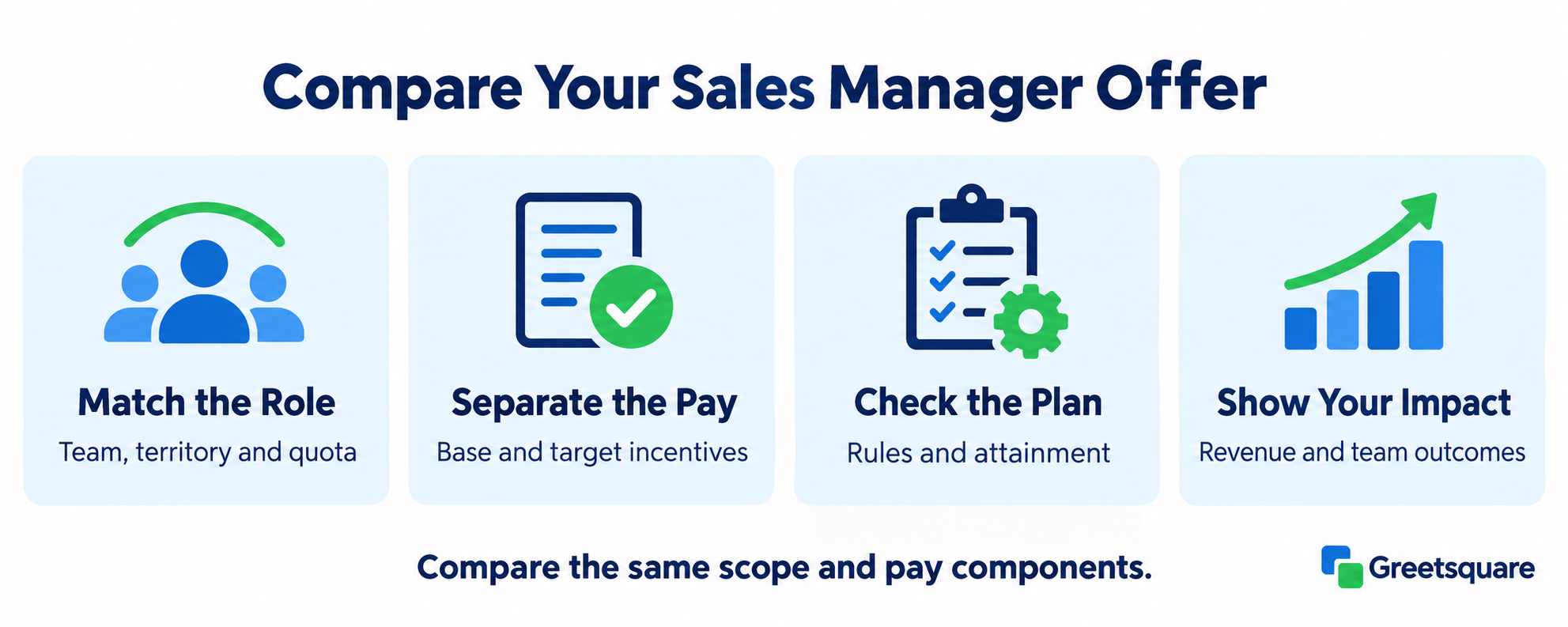
Before accepting, compare base, target earnings, attainment evidence, territory and support on one page. You can present a concise sales leadership example through Greetsquare’s jobseeker and video resume tools. Explain how you helped the team produce a repeatable result, while protecting confidential customer and commercial information.
Frequently Asked Questions
What Is the Average Sales Manager Salary in Singapore?
Michael Page’s current tool reports an average sales manager salary of S$120,000 annually in Singapore, excluding bonuses and benefits. That equals S$10,000 monthly when divided by 12. Treat it as a recruiter benchmark and match the sales model, territory and leadership responsibility before applying it to an individual offer.
What Does OTE Mean in a Sales Manager Offer?
OTE means on-target earnings: base salary plus the incentive payable at the specified performance target. It is not automatically guaranteed cash. Check the quota, payment formula, eligibility and timing. Compare base salary separately, then assess whether the operating plan and attainment evidence make the target incentive credible for the role.
Is Sales Commission Always Paid Proportionally to Quota Attainment?
No. Commission plans can include thresholds, caps, accelerators and different payment triggers. Achieving half the quota does not necessarily produce half the target incentive. Ask for the written formula and worked examples at several attainment levels, including how cancellations, collections and shared account credit affect the final payment.
How Can I Negotiate a Sales Manager Salary?
Use relevant salary evidence and examples of revenue or team outcomes at a comparable scope. State the annual base salary you seek, then discuss target incentives separately. Ask about territory, support and historical attainment so that a higher headline OTE does not hide a weaker base or unclear plan.



