
If you are asking, “Why am I not getting responses to my job applications?”, start by checking role fit, application clarity and whether the vacancy is still active. This job search survival guide helps you identify the weakest stage, improve one part of your approach and build a routine you can sustain. Silence alone cannot tell you whether software, timing or another candidate determined the outcome.
Repeated applications with no reply are frustrating because they provide almost no feedback. You do not need to assume every rejection is your fault, but you do need a way to distinguish what you can improve from what you cannot observe.
What Hiring Research Can and Cannot Tell You
In its 2025 Spring Update, the US National Association of Colleges and Employers reported that 11% of responding employers used AI to screen candidate resumes. That finding describes a particular employer sample and hiring period. It does not measure every employer, Singapore hiring, or all uses of applicant tracking systems.
The useful distinction is between an applicant tracking system, which helps manage applications, and a particular automated screening decision. An employer may use an ATS without using AI to decide whom to interview. Treat claims that a universal percentage of resumes is rejected by robots with caution unless the source defines the sample and process.
Research can describe patterns. Your own application records help you decide which part of your search deserves attention next.
Use This Job Search Survival Guide to Locate The Problem
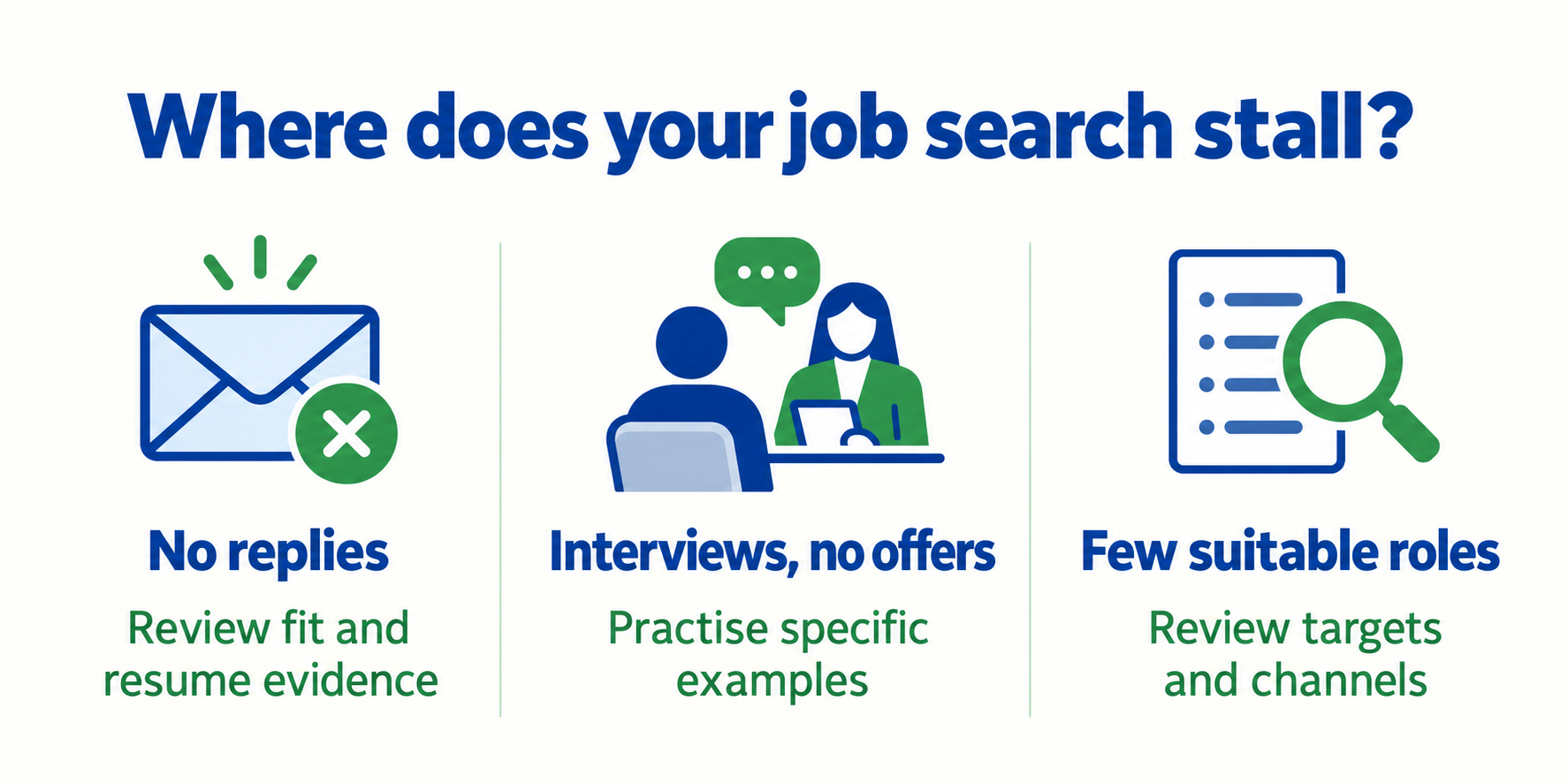
Separate your search into finding suitable vacancies, earning initial conversations, progressing through interviews and evaluating offers. These stages require different fixes. Rewriting your resume repeatedly will not resolve an interview answer that never explains your contribution.
If you find few suitable vacancies, examine your target job titles, location constraints and search channels. Similar work can appear under different titles. Compare responsibilities before deciding that a role is irrelevant or beyond your experience.
If suitable applications rarely produce conversations, inspect eligibility, the top half of your resume and the evidence attached to your strongest claims. If interviews happen but offers do not, practise explaining decisions, outcomes and what you learned. These are working hypotheses, not certain explanations for an individual rejection.
Check Whether Your Target Roles Match Your Evidence
Choose one or two role families for an initial review. Collect several current job descriptions and identify responsibilities that recur. Separate essential conditions from preferences so you neither ignore a genuine requirement nor reject yourself over every desirable skill.
Create a simple requirement-to-evidence comparison. For “prepare weekly reports”, your evidence might be an internship dashboard, a student society budget or a project with recurring updates. Write down exactly what you produced and who used it.
If you have no evidence for a central responsibility, decide whether you can build a small relevant sample, target a more suitable entry level or pursue training. Collecting certificates without practising the underlying work rarely answers the employer’s practical question: can you perform this task?
For a first job, start with the fresh graduate job hunting guide. It explains how to build evidence from education and projects, then connects you to the next stage of the graduate journey.
Make The Application Easy To Understand
A reviewer should be able to identify your target role and relevant capability without reconstructing your history. Put strong, role-specific evidence near the beginning. Replace unsupported descriptions such as “excellent communicator” with an example of explaining, documenting or coordinating something.
Use the employer’s terminology when it accurately describes your work. If the vacancy asks for SQL and you used SQL, name it alongside the task. Do not add tools you cannot discuss or paste lists of keywords without context.
Follow the requested file format and inspect the submitted version. Copying text from the file into a plain document can reveal missing or scrambled content, although it cannot reproduce every employer’s software. Check contact details, portfolio access and the accuracy of application-form fields as well.
Replace Guesswork With a Small Application Review
Keep a record of employer, role, submission date, application version and current stage. Save the job description because listings can change or disappear. Distinguish a confirmation email from a recruiter response, and a recruiter conversation from a formal interview.
Consider this hypothetical example: you sent 20 reasonably similar applications and received two initial conversations. That is a 10% conversation rate for that small group, not a market benchmark or a forecast. Applications to unrelated roles should not be combined as though they measure the same strategy.
Review what differed between the applications that progressed and those that did not. You may find stronger role alignment, a clearer project example or a different channel. Test one plausible change in the next group, allowing time for responses before interpreting the result.
Handle Silence Without Letting It Take Over
When an employer provides a timeline, use it. If that timeline passes, a short follow-up can ask whether there is an update and confirm your interest. Where no timeline exists, choose a reasonable interval based on the closing date and stage rather than sending repeated messages each day.
A useful message identifies the role, the date of your application or interview, and one sentence of continued interest. Avoid demands for an explanation or a long repetition of your qualifications. Keep applying elsewhere while you wait.
For a more detailed reset after an extended stall, use the practical guide to a stuck job search. It develops the diagnostic process beyond this overview so you can review targeting, materials and routine together.
Decide Whether Video Adds Useful Evidence
A short introduction can demonstrate how you explain your work when video is accepted and relevant to the role. It should complement the requested application materials. It does not remove eligibility requirements, guarantee attention or prove that an employer will bypass its normal screening process.
Build the introduction around your target work, one relevant example and a clear closing statement. A graduate might explain a project decision; an experienced applicant might describe a responsibility relevant to the vacancy. Keep confidential documents and personal contact details out of the visible background.
Explore Greetsquare’s video resume option if you want an additional way to introduce your skills. Choose the format because it communicates something useful, and keep your written evidence complete enough to stand on its own.
Choose One Improvement For The Next Week
Set a manageable schedule with time for finding roles, tailoring applications, practising answers and reviewing results. Reserve a stopping time so the search does not expand into every evening. A realistic routine is more useful than an ambitious schedule you abandon after two days.
Your next step is to review a recent application against its job description. Identify one missing or unclear piece of evidence, improve it and record the change. That gives your next application a concrete purpose and your next review something meaningful to assess.
Frequently Asked Questions
Why do job applications get no response?
Possible reasons include high application volume, a weak match, an unclear resume, delayed decisions or a vacancy that has changed. Silence does not identify the cause. Check the requirements and submitted materials, then review patterns across comparable applications instead of drawing conclusions from one employer.
How many jobs should I apply for each day?
There is no useful universal quota. Choose a pace that lets you find suitable roles, tailor evidence and prepare for interviews. Track whether applications lead to conversations. If quality drops or you cannot explain why each role fits, reduce volume and improve your selection process.
Does an ATS reject every resume without exact keywords?
No single rule describes every applicant tracking system or employer configuration. Use relevant terms accurately, follow submission instructions and make your experience readable. Do not assume a keyword score predicts selection. Employers can combine application questions, recruiter review and other assessments in different ways.
Can a video resume guarantee an interview?
No. A video can provide additional evidence of communication when the employer accepts it, but selection still depends on the role and hiring process. Keep the required resume and application complete. Use video to explain one relevant example rather than promising that it will overcome every screening barrier.



