

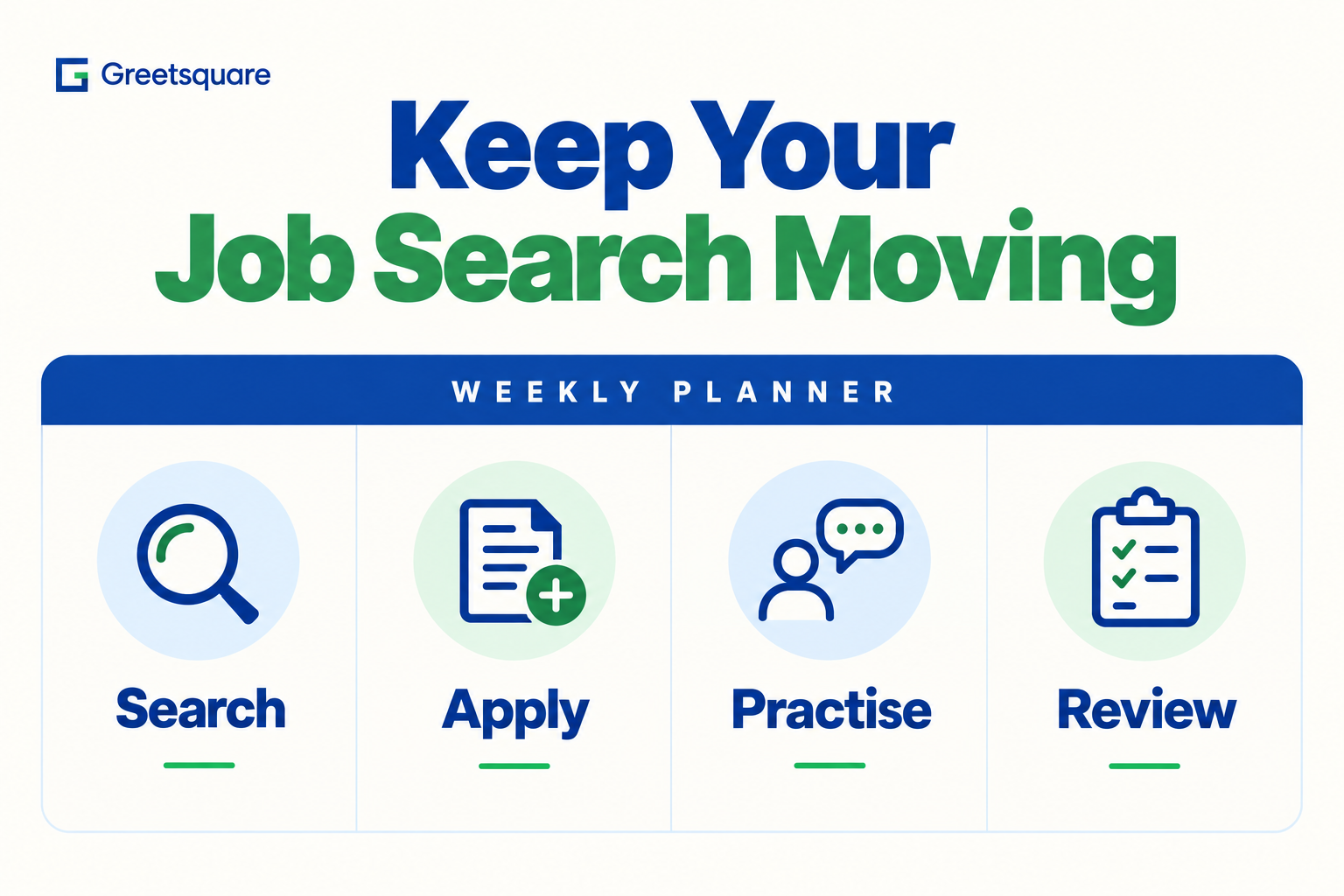
To stay consistent during a long job search, set a realistic weekly routine, choose specific tasks and review progress at defined intervals. Track completed actions alongside employer responses, and reduce the workload when necessary rather than abandoning the process. Consistency means returning to useful work, not maintaining maximum effort every day.
A long search creates uncertainty because effort and results do not arrive on the same schedule. A routine cannot remove that uncertainty, but it can help you decide what to do next without rebuilding your plan every morning.
What Job Search Planning Guidance Emphasises
CareerOneStop, sponsored by the US Department of Labor, organises its job search guidance around planning, finding opportunities, preparing documents and getting ready for interviews. This provides a useful reminder that submitting applications is only one part of the work.
Treat those activities as parts of a practical process rather than separate emergencies. This article’s suggested routine is an adaptable planning example, not a research-tested schedule or a guarantee of faster employment.
Build a Routine to Stay Consistent During Your Job Search
Start with the time you actually have. Work, caring responsibilities, study and other commitments affect what is realistic. A plan based on an imaginary free week is likely to collapse when ordinary life returns.
Choose a few recurring blocks and give each a clear purpose. One might be for identifying suitable roles, another for tailoring, another for contacting people and another for interview practice. Decide when the day’s search work ends.
Leave some space for an unexpected recruiter call or assessment. A schedule packed to its limit can turn a positive development into another source of pressure. Useful structure should make the search easier to manage, not punish you for interruptions.
Separate Actions from Outcomes
You control whether you check a vacancy, tailor evidence and submit a complete application. You do not control when an employer reviews it or how many other suitable candidates apply. Track both categories, but do not confuse them.
An action record might show that you completed two relevant applications and practised one interview answer. An outcome record might show one screening call and several applications still awaiting a response. Both contain information without implying that every unanswered application was poor.
Avoid turning the tracker into a judgement of your worth. Its purpose is to help you notice what is happening and choose the next action. A complicated scoring system can become another task that consumes time without improving decisions.
Define a Minimum Routine for Difficult Weeks
Your fallback routine should be smaller than your normal plan. It might involve reviewing one suitable vacancy, completing one meaningful application step and checking messages at a planned time. Choose actions that maintain continuity without pretending your capacity is unchanged.
This is particularly useful when the search coincides with other demands. Reducing the workload deliberately is different from drifting into several days of anxious browsing with no clear next step. Write down what the smaller plan includes and when you will review it.
Do not carry every unfinished task into the next week automatically. Reassess whether the vacancy is still open and whether the action remains useful. An ever-growing backlog can make even a sensible plan feel impossible.
Use a Weekly Review Instead of Constant Reassessment
Set aside a short review period. Look at suitable vacancies found, applications submitted, conversations arranged and stages reached. Ask what the evidence suggests about your process rather than whether you feel successful that day.
If suitable vacancies are scarce, explore adjacent titles or channels. If good matches produce no conversations, review the application. If interviews repeatedly stall, practise the specific questions that caused difficulty. Use the stuck job search guide to locate the problem.
Choose one improvement for the next week. Changing your target roles, resume, outreach and interview style simultaneously makes it hard to know which change helped. Small, justified adjustments are easier to sustain and evaluate.
Make Progress Visible Without Inventing Wins
Useful progress can include a clearer example, a verified contact, an improved portfolio item or a completed practice conversation. These are not job offers, but they can strengthen the process that leads to one.
Keep the description concrete. “Clarified my contribution to the warehouse project” is more informative than “worked on personal branding.” Specific records help you reuse the result instead of repeating the same preparation next week.
At the same time, avoid filling your schedule with comfortable preparation that never reaches employers. If you spend every week polishing a resume but submit nothing suitable, the routine needs a clearer transition from preparation to action.
Handle Silence and Rejection Differently
Silence gives you little information. A rejection confirms that a particular process did not result in an offer, but it may still provide no explanation. Detailed feedback is more actionable, though it reflects one employer’s needs and perspective.
Record the outcome, decide whether any response is needed and return to your plan. If feedback identifies a concrete weakness, choose a way to address it. Do not rewrite your entire professional history because one vacancy ended unsuccessfully.
For an early-career perspective, the guide to handling graduate job rejection explains how to separate useful feedback from guesses. The same distinction can help applicants at other stages avoid overinterpreting limited information.
Create Boundaries Around Checking Messages
Choose regular times to review email, calls and application portals, while staying responsive to scheduled conversations. Repeatedly refreshing a status page does not change the employer’s timeline and can interrupt work that would improve your next application.
Use notifications selectively if they help you respond to direct contact. Separate genuine recruitment messages from promotional alerts and broad job recommendations. The goal is to notice important information without making every notification feel urgent.
When you finish a search session, record the next small step. “Choose two examples for the analyst application” is easier to resume than “sort out career.” A clear restart point reduces the friction of beginning again.
Use Support for a Specific Purpose
Ask a trusted person for a focused review, such as whether a resume communicates your target role or whether an interview answer explains your contribution. A specific question produces more useful feedback than asking someone to fix your whole search.
Career advisers, professional communities and former colleagues may also help you understand roles or practise conversations. Check the relevance of their experience and avoid treating any one person’s advice as a universal hiring rule.
If the search is affecting your day-to-day wellbeing, it is reasonable to seek appropriate support beyond application advice. You do not need to solve every difficulty by increasing effort or building a more detailed spreadsheet.
Start with a Manageable Week
Write down your available time, two or three useful actions and a review point. Include a smaller fallback plan. Choose one improvement based on actual evidence from your recent search.
At the end of the week, review what happened and adjust. A sustainable search is built from repeated decisions you can carry out, including the decision to rest and return with a clear next step.
Frequently Asked Questions
How Do I Stay Motivated When Employers Do Not Reply?
Use a routine that does not depend entirely on immediate employer responses. Track useful completed actions, review comparable applications and make specific improvements. Keep checking messages at planned times while pursuing other opportunities. Silence provides limited information, so avoid treating it as proof that your effort or ability has no value.
Is It Okay to Take a Break from Job Searching?
Yes, a planned break can fit within a sustainable routine. Consider deadlines and ongoing conversations, then decide when you will return and what the next small task will be. You do not need to maintain the same intensity every day to keep making progress toward suitable work.
What Should I Track During My Search?
Record the role, employer, submission date, document version, confirmed stage and next action. You can also track useful preparation and outreach. Keep the system simple enough to maintain. Separate employer outcomes from actions you control so the record helps you diagnose problems rather than merely count unanswered applications.
When Should I Change My Job Search Strategy?
Change a specific part when repeated evidence suggests a problem, such as unsuitable vacancies, unclear application evidence or difficulty with particular interview questions. Review comparable opportunities and allow for employer timelines. Avoid rebuilding everything after one rejection, and choose one improvement you can assess during the next review period.



