

A sales director leads the sales plan and commercial performance of an assigned business, region or customer segment. A sales director job description commonly includes setting priorities, allocating sales capacity, reviewing forecasts, developing leaders and coordinating major commercial decisions across functions.
This guide focuses on the director’s decisions and hiring requirements. For a broader overview of career options across both functions, use our marketing and sales leadership guide. Here, the emphasis is on demonstrating that you can build a dependable sales organisation within a defined remit.
What Occupational Guidance Can Tell Applicants
The US Bureau of Labor Statistics sales management profile describes a broad occupation that includes planning, budgets and sales team leadership. It does not establish a universal boundary between manager, director and head of sales titles.
Applicants therefore need to read the organisation’s actual expectations. A director managing several country teams has different authority from a director leading one specialist team. Our job roles guide explains why scope and decision rights are more useful than title alone when selecting evidence for an application.
Sales Director Job Description: Core Responsibilities
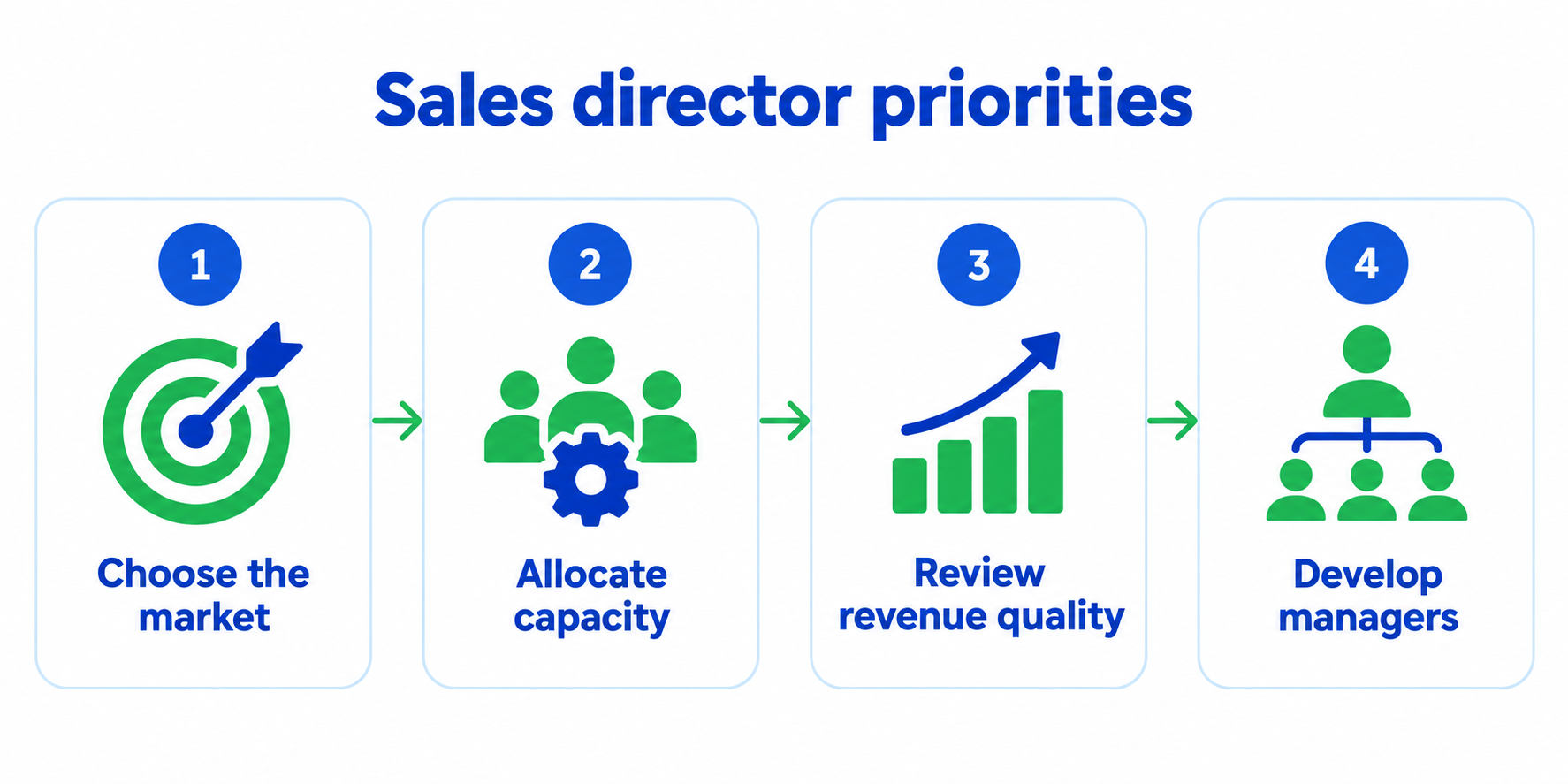
Decide Where Sales Effort Should Be Concentrated
The director evaluates customer segments, routes to market and the organisation’s ability to serve them. Attractive market size is only one consideration. The plan also needs a credible customer problem, a suitable offer, delivery capacity and a way to reach the relevant buyers.
Within the authority granted, the director recommends where to expand, maintain coverage or reduce effort. A useful plan states what the team will prioritise and what it will stop doing. Without those choices, a growth strategy can become a long list of initiatives competing for the same people.
Allocate Capacity and Establish Realistic Targets
Resource decisions include headcount, territories, specialist support and account coverage. The director considers ramp-up time, sales cycle length and differences between markets. Adding representatives does not create immediate revenue when hiring, training and opportunity development take time.
Targets should connect to explicit assumptions. If the plan depends on a new product or partner channel, the director should explain the evidence, timing and fallback options. Finance and delivery teams need enough visibility to challenge the assumptions before they become commitments.
Review Revenue Quality and Forecast Risk
Revenue reviews should look beyond whether the quarter finished above target. Relevant questions include how concentrated the customer base is, whether discounts are increasing, whether customers can be served profitably and whether growth depends on unusually large one-off deals.
A credible forecast makes uncertainty visible. Directors compare current expectations with previous assumptions, investigate material changes and distinguish committed business from less certain opportunities. They also challenge incentives or reporting habits that encourage teams to hide risk until the final weeks of a period.
Develop Managers and Operating Discipline
Directors improve performance partly through the managers who lead day-to-day execution. They set expectations for coaching, reviews and escalation while allowing managers room to make decisions. Repeatedly bypassing a manager to direct representatives can weaken accountability and create conflicting instructions.
Leadership development should include succession and capability gaps. A team dependent on one exceptional seller or one indispensable manager is vulnerable. The director identifies which skills need to be distributed and supports a plan for developing them across the organisation.
Coordinate Major Customers and Internal Commitments
Directors may support strategic customer relationships and complex negotiations. Their involvement should have a clear purpose, such as aligning executive expectations or resolving a commercial issue beyond the team’s authority. Senior attendance alone does not make a customer meeting valuable.
Major deals also require coordination with legal, finance, product and delivery owners. The director should understand the operational consequences of promises made during negotiation. A contract that generates bookings but creates unsustainable delivery obligations can damage the wider business.
Skills and Experience Employers Look For
Commercial Judgement and Analytical Depth
Relevant skills include sales planning, customer economics, forecasting and understanding how different channels perform. The director should be able to compare investment choices using transparent assumptions. A recommendation becomes stronger when it explains both the potential benefit and what could make it fail.
Experience in a particular industry may matter when buyers, products or sales cycles are complex. However, candidates should distinguish transferable judgement from familiarity with one employer’s process. Explain how you learned a new market or adapted a plan when the original assumptions no longer held.
Leadership and Cross-Functional Influence
The role requires clear communication with executives, managers and partner functions. Directors need to handle disagreement about priorities without reducing every discussion to a sales target. Strong influence includes understanding why another team is concerned and revising a proposal when that concern is justified.
Qualification requirements vary, and there is no single experience threshold that guarantees readiness. Employers may request a degree, substantial commercial experience and evidence of leading managers. Show the scale you actually owned, including team structure, geography and budget authority, rather than relying on an impressive title.
Reporting Lines and Differences From Nearby Roles
A sales director may report to a head of sales, chief revenue officer, managing director or CEO. In some smaller organisations, the director is the most senior sales leader. Ask who owns pricing, hiring, budgets and the final commercial plan to understand the actual mandate.
Sales managers typically focus more closely on team execution and coaching. Heads of sales may own the entire sales function, but title conventions differ. Our existing leadership guide provides the broader hierarchy, while this article helps you evaluate the specific director responsibilities in a vacancy.
Compensation should be compared using the same scope. See the sales director salary guide for Singapore context, including the distinction between base pay and variable rewards. A regional remit and a single-team position should not be treated as equivalent simply because both use director titles.
An Example of Director-Level Decision-Making
Consider a fictional company choosing between hiring more sellers in an established segment and entering a new market. The director compares expected demand, sales cycle, delivery requirements and the time needed to build capability. A large opportunity estimate is insufficient without a feasible route to customers.
A staged pilot might test buyer interest and delivery readiness before a larger commitment. The director would agree decision points and evidence that would justify expanding, changing or stopping the investment. This demonstrates resource judgement rather than treating every growth initiative as something that must continue.
How to Demonstrate Readiness in an Application
Prepare examples of a market choice, a resource decision and development of a sales leader. Explain the original assumptions, alternatives considered and outcome. Separate your contribution from broader market growth or improvements delivered by other functions.
Use the interview question guide to practise discussing a missed target or a decision you reversed. For a short introduction, follow the video resume guide and explain one commercial trade-off clearly, without disclosing confidential customer or financial information.
Build a Focused Director Application
Identify the mandate behind the vacancy and match it to evidence at the appropriate scale. Use Greetsquare for jobseekers to introduce your leadership approach, then support it with a CV showing the decisions, teams and outcomes you genuinely owned.
Frequently Asked Questions
Is a Sales Director Higher Than a Sales Manager?
Usually, a sales director has a broader remit and may lead several managers, regions or customer segments. Titles are not standardised, however. Confirm the reporting line, budget authority, team structure and commercial decisions owned by the position before comparing its seniority with another employer’s sales manager role.
What Is the Difference Between a Sales Director and Head of Sales?
A head of sales often owns the whole sales function, while a sales director may lead a region or business unit. Some employers use the titles differently or interchangeably. The most useful distinction is the actual mandate, including who sets strategy and approves resources across the organisation.
What Experience Demonstrates Readiness for a Sales Director Role?
Relevant evidence includes allocating resources, leading managers, improving forecast discipline and making commercial choices across teams or markets. Explain the scale and your authority accurately. Strong personal sales results can support the application, but they do not alone demonstrate the ability to build and lead a wider sales organisation.
What Should a Sales Director Discuss in a Video Introduction?
Choose one example showing commercial judgement, such as prioritising a market or developing a management team. Explain the problem, decision and outcome concisely. Keep customer names, contract terms and confidential financial information out of the recording, and connect the example directly to the vacancy’s stated responsibilities.



