

Job roles describe the work a person owns, the decisions they can make and the results they are expected to deliver. Hiring differs by role because employers need different evidence: a finance manager must explain financial judgement, while a project manager must show how they coordinate delivery. Start with those responsibilities before deciding which achievements belong in your application.
Two vacancies with the same title can involve very different jobs. One manager may supervise a team and control a budget; another may be an individual specialist. Reading the title alone can lead you to prepare for the wrong interview.
What Research Says About Changing Skill Requirements
The World Economic Forum’s Future of Jobs Report 2025 draws on more than 1,000 employers across 55 economies. It reports that employers expect 39% of workers’ existing skills to change or become outdated between 2025 and 2030. That is a surveyed expectation, not a prediction that 39% of any individual’s job will disappear.
For applicants, the useful lesson is to connect past experience with the employer’s current problem. A familiar title does not establish that yesterday’s tools, priorities or responsibilities are the best match for today’s vacancy. Read the current description and ask what has changed.
Compare Job Roles by Outcome, Scope and Authority
Use three questions to make an unfamiliar vacancy concrete. What must this person deliver? What resources or processes will they control? Which decisions require someone else’s approval? Answers reveal more than a list of adjectives such as proactive, strategic or dynamic.
For example, “manage budgets” might mean collecting departmental estimates, recommending spending limits or approving expenditure. These are different responsibilities. Ask which applies, then choose an example that demonstrates the same level of ownership.
Also distinguish the role’s purpose from its recurring tasks. Preparing a report is a task; helping leaders decide where to spend is an outcome. A strong application explains both what you produced and how someone used it, without claiming sole credit for a shared result.
Understand the Main Role Families
Executive Leadership and Business Direction
Executive roles bring several functions together. The CEO role centres on overall business direction, while the CFO role focuses on financial leadership. A CMO connects market understanding with growth, and a COO concentrates on how the business operates.
A managing director may lead a whole business or a defined entity; a country manager leads activity within a market. Compare managing director and CEO authority and country manager scope before assuming a universal hierarchy. Ownership structures and reporting arrangements matter.
Functional Leadership
Sales directors, marketing directors, HR directors and IT directors translate business priorities into plans for a function. Their applications should show how they chose priorities, developed capability and handled competing demands. Team size alone does not establish the complexity of the work.
An HR director addressing retention across several business units faces a different challenge from a leader building a first HR team. A marketing director managing established channels faces different constraints from someone entering a new market. Describe the starting situation so the reader can judge the achievement fairly.
Management, Coordination and Specialist Delivery
The finance manager job description combines dependable financial processes with decision support. Accountants produce and examine financial information, while finance managers may coordinate its interpretation and use. Marketing managers and sales managers own different parts of customer acquisition and revenue delivery.
HR managers organise people processes; operations managers maintain and improve ongoing delivery; supply chain managers coordinate the flow of materials, information and goods. Business analysts clarify needs and processes, and data analysts examine evidence to answer business questions. Similar analytical tools do not make these roles interchangeable.
Software engineers build and maintain software, while product managers help determine which problems a product should solve. The project manager role coordinates a defined change or delivery effort. A project manager’s time-bound assignment differs from an operations manager’s continuing responsibility for a service or process.
How Seniority Changes the Evidence Employers Need
At an early career level, useful evidence may come from supervised work, projects or internships. Explain what you personally completed, the guidance available and how you checked the result. An honest small example is more credible than an inflated leadership claim.
For an experienced specialist, show independent judgement and depth. Describe an ambiguous problem, the options considered and the reason for your choice. For a people manager, add how you allocated work, supported others and addressed performance or capability gaps.
At director and executive levels, explain choices across functions and time horizons. Who benefited, what was deprioritised and which risks remained? Seniority is visible in the reach and consequences of a decision, not merely in the number of people attending a meeting.
Build an Application Around Evidence the Role Can Use
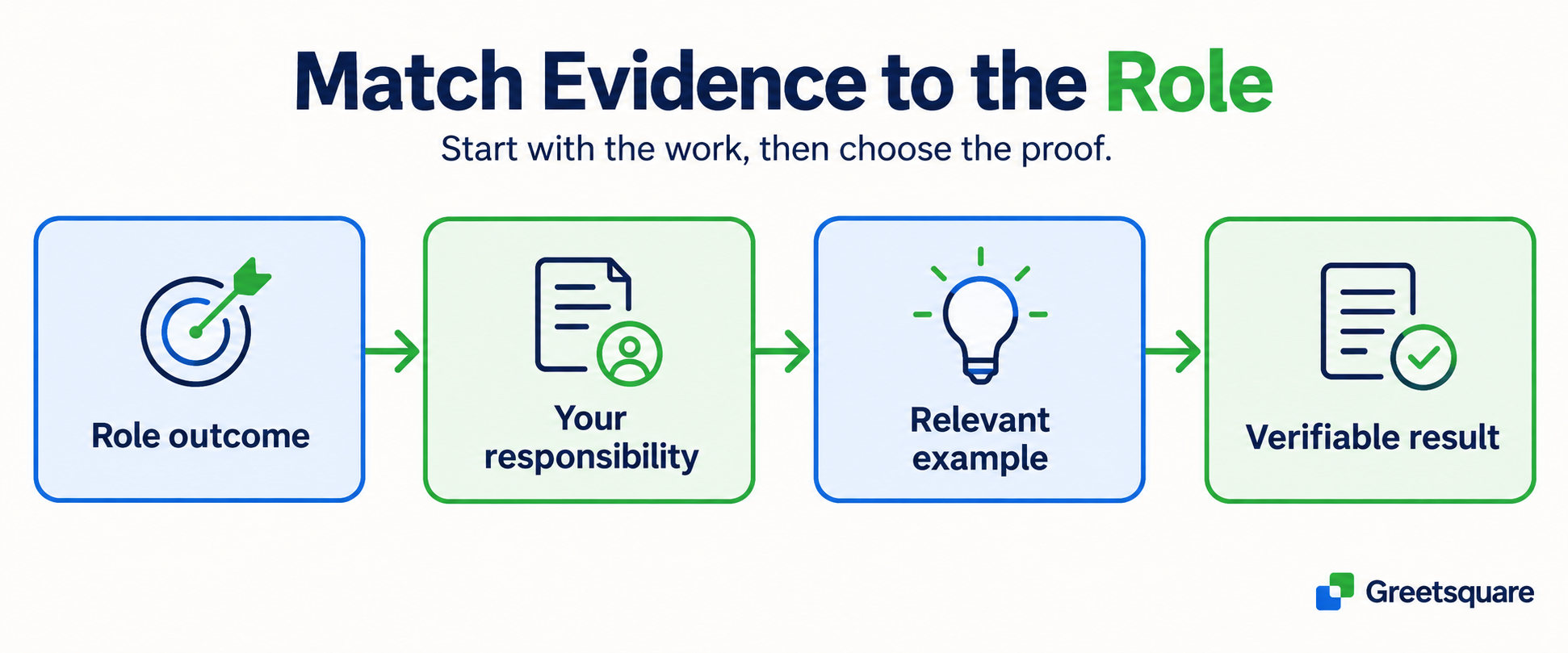
Take three important requirements from the vacancy and pair each with one truthful example. For every example, record the situation, your responsibility, your action and the result. Add scale or timing where you can substantiate it, and make the boundaries of your contribution clear.
Consider this fictional comparison. “Excellent stakeholder management” tells the reader little. “Agreed a revised launch sequence with sales and operations after identifying a supplier delay” shows a situation and a decision. A stronger version would explain the trade-off and the verified outcome, if those details are available.
Choose supporting material that fits the work. A sanitised forecast explanation may suit finance; a dependency map may suit project management; a code sample may suit engineering. Never disclose an employer’s confidential data to make an example look impressive. Use a labelled hypothetical demonstration when permission is unavailable.
When Does a Video Application Add Value?
Video can help you explain a decision, introduce your background or demonstrate clear communication. It may be useful for customer-facing, leadership and collaborative roles when the employer accepts the format. It does not prove technical competence on its own, and production quality should not substitute for relevant evidence.
Our video resume guide explains the format in more detail. Keep your introduction focused on one employer need and one example. Follow the vacancy’s instructions, supply required written materials and avoid adding a video where the employer requests a different process.
If a video introduction fits the application, explore Greetsquare’s video-profile features for job seekers. Show how you think and communicate rather than reading your whole resume aloud. A recording is an additional introduction, not a guarantee of an interview.
Choose Your Next Application Deliberately
Before applying, summarise the role’s outcome, scope and authority in your own words. Identify the strongest relevant example you can support, then note any requirement you need to clarify. This gives you a more useful starting point than sending the same application to every vacancy with a familiar title.
Frequently Asked Questions
What Is the Difference Between a Job Role and a Job Title?
A job title is the label attached to a position. A job role describes its responsibilities, decisions and expected results. Titles are not standardised across employers, so compare the actual scope, reporting line and requirements before assuming two similarly named vacancies offer equivalent work or seniority.
Can the Same Job Title Mean Different Seniority Levels?
Yes. A manager title may describe a people leader, a specialist or someone coordinating a process. Compare decision authority, business impact, team responsibilities and the complexity of the work. Years of experience can provide context, but they do not establish the scope of a particular vacancy.
How Should I Choose Which Skills to Highlight?
Start with the vacancy’s essential responsibilities and select skills that directly support them. Pair each important skill with a truthful example of using it. Include technical knowledge and relevant communication or collaboration, then explain the result rather than presenting a long list of unsupported personal qualities.
Should Every Job Application Include a Video Resume?
No. Follow the employer’s submission instructions and complete all required documents first. A short video can add context when the employer welcomes it and communication is relevant to the role. It should support your evidence, respect confidentiality and remain consistent with your written application and experience.



