
How should you handle a job offer or multiple offers? Confirm the written details, compare each role against your priorities, clarify uncertainties and communicate your decision before the agreed deadline. When handling multiple job offers, use the same criteria for every option. A higher headline salary is useful information, but it does not explain the whole job.
What Singapore Employment Guidance Helps You Check
MOM’s key employment terms guidance identifies items including main duties, start date, working arrangements, basic salary, allowances, other salary components, leave, probation and notice period. These provide practical categories for reviewing the information you receive. Check the guidance for its applicability rather than assuming every document or arrangement has identical requirements.
The comparison framework below helps organise your decision. It does not determine the legal effect of a particular offer or acceptance. If an obligation is unclear, obtain an explanation and appropriate advice before relying on an assumption. Understanding the arrangement matters more than replying quickly to appear enthusiastic.
Start by Confirming What Has Actually Been Offered
Thank the employer and ask for the written offer if you have only discussed it verbally. Check the employing organisation, job title, reporting line, responsibilities, start date and response deadline. Identify conditions that remain outstanding, such as verification checks or another approval. Keep a record of questions and the employer’s answers.
Distinguish an offer from a positive interview conversation. An interviewer saying that you would fit the team is not enough information to compare pay or plan a resignation. The interview and application process guide explains how offers fit into the wider hiring stages. Continue using the employer’s stated process until the next step is confirmed.
Set Your Decision Criteria Before Comparing Numbers
List what you need, what you prefer and what would be difficult to accept. Examples include the main work, supervision, location, working hours, guaranteed income and opportunities to develop relevant skills. Your criteria should reflect your circumstances. You do not need to share your private financial or family details to ask a clear question about a term.
Give the most important criteria more attention, but avoid treating a score as a substitute for judgement. A serious mismatch in one essential condition can outweigh several minor benefits. If the role is different from what you expected, revisit the responsibilities before deciding whether a better package solves the problem.
| Criterion | What to Compare | Question to Resolve |
|---|---|---|
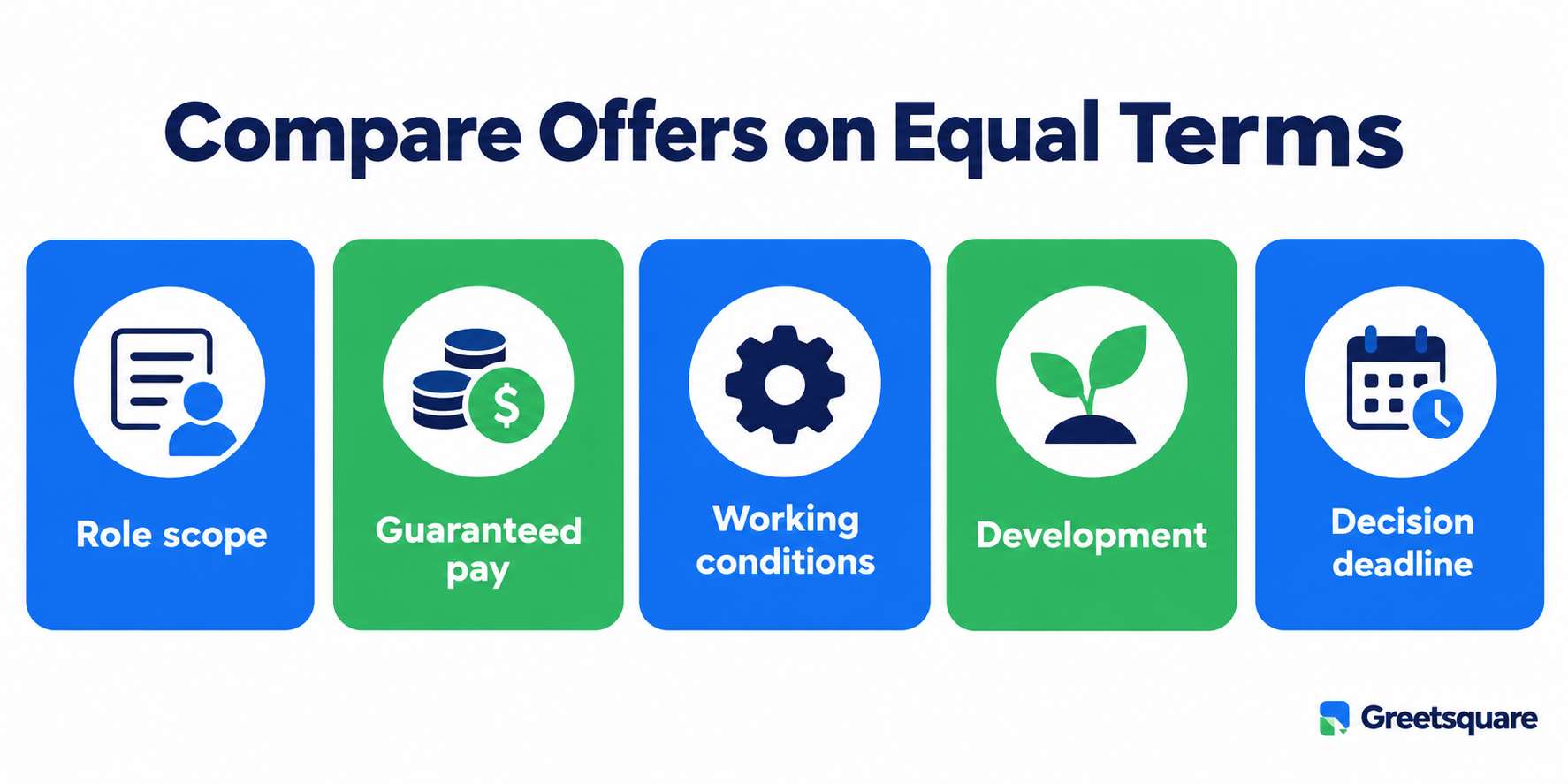
| Role scope | Actual duties, authority and reporting line | What will I own, support or approve? |
| Pay | Guaranteed amounts and variable components separately | Which payments are conditional? |
| Working conditions | Hours, location, travel and working arrangements | What is agreed rather than assumed? |
| Development | Supervision, responsibilities and learning support | How will progress be reviewed? |
| Timing | Decision deadline, conditions and start date | What must happen before the start? |
Compare Compensation on the Same Basis
Write guaranteed basic pay and fixed allowances separately from bonus targets, commissions and other conditional rewards. Use consistent periods when comparing figures. A monthly amount and an annual package cannot be compared directly without understanding which components are included. Avoid adding a possible maximum bonus as though it were certain income.
Hypothetical example: one offer may state higher fixed pay, while another describes a lower fixed amount plus a performance-related reward. The second package may or may not produce more income. Ask about the basis, eligibility and timing of the variable component, then compare confirmed information and uncertainty separately.
For market context, consult the Singapore salary guide and relevant role benchmarks. Check responsibilities and data definitions before using a figure. A broad benchmark can inform a question, but it does not establish what a particular employer must offer or what you should value most.
Look Closely at the Work Behind the Offer
A familiar title can hide a different job. Ask about the first responsibilities, team structure, available support and how performance will be assessed. Check whether the authority matches the expected outcomes. Responsibility for a result is harder to evaluate when the resources or decision rights remain unclear.
Consider development in concrete terms. “Good progression” is less informative than an explanation of feedback, responsibilities and review practices. Ask what learning support means in practice and which approvals apply. Do not assume that an attractive future possibility is a commitment to promotion, a particular course or a salary increase.
Manage Different Decision Deadlines Honestly
Record the deadline for each genuine offer. If you need more time, ask for a specific extension and explain the relevant timing briefly. The employer may agree or decline. Do not assume that silence creates an extension, and avoid inventing a competing offer to create pressure.
Example template: “Thank you for the offer. I appreciate the opportunity and would like to review the details carefully. Would it be possible to confirm my decision by [date]? Please let me know whether that timing works for your process.” Replace the date with a request you can honour.
If another employer is still interviewing you, distinguish that process from an offer. You can ask about its expected timeline without suggesting it has promised you a position. Avoid making an immediate commitment solely to keep an option open while assuming you can reverse it without consequences.
Clarify or Negotiate Before Deciding
Identify the uncertainty or term that most affects your decision. Ask a focused question or make a request the employer can evaluate. If a change is agreed, request written confirmation and review the updated details. A useful discussion can improve clarity even when the employer does not change the package.
The job offer negotiation guide covers preparing a request and discussing alternatives. This article concentrates on comparing and deciding between offers. Keep the two tasks separate: negotiation may change an option, but you still need to decide whether the confirmed arrangement fits your priorities.
Accept or Decline Clearly
Before accepting, check the final documents, unresolved conditions and next steps. Make your response unambiguous through the requested channel. If something you agreed verbally is missing, resolve it before making plans that depend on it. Keep copies of the relevant correspondence for your own records.
Decline template: “Thank you for offering me the [role] position and for your time during the process. After reviewing the opportunity, I have decided to decline. I appreciate your consideration and wish the team well.” You do not need to provide a detailed comparison with another employer or criticise the offer.
Make a Decision You Can Explain
Summarise the strongest reason to accept each option, its main drawback and any unresolved information. Return to your essential criteria and choose using confirmed terms. If you continue searching, you can explore Greetsquare’s job-seeker platform while keeping your applications and recorded introductions accurate. No comparison method can remove all uncertainty, but a clear record makes the trade-offs easier to understand.
Frequently Asked Questions
Should I Choose the Offer with the Highest Salary?
Compare the whole arrangement against your priorities. Separate guaranteed pay from conditional rewards, then consider responsibilities, working conditions and development. A higher figure may be valuable, but it does not resolve an unsuitable role or unclear expectations. Ask for missing information before treating the headline amount as the deciding factor.
Can I Ask for More Time to Decide?
Yes, you can request a specific extension before the stated deadline. Explain the timing briefly and ask whether the employer can accommodate it. An extension is a request, not an automatic entitlement. Confirm the agreed date and communicate promptly if your circumstances change rather than assuming the offer remains open.
Should I Tell an Employer About Another Offer?
You may explain a genuine competing deadline when it affects your decision. Keep the information accurate and share only what is needed. An ongoing interview is different from an offer. Do not invent leverage or disclose another employer’s confidential documents, and ask clearly what timing or flexibility you are seeking.
How Do I Decline a Job Offer Professionally?
Thank the employer, state your decision clearly and respond through the agreed channel before the deadline where possible. A short explanation is optional; an extensive comparison is usually unnecessary. If you have already made a commitment, understand any obligations before assuming that a simple decline message resolves the situation completely.



