

Data analyst salary in Singapore depends on experience, sector and the complexity of the work. Morgan McKinley’s 2026 technology guide places its 5–10-year Data Analyst band at S$60,000–S$90,000 annually, while more experienced bands run higher. Use these scoped benchmarks alongside relevant vacancies and the complete offer, rather than treating one figure as the salary for every analyst.
What Current Data Analyst Salary Research Covers
Morgan McKinley’s 2026 permanent technology salary guide lists these Singapore Data Analyst annual rates for IT Product & Engineering in both Technology, Telecommunications and Fintech, and Banking & Financial Services. The monthly column below is annual pay divided by twelve, not a stated take-home figure.
| Experience band in the source | Annual rate | Monthly equivalent |
|---|---|---|
| 5–10 years | S$60,000–S$90,000 | S$5,000–S$7,500 |
| 10–15 years | S$90,000–S$170,000 | About S$7,500–S$14,167 |
| 15+ years | S$140,000–S$240,000+ | About S$11,667–S$20,000+ |
These are recruiter benchmarks for the named sectors, checked on 7 October 2026. The source does not provide an under-five-year band in this table. Do not label the first row entry-level, assume every industry pays these rates, or infer that experience alone guarantees movement between bands. Confirm what an employer includes in its quoted annual figure.
For another market signal, Michael Page’s current Data Analyst vacancies include an Energy Group role advertised at S$60,000–S$96,000 annually. That is one vacancy range, not a national average or a confirmed offer. Vacancies change, so recheck availability and responsibilities before using the example in a negotiation.
Match the Role Before Comparing the Number
The title can describe very different work. One analyst refreshes recurring reports and investigates unusual results. Another designs experiments, joins several operational datasets and advises product teams. A third supports regulated reporting with strict controls. The tools may overlap while the judgement, accountability and business context differ.
Read the Data Analyst job description to clarify the underlying responsibilities, then compare the vacancy against your actual experience. Ask which decisions the analysis supports, who uses the output and how much independence the role requires. A list of software names is a poor substitute for understanding the assignment.
Distinguish Analysis from Adjacent Responsibilities
Dashboard development, data engineering and data science are related capabilities, but they do not automatically share the same salary benchmark. If the vacancy includes pipeline ownership, production model deployment or extensive platform administration, identify how much of the role involves those tasks. Check the corresponding role market rather than silently substituting its pay range.
Also ask whether the analyst owns metric definitions or only implements agreed specifications. Resolving contradictory definitions across departments may demand stakeholder management that routine reporting does not. Evidence of that responsibility helps explain why two apparently similar analyst positions can have different budgets.
How Experience and Industry Affect Your Comparison
Years of experience help organise a benchmark; relevant scope makes the comparison useful. Experience in financial reporting, customer analytics or supply-chain planning can transfer, but the employer may still need familiarity with its systems, terminology and decision cycles. Discuss the learning required without dismissing the skills you already bring.
Early-Career Analysts
For an early-career application, compare live roles that explicitly accept your experience level. Check whether internships, coursework or portfolio projects satisfy the stated requirements. Keep a record of dates, annual or monthly basis and whether the role is permanent or contractual. This article’s experienced recruiter bands should not become a promised starting salary.
Experienced and Senior Analysts
For an experienced role, show how your analysis improved the quality or speed of a decision. Explain the question, data checks, method, limitation and resulting action. Senior scope may include setting standards, reviewing colleagues’ work or advising several teams. Clarify those responsibilities before comparing an individual contributor with a lead position.
Separate Base Pay, Bonus and Contract Terms
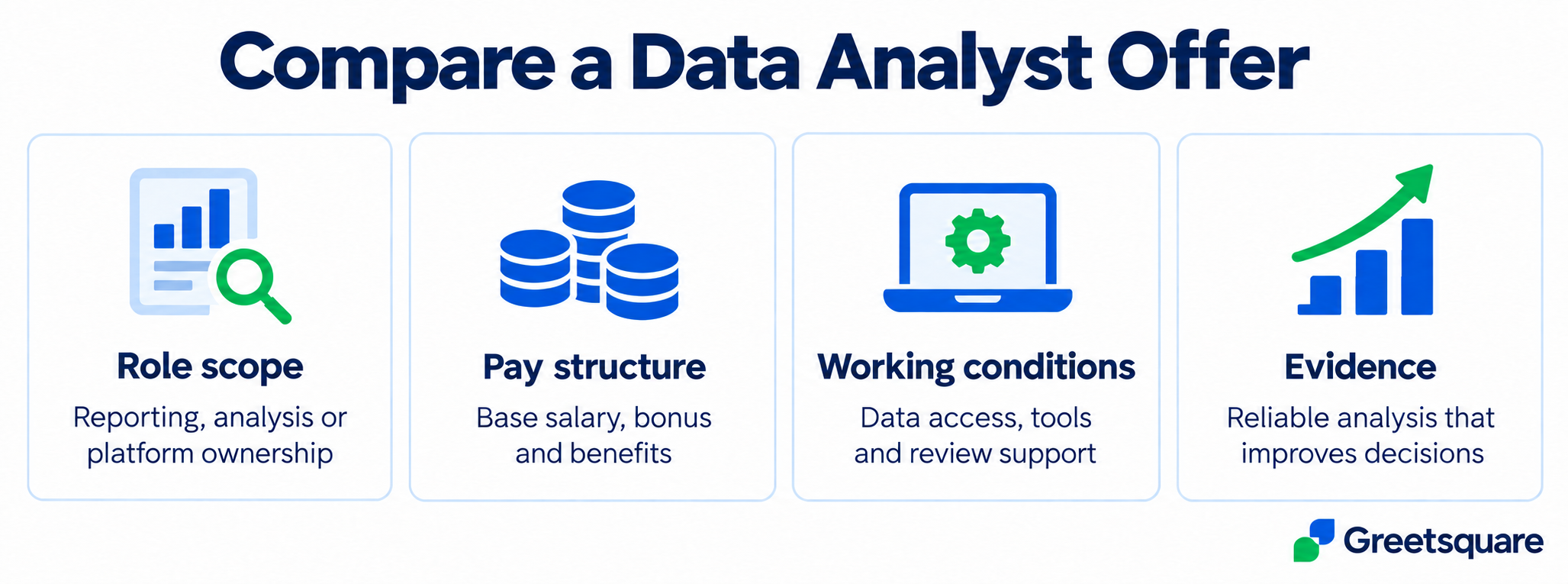
Compare guaranteed cash first. Confirm the monthly basic salary, number of contractual payments and whether any additional annual payment is guaranteed. A discretionary bonus belongs in a separate column. Ask how performance is assessed, when payment occurs and whether joining part-way through the year affects eligibility.
For a contract role, check duration, renewal conditions, paid leave, benefits and the employing entity. Do not compare a daily rate with a permanent monthly salary without accounting for the number of paid days and the different terms. Equity, allowances and reimbursements also need separate treatment because they are not interchangeable with basic pay.
Here is a hypothetical comparison: one offer provides higher fixed cash but a short contract; another offers lower basic pay with permanent employment and funded training. Neither is automatically better. Compare predictable income, learning, stability and your own priorities before deciding how much value to assign to each component.
Check the Conditions Behind the Analytics Work
A salary offer also buys your time and professional judgement. Ask how you will obtain data, who maintains pipelines and whether analysts have access to suitable tools. Clarify the review process for sensitive analysis and whether operational teams can act on recommendations. These questions reveal whether the stated expectations are achievable.
Ask about reporting deadlines and support during urgent requests. An analyst supporting several regions may have different meeting hours from someone working with one local team. Understand how competing requests are prioritised and who resolves conflicting requirements. A higher salary may come with broader responsibility, but that responsibility should be clear before you accept.
Questions to Ask the Hiring Manager
Start with the first assignment: what would a useful result look like, and what data already exists? Then ask which metrics are trusted, where quality problems occur and how your work will be reviewed. Finally, clarify whether success means accurate delivery, adoption by users, improved decisions or a combination of these outcomes.
Negotiate with Evidence of Relevant Contribution
Choose a salary discussion range grounded in comparable responsibilities and current vacancies. Explain where your experience meets the role’s needs. A documented example of improving reporting reliability or explaining an uncertain result is stronger than a general claim that you are proficient in every analytics tool.
Use the salary negotiation guide to prepare the conversation. Ask whether the employer can adjust fixed pay, review timing, training support or responsibilities if its immediate budget is limited. Request the agreed terms in writing and evaluate the complete package rather than focusing only on the headline number.
For a wider industry comparison, use Greetsquare’s Singapore salary guide by industry. Keep your written CV precise about methods, tools and outcomes. If a video introduction is appropriate for the application, explore Greetsquare’s job-seeker platform to explain one relevant analytical contribution without exposing confidential data.
Frequently Asked Questions
What Is a Typical Data Analyst Salary in Singapore?
There is no single figure that describes every analyst role. Morgan McKinley’s 2026 guide lists S$60,000–S$90,000 annually for its 5–10-year Data Analyst band in the specified technology and banking sectors. Compare the experience band, responsibilities and package before treating it as relevant to you.
Can Fresh Graduates Use These Experience Bands?
Fresh graduates should not treat an experienced recruiter band as a starting salary promise. Look for current vacancies that explicitly accept graduates or limited experience. Compare the work, training, contract type and pay basis, then use your projects and internships to demonstrate readiness for that particular role.
Does Knowing Python Automatically Increase Pay?
Knowing Python can support a role that uses it, but one tool does not establish a salary premium. Employers also need reliable analysis, suitable methods and clear explanations. Show how you used the tool to solve a relevant problem and how you checked the result before discussing compensation.
Should I Compare Monthly Salary or Annual Pay?
Use both, with a clear definition for each. Compare guaranteed monthly basic pay first, then calculate contractual annual cash. Keep discretionary bonuses, equity and benefits separate. Confirm the number of payments and eligibility conditions so two offers are compared on the same basis rather than similar-looking totals.



