

A finance manager job description usually covers financial reporting, budgeting, forecasting and support for business decisions. Depending on the organisation, the role may also include cash-flow monitoring, controls and supervision of finance staff. The essential combination is accurate information, thoughtful analysis and the ability to explain what the numbers mean for action.
The title does not tell you how much accounting, planning or business partnering the job contains. A small company may combine these activities in one position, while a larger group may divide them among specialist teams. Your application should address the actual mix of work.
What Occupational Research Shows About the Role
The U.S. Bureau of Labor Statistics profile of financial managers describes work spanning financial reports, planning and advice to senior management. It projects 10% employment growth in this U.S. occupational group from 2025 to 2035. This is U.S. labour-market context, not a Singapore hiring forecast or a promise of demand for a particular vacancy.
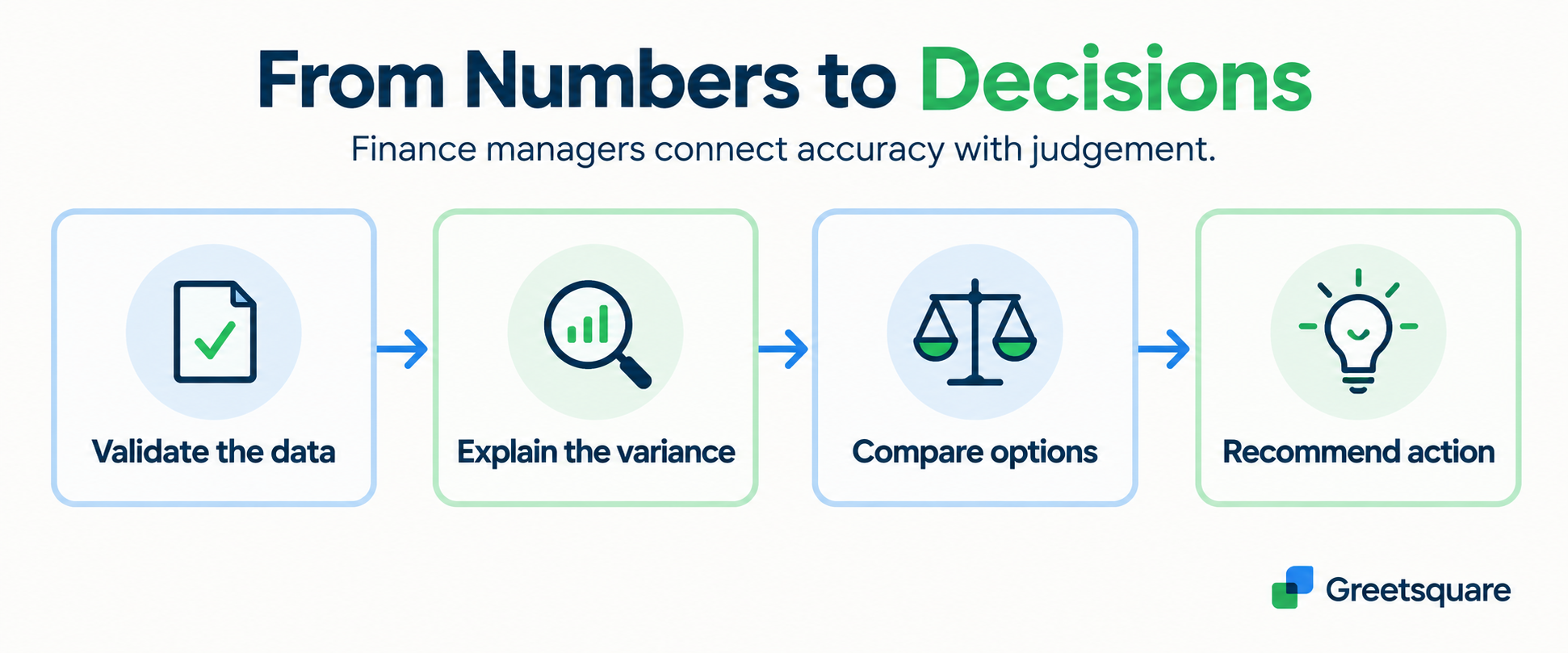
For candidates, the useful distinction is between producing information and helping others use it. Accurate reporting remains essential, but a manager also needs to identify the decision behind a request. A technically correct report can still be unhelpful if its assumptions or practical implications are unclear.
What a Finance Manager Job Description Should Specify
A clear description explains the business units covered, the reporting line and the decisions the manager can make. It should distinguish responsibility for preparing a forecast from authority to approve expenditure. It should also identify whether the position manages people, coordinates shared services or works as an individual contributor.
Look for the immediate priorities. Is the employer trying to improve reporting quality, establish a planning process, support growth or stabilise cash visibility? Those starting conditions change what success looks like. The broader guide to job roles and hiring evidence can help you compare responsibility across functions.
Main Responsibilities and the Decisions Behind Them
Reporting and Financial Close
Reporting work may include coordinating the month-end timetable, reviewing reconciliations and explaining movements in results. Ask whether the manager owns the entire close or reviews information prepared elsewhere. A role involving several entities, currencies or systems can be more complex than its title suggests.
In an interview, explain how you checked an unusual balance or prevented a recurring reporting error. State what you reviewed personally and when you escalated an issue. Do not imply that faster reporting is always better if the change weakens review or documentation.
Budgeting, Forecasting and Business Support
Planning connects assumptions about activity with expected financial outcomes. A useful forecast explains its drivers, such as demand, staffing or delivery capacity, instead of simply extending last month’s figures. The manager should be able to distinguish a change in timing from a lasting change in performance.
For example, consider a fictional department whose costs exceed budget because work was brought forward. The immediate question is whether the full-year cost has changed or only the monthly pattern. A good explanation separates those possibilities before recommending cuts or revising expectations.
Cash Visibility and Controls
Cash responsibilities may involve monitoring collections, payment timing and expected commitments. Clarify whether treasury decisions belong to this role or another team. Profit, cash and available borrowing capacity answer different questions, so avoid treating a positive profit figure as proof that near-term obligations are covered.
Controls make responsibilities and evidence traceable. Examples include appropriate approvals, review of changes and clear ownership of reconciliations. In a hiring conversation, explain how you made a process dependable while preserving useful checks, rather than suggesting that every control is unnecessary administration.
People and Stakeholder Coordination
Where the role leads a team, its responsibilities include setting priorities, reviewing work and developing capability. Where it has no direct reports, coordination still matters. The manager may need timely information from sales, operations or procurement without having authority over those teams.
Describe how you resolved an unclear request or challenged an assumption constructively. “I explained the issue in simple language” is only a starting point. Show what the other person needed to decide and how your explanation helped them understand the available options.
Technical Skills, Qualifications and Experience
Relevant technical knowledge can include accounting fundamentals, financial analysis, forecasting and spreadsheet modelling. Familiarity with the employer’s enterprise resource planning system or reporting tools may help, but tool names alone do not establish competence. Explain what you built, checked or improved using them.
The BLS profile describes a bachelor’s degree and substantial related experience as typical for its U.S. occupational category. Individual employers set their own requirements. Read professional qualification criteria carefully, especially where a vacancy requires a specific designation or experience with particular reporting standards.
Do not assume an MBA or a particular certification is compulsory for every finance manager position. Equally, do not substitute general confidence for a stated technical requirement. Distinguish qualifications you hold, those you are pursuing and experience that demonstrates the requested capability.
How the Role Differs From an Accountant, Controller and CFO
An accountant’s work often centres on preparing, maintaining or examining financial records. A finance manager may coordinate that work and connect it with planning and decisions. In some organisations the boundary is narrow, so compare responsibilities rather than relying on the label.
A controller often has a strong reporting and control remit, while a CFO leads the wider finance function and its contribution to business direction. Reporting structures vary. Ask who owns policy, who reviews the manager’s recommendations and who approves major commitments before assuming the position carries executive authority.
The same caution applies to pay comparisons. Compare positions with similar geography, business complexity and responsibility, and separate base pay from variable compensation. A salary attached to a broader finance director or CFO remit is not automatically a suitable benchmark for a finance manager vacancy.
Show Finance Judgement in Your Application
Prepare three examples: one about accuracy, one about a business decision and one about working with others. For each, explain the original problem, your own responsibility, the alternatives considered and the outcome you can verify. Include limitations when the result depended on other teams or market conditions.
A fictional application example might say: “Separated a timing variance from a recurring cost increase, explained both to the department lead and revised the forecast assumptions.” Add genuine scale and results only when supported by your records. The value lies in your reasoning, not in attaching an impressive percentage to every sentence.
Use our guide to answering difficult interview questions to practise explaining a disagreement, mistake or uncertain forecast. A strong answer acknowledges what was unknown at the time. It does not pretend every decision produced the ideal result.
Use a Video Introduction to Explain One Relevant Example
If the employer welcomes video, introduce the type of finance work you do and explain one decision in plain language. Avoid showing private accounts, client names or internal dashboards. A labelled hypothetical example can demonstrate your approach when real work cannot be shared.
The Greetsquare video resume guide can help you structure an introduction. Explore Greetsquare’s video-profile features when the format fits the application. Keep required written qualifications and experience clear; a video supports them and does not replace technical assessment.
Check the Scope Before You Apply
Identify the role’s first priorities, reporting line and approval boundaries. Then choose evidence that shows you can make financial information dependable and useful. If the description leaves major responsibilities unclear, prepare a focused question for the recruiter before treating the vacancy as a straightforward next step.
Frequently Asked Questions
What Does a Finance Manager Do Each Day?
Daily work depends on the reporting and planning cycle. It may include reviewing results, resolving data issues, discussing forecasts and advising department leaders. During a close or budget period, deadlines become more prominent. Ask the employer which activities dominate the role rather than expecting a fixed daily schedule.
Does a Finance Manager Need to Be an Accountant?
Many finance managers develop through accounting or other finance roles, but requirements vary. Some employers require a recognised accounting qualification, while others emphasise planning, analysis or commercial experience. Check the vacancy’s stated criteria and distinguish your technical training from the practical responsibilities you have already handled independently.
Who Does a Finance Manager Report To?
A finance manager may report to a financial controller, finance director, CFO or business leader. The structure depends on the organisation’s size and how finance is organised. Confirm who sets priorities, reviews reporting and approves recommendations, especially where the role supports several departments or has a regional remit.
How Can I Stand Out in a Finance Manager Interview?
Explain how you turned financial information into a useful decision. Show your checks, assumptions, alternatives and personal contribution, then state the outcome accurately. Prepare examples involving stakeholders and difficult trade-offs as well as technical work. Clear judgement is more persuasive than unsupported claims about being strategic or detail-oriented.



