
Graduate interview questions commonly explore why you want the role, what you can contribute and how you respond to problems, teamwork and feedback. Answer with relevant examples from study, projects, volunteering or employment. You do not need a long professional history to explain a thoughtful decision and what you learned from it.
Preparation works best when it makes you more responsive. Build a small set of true examples, then practise selecting the right one for the question you actually hear.
What University Guidance Recommends
The NUS interview preparation guide covers different interview formats, research, answer frameworks and practice. This is practical university guidance, not a study proving a particular answer will secure an offer.
Its relevance is that interviews involve more than rehearsing common questions. You also need to understand the role, confirm the format and prepare to ask useful questions yourself. Treat the conversation as a chance for both sides to assess the match.
Build Examples Before Practising Graduate Interview Questions
Select examples covering a problem, a team task, feedback, an unfamiliar responsibility and a result you are proud of. Record the context and your contribution in short notes. Avoid writing full scripts before you understand the core facts.
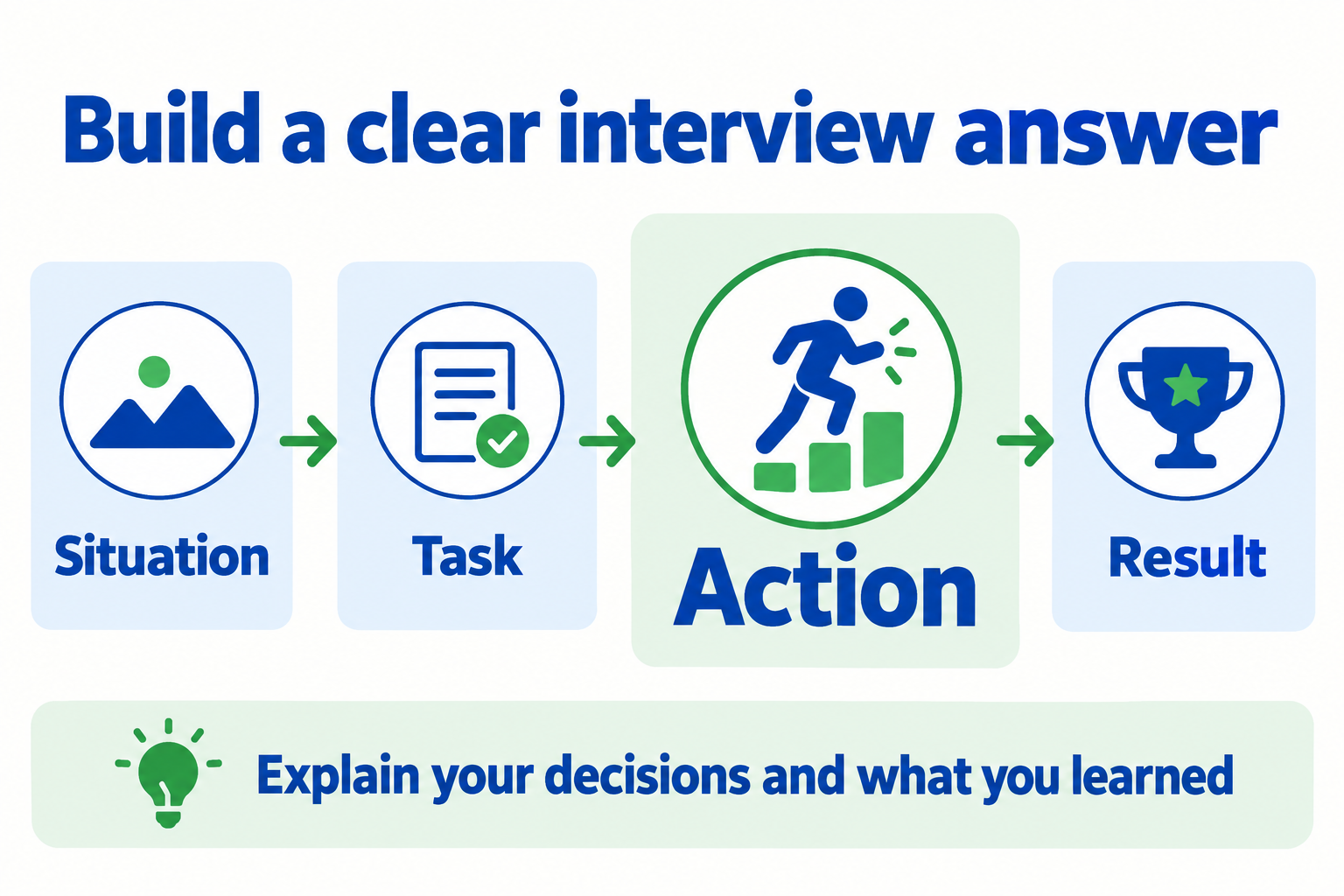
For behavioural questions, STAR means situation, task, action and result. Keep the background brief and spend most of the answer on what you did and why. Add learning where it helps, especially when the result was imperfect.
The fresh graduate job hunting guide places interview preparation within the wider application process. Your examples should remain consistent with the experience described in your resume and any submitted portfolio.
Answer Questions About Motivation and Direction
Tell Me About Yourself
Give a concise professional introduction: your current situation, one relevant experience and why this role is a sensible next step. Do not recite your entire life story. Choose details that make the rest of the conversation easier to follow.
A hypothetical answer might be: “I recently completed a business degree and enjoyed the operations projects most. In our final project, I organised the dataset and documented checks for the team. I am looking for a junior role where I can develop that combination of analysis and coordination.”
Why Do You Want This Role and Company
Connect an actual responsibility to your interests and preparation. Refer to something you have verified about the organisation, such as its service or customer group. Generic praise tells the interviewer little about your choice.
Explain both sides of the match: what attracts you to the work and what evidence suggests you could contribute. Avoid pretending to understand internal challenges from a brief website visit. A well-informed question can be more useful than an unsupported claim.
Answer Questions About Skills and Behaviour
Tell Me About a Problem You Solved
Explain how you recognised the problem, compared options and checked your response. For a hypothetical project, you might describe noticing inconsistent survey categories, agreeing a coding rule with the team and reviewing ambiguous responses separately. State the actual result without adding invented efficiency figures.
The interviewer may ask why you chose that approach. Prepare to discuss an alternative and the tradeoff. This is where a specific example becomes more useful than saying you are naturally analytical.
Describe a Disagreement in a Team
Choose a situation you can discuss respectfully. Explain the work issue, how you understood the other view and what helped the team make a decision. Avoid presenting yourself as the only competent person in the group.
For example, explain how you agreed decision criteria before comparing two project approaches. If the disagreement remained partly unresolved, say what you did to keep the work moving. Collaboration does not require pretending every team interaction ended perfectly.
Tell Me About a Mistake or Weakness
Choose a real, relevant limitation that you can discuss constructively. Explain its effect and the steps you took to improve. Avoid a disguised compliment such as working too hard unless you can explain an actual problem and a credible change.
If you missed an early project checkpoint, describe how you changed your planning and communication. Do not claim the issue has vanished permanently. Show that you can notice a problem, accept responsibility and use feedback.
Handle Questions About Limited Experience
When asked why the employer should hire you without experience, acknowledge your career stage briefly and move to relevant evidence. Explain what you have practised and where you would need support. This is more credible than suggesting a university assignment is identical to years of professional work.
If you have not encountered a situation, say so. Offer a related example or explain how you would approach it, clearly distinguishing a hypothetical response from something you have done. Ask a clarifying question if the problem is ambiguous.
For technical questions, explain your reasoning and assumptions. Do not bluff knowledge of a tool or method. An interviewer can assess your thinking more effectively when you make the limits of your answer visible.
Make Your Examples Relevant and Memorable
Choose a few details that help the interviewer understand the work: the constraint, your decision and the consequence. More detail is not always better. Pause after a complete answer and let the interviewer decide whether to explore further.
The guide to standing out as a fresh graduate explains how to connect a role requirement with visible evidence. Use that connection when choosing stories, rather than repeatedly using the same impressive example for unrelated questions.
Practise on Video and Review the Content First
Record a practice answer and check whether you answered the question, identified your contribution and explained the outcome. Then review pace, volume and distracting habits. Do not spend all your preparation time fixing minor gestures while leaving the answer vague.
If an employer requests recorded responses, follow its instructions on length, retries and submission. A profile introduction and a role-specific interview response serve different purposes. Greetsquare’s video resume option can help you present an introduction, but it should not be confused with completing an employer’s required assessment.
Prepare Questions and Finish Professionally
Ask what a new graduate would be expected to learn or deliver first, how feedback is provided and how the team works together. Choose questions whose answers matter to your decision. Avoid spending the whole conversation asking for information already stated clearly in the vacancy.
Confirm the next stage and expected timeline before leaving. Afterwards, note which examples worked and which questions exposed a gap. Your next practice session should address that gap instead of repeating every answer from the beginning.
Frequently Asked Questions
What Questions Do Fresh Graduates Usually Get Asked?
Prepare for questions about yourself, motivation, relevant skills, teamwork, problem-solving, feedback and learning. The exact questions depend on the role and interview format. Use a small set of truthful examples from study or other experience, then adapt them to the question instead of relying on memorised wording.
Can I Use University Examples in an Interview?
Yes. Explain the context, your responsibility, your actions and the result. Identify group work clearly and distinguish your contribution from the team’s achievement. Choose examples relevant to the role and be prepared for detailed follow-up questions. Academic examples are useful without being presented as paid professional experience.
What Should I Do If I Cannot Answer a Question?
Pause and clarify the question if needed. Be honest about what you do not know, then explain any relevant reasoning or related experience. Do not invent facts or experience to fill the silence. For a technical problem, state assumptions and describe how you would investigate the missing information.
How Long Should an Interview Answer Be?
Use enough detail to answer the question and explain your evidence, then pause. Follow explicit time limits in recorded interviews. Complex examples may need more time than a short motivation question. Practising aloud helps you remove unnecessary background while retaining your actions, decisions and outcome.



