

To stand out as a fresh graduate, make your relevant skills easier to understand and verify than a generic list of qualifications. Choose a specific employer need, show how you have practised related work and explain your decisions clearly. A shared degree does not mean your contribution, preparation or examples are identical.
You do not need to become the loudest person in the applicant pool. Your task is to give a reviewer a credible reason to explore your suitability further.
What Hiring Research Says About Standing Out
NACE’s April 2026 guidance for new graduate job seekers emphasises demonstrating skills through examples of solving problems. Its underlying employer research concerns the US college recruitment market. It supports an evidence-led approach, not a claim that one format guarantees success in Singapore.
Use the research as a prompt to examine your application. Does it explain an actual problem you worked on, or does it mainly contain descriptions such as motivated, passionate and adaptable? Those qualities become more persuasive when linked to behaviour a reviewer can assess.
Find the Responsibility You Can Explain Well
Read the job description and choose a task that is central to the role. Look for a task you understand and can connect to genuine experience. For a marketing assistant, this could be organising campaign information; for an operations coordinator, it could be maintaining accurate records.
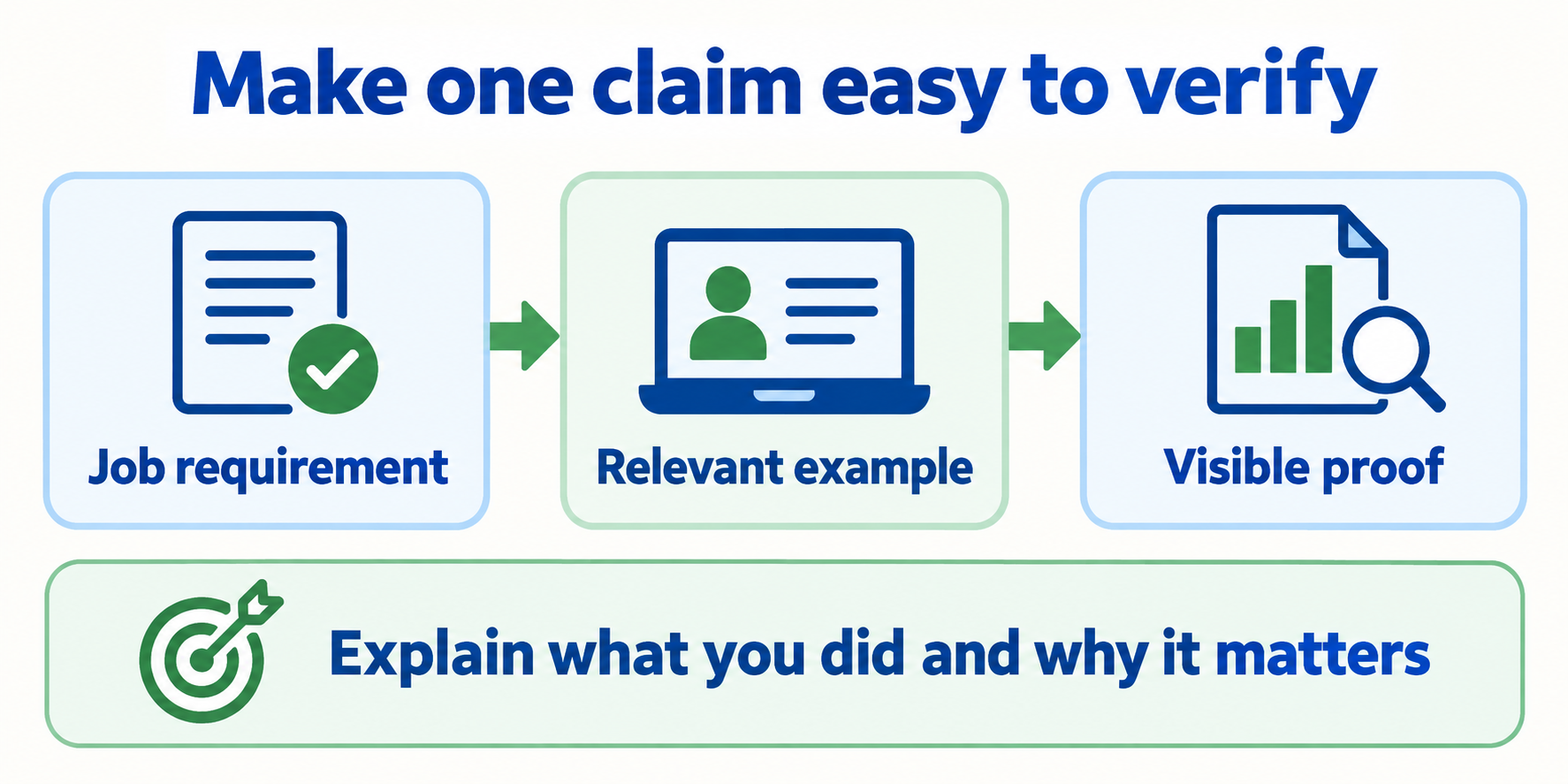
Write a one-sentence connection: “This role needs X, and my example shows Y.” If the connection requires a long explanation, choose a clearer example or check whether the vacancy fits your current skills. Specific relevance makes your application easier to follow.
The fresh graduate job hunting guide helps you establish that role direction. Use it before investing time in a distinctive presentation for a job whose core requirements you cannot yet meet.
Stand Out as a Fresh Graduate with a Useful Work Sample
A work sample should be small enough to review and substantial enough to reveal your thinking. It might be an annotated spreadsheet, a short written analysis or a simple design with an explanation of the audience and constraints. Choose the format that suits the work.
For a hypothetical operations application, you could create a basic inventory exception report using fictional data. Explain how you defined an exception, checked the information and prioritised items for review. Label it as an independent exercise so no one mistakes it for a client engagement.
Avoid producing an extensive unsolicited strategy for an organisation you barely know. A narrow sample with explicit assumptions is more credible than a confident solution to an unverified business problem. Respect the employer’s instructions if additional materials are not accepted.
Make the Reasoning Visible
Describe the goal, your approach and one tradeoff. A reviewer may learn more from why you selected a method than from a polished final screen. Explain what you checked and what you would investigate next if you had more information.
Suppose your sample summarises customer feedback. You might explain that comments were grouped manually because the sample was small, and that ambiguous comments were kept separate rather than forced into a category. This shows a decision the interviewer can question and understand.
Keep the explanation concise. Place the main output first, followed by essential context and limitations. A reviewer should not need to search through a long presentation to discover what you personally did.
Demonstrate Communication Without Performing a Personality
Clear communication means helping another person understand something. It can appear in a concise email, a useful handover, a well-labelled chart or a direct spoken answer. Confidence is helpful when it supports clarity, but confidence alone is not evidence of job capability.
Choose an example where you adjusted your explanation to the audience. Perhaps you removed technical detail for a student committee or added instructions when teammates struggled with a spreadsheet. Explain the adjustment and whether it helped.
Do not treat extroversion as a requirement for every role. A thoughtful applicant who listens and answers directly can demonstrate strong communication. Aim to be understandable and responsive rather than imitating someone else’s interview style.
Show Potential Through a Learning Example
Select a situation where feedback changed your work. Explain the original issue, the feedback, the revision and what you applied later. This shows how you respond when your first attempt is incomplete.
A hypothetical graduate might describe submitting a report that was too technical, asking which decisions the audience needed to make, then rewriting the summary around those decisions. The useful detail is the change in approach. “I am a quick learner” does not communicate that process.
Be honest about the limits of your knowledge. You can explain how you would learn an unfamiliar tool without claiming proficiency. Specific preparation and a realistic learning plan are stronger than saying you can do anything immediately.
Use a Video Introduction for a Clear Purpose
Video can add a spoken explanation when the employer accepts it and the format is relevant. A simple structure is your target role, one useful example and a brief closing. Follow any time limit and avoid repeating every section of your resume.
For example: “I am applying for junior operations roles. In a student project, I checked inconsistent records and documented how we resolved them. I enjoyed making the process easier for teammates to follow, and I would like to develop that work in an operations team.” Adapt the details to your actual experience.
Explore Greetsquare’s video resume option if you want to introduce your work in this format. It can complement your written evidence, but it does not bypass mandatory requirements or guarantee attention. Good audio, a clear explanation and accurate claims matter more than elaborate production.
Prepare for the Conversation Your Evidence Creates
A distinctive example often prompts detailed questions. Be ready to explain what you did personally, why you chose the method, what went wrong and what you would improve. Do not submit a sample you cannot discuss without reading a script.
Use the graduate interview questions guide to practise those follow-ups. Ask a friend to interrupt with a reasonable question so you learn to respond naturally. Practise listening as carefully as speaking.
Make One Application More Specific Today
Choose a suitable vacancy and remove one generic claim from your application. Replace it with a relevant example and, where useful, a small piece of supporting work. Check that the connection to the role is obvious.
You now have a clearer reason for the employer to continue the conversation. Repeat the process thoughtfully across related roles, keeping the facts consistent and the emphasis relevant to each opportunity.
Frequently Asked Questions
How Can I Stand Out with an Ordinary Degree?
Focus on the responsibilities of the role and explain relevant work you have done. Projects, volunteering and part-time employment may supply useful examples. Show your contribution and decisions clearly. A degree is one part of your application; specific evidence helps an employer understand how you might perform the work.
Do I Need a Personal Website to Get Noticed?
No. A concise, accessible sample or portfolio document can be sufficient when additional material is accepted. Choose a format appropriate to the role and keep links working. A website adds little if the examples are unclear, unrelated or difficult to review. The quality of the evidence matters most.
Should I Send a Video with Every Application?
No. Follow the employer’s instructions and use video where it is accepted and adds useful information. Keep the required application complete without it. A brief explanation of relevant work can help demonstrate communication, but an unsolicited video may not be reviewed and cannot guarantee a different hiring outcome.
How Do I Show Potential Without Strong Grades?
Prepare examples of learning, applying feedback and completing relevant work. Be accurate about academic results and meet any stated eligibility requirements. Explain improvements through actions and outputs rather than vague claims. Some roles have grade thresholds, while others give you more opportunity to demonstrate suitability through other evidence.



