
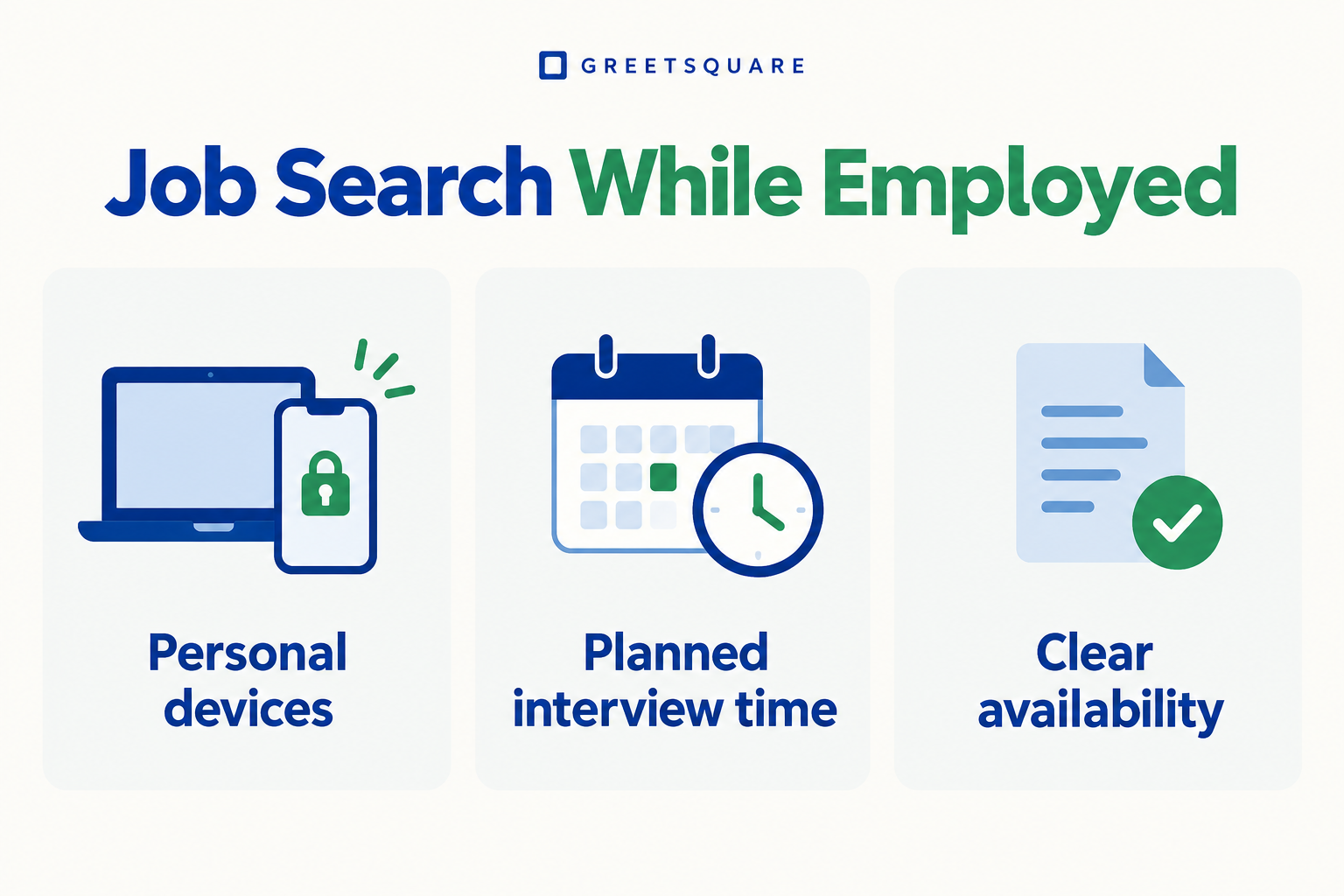
To job search while employed, use your own contact details and devices, schedule focused search time and arrange interviews around your work commitments. Keep your current responsibilities professional while discussing availability honestly with prospective employers. Discretion depends on your choices and the hiring process, not on any single privacy setting.
Searching while working can give you space to evaluate opportunities, but it also adds another set of tasks to an already busy week. A small, deliberate process is easier to manage than trying to respond to every vacancy immediately.
What LinkedIn Says About Search Privacy
LinkedIn’s Open to Work guidance states that its recruiters-only setting takes steps to hide shared career interests from recruiters at your current company, but cannot guarantee complete privacy. The all-members option is visible more broadly, including to people at your company.
That makes privacy a practical judgement rather than an absolute promise. Review the visibility of your profile activity and shared material, and assume that information you give another person could become known beyond the immediate conversation.
Create a Job Search While Employed Plan
Choose the type of move you want before browsing widely. Write down the responsibilities, working arrangements and development you are looking for. Separate genuine requirements from preferences you are willing to discuss.
This helps you decline unsuitable conversations early. If you have limited time, a role with a clear mismatch in location or schedule may not deserve several interview rounds simply because the title sounds attractive.
Use the guide to a stuck job search if you are unsure whether your current approach is too broad. A focused target reduces the number of applications that require attention without reducing the care given to suitable ones.
Keep Search Activity on Personal Systems
Use a personal email address and phone number you can monitor appropriately. Store resumes, notes and application records in your own account. Avoid relying on access to your employer’s systems for material you will need after leaving.
Do not use confidential company documents as portfolio samples. Describe your contribution in general terms or create a clearly labelled demonstration using public or fictional information. Removing a logo alone may not remove sensitive details.
Follow the policies and obligations that apply to your current work. If you are unsure about a restriction affecting your situation, seek appropriate advice rather than assuming that a generic article can determine what your agreement allows.
Schedule a Small Number of Focused Sessions
Set aside realistic blocks outside your work commitments. One session can identify suitable vacancies; another can prepare an application; another can support interview practice. Keep the next action clear so you can restart quickly.
Batch low-priority tasks such as reviewing alerts. Respond to genuine recruiter messages within a reasonable period, but do not feel obliged to interrupt every work task whenever a notification arrives.
For example, a fictional applicant might review vacancies twice a week and reserve a longer weekend session for tailored applications. Someone with shift work may use a different pattern. The useful principle is fitting the search to your actual availability.
Arrange Interviews Professionally
Ask about scheduling flexibility early. A recruiter may be able to offer a morning, lunchtime or late-afternoon appointment, but do not assume that every interviewer can accommodate your preferred time. Offer several realistic options.
Use leave or another appropriate arrangement when an interview cannot fit around existing commitments. Avoid inventing illnesses or other explanations. You can request personal time without volunteering unnecessary detail, subject to your workplace’s normal process.
For remote interviews, choose a private setting where you can speak clearly and avoid interruption. Check the connection, sound and background beforehand. A rushed conversation from an unsuitable place can make it harder to evaluate the role properly.
Tell Recruiters What They Need to Know
Explain that you are currently employed and provide realistic interview availability. Clarify your likely start timing based on your actual obligations, while avoiding a commitment before you understand the offer and transition requirements.
If confidentiality matters, state that clearly: “Please contact me through this personal email address, and discuss reference timing with me before approaching my current employer.” This communicates a preference; it does not guarantee how every party will behave.
Ask how the process handles references and checks. Knowing the sequence helps you decide whether to proceed and when a conversation with your current employer may become necessary.
Keep Your Current Performance Professional
Continue meeting commitments and communicating about your work. A search can create distraction, especially after an exciting interview, but the current role still deserves reliable attention while you hold it.
Avoid using colleagues as an audience for every frustration about the employer. A neutral account of why you want a different role is easier to use in interviews and less likely to turn the search into an ongoing workplace conflict.
If you are considering an internal move, check the relevant process before assuming it can remain confidential. Internal recruitment may involve your manager at a particular stage. Understanding that process lets you make an informed choice about timing.
Discuss Your Reason for Moving Constructively
Connect the move to the work you want next. You might be seeking a different scope, a more suitable schedule or opportunities to develop a specific capability. Use reasons that are true rather than a polished answer disconnected from your priorities.
You can acknowledge limitations in the current role without attacking individuals. For example: “I am looking for a position with more direct responsibility for reporting and analysis” explains direction more clearly than a lengthy complaint about management.
Then ask questions that test whether the new role actually offers what you seek. A move does not solve the underlying problem if you never investigate the responsibilities or conditions that matter to you.
Follow Up Without Losing Control of Your Calendar
Record interview dates, expected updates and next actions in a personal tracker. Use the job application follow-up guide to keep messages concise and aligned with the employer’s timeline.
If several processes overlap, tell recruiters about genuine timing constraints. Do not invent another offer to create urgency. Clear scheduling information helps both sides plan without turning every conversation into a negotiation tactic.
Keep applying selectively until you have a confirmed outcome. A promising discussion is useful, but it is not the same as a final offer with terms you understand.
Plan the Transition from Confirmed Information
Before deciding when to leave, review the written offer, conditions, expected start date and your current obligations. Clarify anything uncertain directly with the relevant party. Avoid making an irreversible career decision based only on an informal indication of interest.
Once you have decided to move, plan a professional handover and the communication your workplace requires. The timing depends on your circumstances and agreements; there is no universal date that applies to every employee.
Take the Next Step Discreetly
Set up your personal tracker, choose a suitable vacancy and block time to prepare. Check your contact details and availability before the first recruiter conversation. Keep the search focused enough that it can coexist with your current responsibilities.
The goal is a considered move into suitable work, supported by clear information and a manageable process.
Frequently Asked Questions
Can My Employer See That I Am Looking on LinkedIn?
It depends on what you share and who can view it. LinkedIn says recruiters-only Open to Work uses privacy measures but does not guarantee complete privacy. Review your settings and public activity, use personal contact details and avoid treating any platform feature as a promise that your search will remain secret.
Should I Tell My Manager I Am Job Searching?
That depends on your relationship, circumstances and any relevant workplace process. You do not need to make the decision simply because you have started browsing. Consider confidentiality, internal opportunities, reference timing and transition requirements. Understand your actual situation before choosing when and how to have that conversation.
How Do I Attend Interviews During Working Hours?
Ask for scheduling flexibility and offer realistic options. If necessary, use leave or another appropriate arrangement under your workplace’s process. Avoid inventing an explanation or neglecting existing commitments. For remote interviews, choose a private setting and allow enough time to participate without rushing between conflicting responsibilities.
When Should I Resign After Receiving an Offer?
Review the written terms, conditions, start date and your existing obligations before deciding. Clarify unresolved points with the employer and seek appropriate advice where needed. An informal expression of interest is not the same as a confirmed arrangement. Plan your notice and handover using information you can rely on.



