

Operations manager salary in Singapore varies widely because the title covers different industries and operating models. Michael Page’s current salary comparison tool reports an average of S$140,000 annually, excluding bonuses and benefits. That is about S$11,667 per month when divided by 12, rather than a guaranteed monthly salary for every operations manager.
A single-site logistics role and a regional service operation may share a title while carrying very different responsibilities. To judge an offer, compare its operating scope, recurring cash and resources with roles that genuinely resemble it.
Operations Manager Salary in Singapore: What the Sources Show
The Michael Page operations manager salary tool, checked on 6 October 2026, reports S$140,000 annually. Its methodology uses placements and advertised roles from the previous 12 months, updates annually and excludes bonuses and benefits.
Specific job advertisements provide another type of evidence. A Michael Page logistics operations manager vacancy advertises S$6,000–S$7,000 monthly, or S$72,000–S$84,000 annually. The remit includes third-party logistics operations, inventory and demand planning. An advertisement is a budget for that vacancy, not a market average.
| Evidence Type | Published Pay | How to Use It |
|---|---|---|
| Recruiter comparison tool | S$140,000 annual average, excluding bonuses and benefits | Start a broad discussion, then narrow by role scope |
| Specific logistics vacancy | S$6,000–S$7,000 monthly; S$72,000–S$84,000 annually | Compare similar logistics responsibilities and conditions |
The difference between these figures does not establish a market-wide low-to-high range. They describe different evidence. Ask recruiters which sector, responsibility level and pay definition best match your vacancy before adopting a figure as your target.
Match the Operational Setting and Responsibility
Operations managers may oversee warehouses, retail locations, service delivery, facilities or financial processes. Each setting has different risk, technical knowledge and performance measures. A salary comparison becomes more useful when you specify the work instead of relying on the title.
Review the operations manager job description to identify the core remit. Then use the Singapore salary guide by industry for sector context. Keep this offer comparison focused on pay; use the role guide for a fuller explanation of duties and qualifications.
Ask how many locations you will manage, whether the operation runs continuously and how much budget you control. Establish the size of the frontline workforce and the number of managers reporting to you. These details help explain the responsibility behind a proposed salary band.
Distinguish Site Leadership From Regional Coordination
A site manager may directly own daily staffing, incidents, supplier performance and service quality. A regional manager may set standards and coordinate several local leaders. Either can be complex, but the decision rights and operating pressure are different.
Clarify whether a regional title gives you authority over budgets and staffing or mainly requires reporting and coordination. Ask who can approve changes when an operation misses its targets. Responsibility for several sites without meaningful authority deserves careful discussion before acceptance.
Compare Experience Through Operational Complexity
There is no reliable universal salary ladder for every operations manager. Years of experience are useful context, but they do not capture the scale or risk of the operation you can lead. Match your experience to the work described in the vacancy.
For a first management role, show that you can run a stable process, supervise people and handle exceptions. For a more senior role, demonstrate multi-site leadership, budget decisions and improvements that remain effective after implementation. Explain the controls you used to protect quality while changing the process.
When comparing industries, look at the actual constraints. A warehouse may emphasise inventory and dispatch reliability, while a service operation may focus on response times and customer commitments. Do not invent a sector premium from unrelated salary examples or assume that a more prestigious title means a larger remit.
Separate Fixed Salary, Incentives and Allowances
Start with annual base salary, usually calculated from the monthly base and number of base payments. Record any guaranteed additional payment separately. Ask whether the stated package includes fixed allowances, variable incentives or reimbursements so you can compare like with like.
For a performance bonus, request the measures, target amount and assessment period. Ask how safety, quality, service and cost interact in the scorecard. A target based entirely on one measure can create difficult trade-offs if your remit requires balancing several outcomes.
Check whether transport, phone or shift-related payments are fixed contractual amounts or dependent on conditions. Reimbursement of an expense is different from additional pay you can retain. Confirm first-year eligibility and any repayment conditions for a joining award.
A Hypothetical Operations Offer Comparison
Suppose Offer A pays S$7,000 monthly base across 12 months and a fixed S$300 monthly allowance. That produces S$84,000 annual base and S$3,600 in annual allowance, assuming it is payable every month. Offer B pays S$7,400 monthly base with a discretionary one-month bonus.
Offer B’s annual base is S$88,800. Its illustrative total reaches S$96,200 if the full bonus is paid. These invented packages are calculation examples, not current market rates. Compare the recurring guaranteed components first, then consider the bonus opportunity and each role’s operating conditions.
Check Staffing, Authority and After-Hours Expectations
An attractive salary can accompany an understaffed operation. Ask about vacancies, employee turnover, supervisor coverage and peak periods. Establish whether the team has enough capacity to deliver the targets the employer expects you to own.
Discuss escalation arrangements directly. Who handles urgent incidents when you are unavailable, and which decisions can frontline supervisors make? Find out whether evenings, weekends or travel are occasional requirements or routine expectations. Include those conditions in your personal offer comparison.
Request the budget and approval limits that support your remit. If you are responsible for reducing delays, understand whether you can change schedules, suppliers or systems. Targets become more credible when the role includes the resources and authority to influence them.
Demonstrate Improvements That Protect the Whole Operation
Choose examples with a clear starting point, intervention and measured result. You might explain how you improved dispatch reliability, reduced repeated service failures or made staffing more predictable. Describe the scale of the operation and the period measured so the result is interpretable.
Avoid presenting a cost saving in isolation. Explain whether service quality, safety or employee workload changed at the same time. A useful operations story shows that the improvement did not simply move the problem into another team or leave a fragile process behind.
Use the salary negotiation guide to turn those examples into a focused request. State the matched scope, your relevant evidence and the annual base you are seeking. If the employer’s band cannot accommodate the remit, discuss the responsibilities and support as well as the number.
Make a Decision With a Complete Offer Comparison
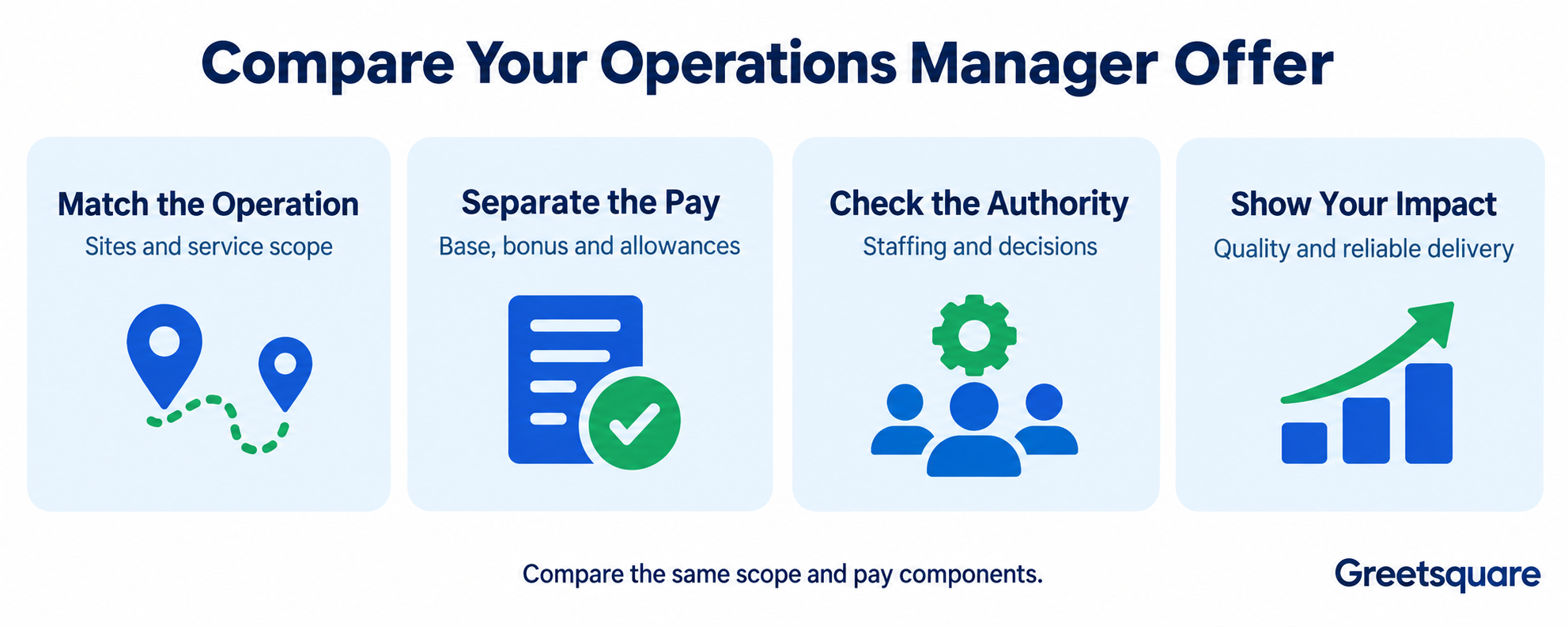
Before accepting, compare scope, guaranteed cash, variable rewards, staffing and working arrangements on one page. Resolve vague terms such as regional ownership or operational flexibility. Ask for a written explanation of the role’s priorities and how performance will be assessed.
To support your next application, use Greetsquare’s jobseeker and video resume tools to explain one operational problem and your approach. A specific, credible improvement story helps employers understand the level of responsibility you can manage without relying on a title alone.
Frequently Asked Questions
What Is the Average Operations Manager Salary in Singapore?
Michael Page’s current comparison tool reports an average of S$140,000 annually for operations managers in Singapore, excluding bonuses and benefits. That is roughly S$11,667 monthly when divided by 12. Treat it as a recruiter benchmark and compare the industry, sites, workforce and authority of the specific vacancy you are assessing.
Why Do Operations Manager Salary Figures Vary So Much?
The title covers different operational settings, from logistics and retail to service delivery and financial processes. Salary sources also use different samples and pay definitions. Compare the role’s industry, scale, decision authority and working arrangements, then distinguish a specific advertised vacancy budget from a broader recruiter salary benchmark.
Should I Include Allowances in an Operations Salary Comparison?
Record fixed contractual allowances separately from base salary, then include them in guaranteed cash only when their conditions are satisfied. Keep expense reimbursements and uncertain payments distinct. Check whether each allowance depends on travel, shifts or another requirement so your comparison reflects the cash you can reasonably expect to receive.
How Can I Negotiate an Operations Manager Salary?
Match the vacancy to relevant salary evidence and explain improvements you delivered at a comparable scale. Show how you balanced cost, quality, service and workforce needs. State your requested annual base clearly, then discuss incentives, staffing and decision authority separately so the proposed package supports the responsibilities you will own.



