

An operations manager oversees the recurring work that keeps a business running. An operations manager job description usually includes resource planning, process improvement, performance monitoring and team leadership, with responsibilities shaped by the industry and size of the organisation.
A warehouse, customer support centre and professional services firm all need reliable operations, but their constraints differ. This guide explains how to read the role, identify the skills behind the duties and demonstrate your judgement when applying.
What Occupational Guidance Says About Operations Management
The US Department of Labor’s O*NET profile for general and operations managers describes responsibility across daily operations, policies and resources, often through subordinate supervisors. It covers a broad occupational group, so it is a useful reference for scope rather than a universal specification for every vacancy.
For applicants, the practical implication is to examine what the manager actually controls. Responsibility for three team leaders and a delivery budget is different from coordinating a small office without staffing authority. Compare the vacancy with our guide to job roles and hiring expectations before deciding whether it matches your experience.
Operations Manager Job Description: Core Responsibilities
Plan Capacity Against Demand
The manager turns expected workload into a workable staffing, equipment and scheduling plan. This involves understanding peak periods, absence cover, service commitments and the time needed to complete different tasks. A plan that assumes everyone works at full capacity every hour leaves little room for interruptions.
Capacity planning also requires conversations with sales, finance and frontline supervisors. If a promotion creates extra orders, operations needs enough notice to prepare. A useful interview example explains how you recognised that demand was changing and adjusted capacity before service deteriorated.
Improve the Flow of Work
Process improvement starts by observing how work moves, including handovers, waiting time and rework. The most visible delay is not always the underlying constraint. Faster intake, for example, can simply move a larger queue to an already overloaded approval team.
An operations manager tests an improvement on a manageable scale, checks the effect and decides whether to expand it. Updated instructions, training and ownership help the change survive after the initial project ends. Improvement is incomplete when the new procedure exists only in a presentation.
Monitor Service, Cost and Quality Together
Performance reviews should connect measures to decisions. Useful measures may include on-time completion, repeat work, backlog age, customer complaints and cost per completed task. Definitions matter: reporting orders dispatched is different from reporting orders received by customers.
A balanced view prevents misleading success. Shorter handling time can look positive while unresolved cases increase. The manager investigates the trade-off, checks whether the problem affects a particular team or task type, and agrees corrective action with an owner and review date.
Lead Supervisors and Handle Exceptions
Daily leadership includes setting priorities, coaching supervisors and making escalation routes clear. Managers need enough visibility to intervene when necessary without taking over every routine decision. Teams should know which issues they can resolve and when to ask for help.
During a disruption, the manager protects critical work, communicates realistic updates and records temporary decisions. Afterwards, a short review should identify causes, failed assumptions and preventive actions. The aim is a stronger process, not an account of who worked the longest hours.
Operations Manager Skills and Requirements
Analytical and Commercial Skills
Spreadsheet analysis, workforce planning and reporting tools help managers compare workload, capacity and cost. Some employers use enterprise resource planning systems or specialist scheduling software. The important skill is understanding how the data represents real work, including missing records and inconsistent definitions.
Commercial judgement means recognising the full consequence of a decision. Outsourcing a task might reduce direct labour cost but add coordination effort, delays or quality checks. Explain how you compared options, what assumptions you made and which risks changed the final recommendation.
Communication and People Leadership
Operations managers translate broad targets into instructions people can act on. They also take frontline feedback seriously, particularly when a proposed process works on paper but fails during busy periods. Clear expectations, respectful challenge and dependable follow-up matter more than management jargon.
Qualification requirements vary. Some employers prefer a relevant degree, while others place greater weight on industry experience and evidence of leading teams. Process-improvement training can support an application, but a certificate should be accompanied by an example of applying the method appropriately.
Reporting Lines and Boundaries With Related Roles
An operations manager may report to an operations director, general manager, country manager or COO. Check whether the remit covers a site, several locations or one service function. Budget authority, direct reports and responsibility for suppliers should be explicit.
The distinction from a project manager is especially useful: operations owns repeatable service delivery, while a project has a defined change or outcome to deliver. The roles collaborate when a project introduces a system or process that operations must maintain afterwards.
An operations manager is also different from a country manager with wider market and commercial accountability. Job titles vary, so ask who owns revenue, investment decisions and cross-functional priorities rather than assuming a fixed hierarchy from the title alone.
A Practical Example of Operational Judgement
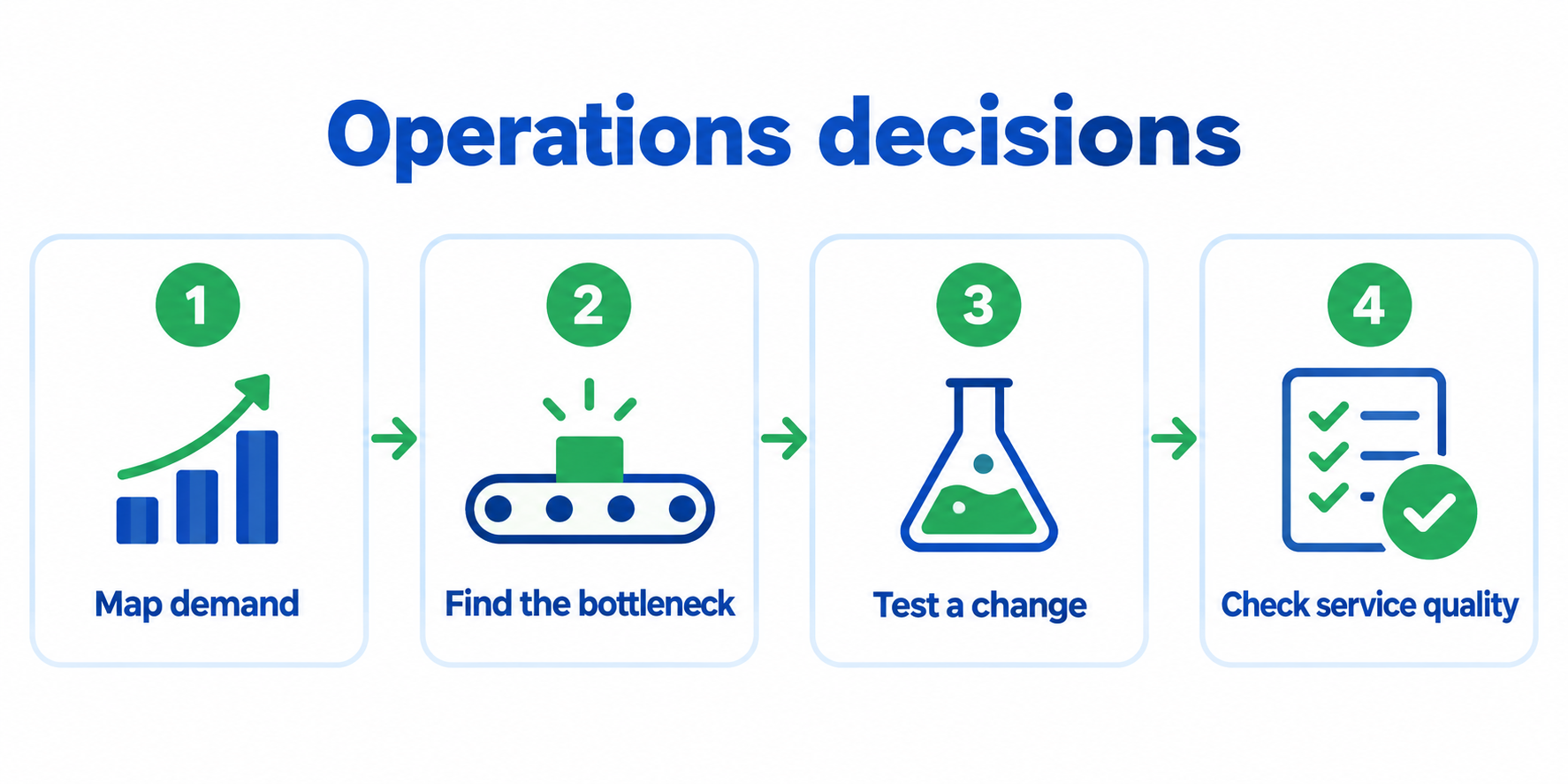
Consider a fictional service team whose backlog grows every Monday. The first suggestion is to add overtime. The manager instead separates cases by type and discovers that incomplete weekend submissions require repeated clarification, leaving skilled staff waiting for basic information.
A sensible pilot could improve the submission form and assign a short triage period before specialist work begins. The manager would compare backlog age, rework and customer completion time before and after the change. Faster triage alone would not prove that the whole service improved.
In an application, describe the equivalent problem from your own experience. State the scale, your actual authority, the evidence you used and the outcome you can substantiate. If several teams contributed, make their roles clear rather than presenting a shared result as a personal achievement.
How to Demonstrate Readiness for the Role
Choose two or three examples covering different responsibilities: planning capacity, improving a process and leading through disruption. For each, prepare a short account of the starting condition, your decision, the trade-off and what happened next. Include the measurement period whenever you cite a result.
Use our guide to answering tough interview questions to practise explaining a decision that did not work as expected. An honest adjustment can demonstrate stronger judgement than a story with no uncertainty or competing priorities.
A short video introduction can show how clearly you explain operational problems. Follow the video resume guide and focus on one example, using anonymised details. Keep customer records, internal dashboards and confidential staffing information out of the recording.
Turn the Job Description Into an Application Plan
Read the vacancy and identify its three most important operational outcomes. Match each outcome to evidence you already have, then note where you need clarification about the team, budget or service standards. This creates a more useful application than repeating every duty in the advert.
When you are ready, use Greetsquare for jobseekers to introduce your experience and explain one relevant improvement clearly. Support the introduction with a focused CV and examples that show reliable delivery over time.
Frequently Asked Questions
What Is the Main Responsibility of an Operations Manager?
The main responsibility is keeping recurring business activity reliable while improving how resources are used. Depending on the employer, this can include staffing, scheduling, suppliers, service quality and cost control. Read the vacancy carefully because a site role and a regional role can have very different authority.
Does an Operations Manager Need a Degree?
Some employers ask for a business, engineering or industry-related degree, while others accept substantial operational experience. The most relevant evidence is usually your ability to manage people, diagnose problems and deliver consistent results. Treat the employer’s stated qualification requirements separately from credentials that are simply preferred.
How Is an Operations Manager Different From a Project Manager?
An operations manager normally owns ongoing processes and service performance. A project manager coordinates a defined change with agreed scope, resources and timing. They often work together during implementation and handover, but responsibility for maintaining the resulting service usually continues with operations after the project closes.
What Should I Include in an Operations Manager Application?
Include examples of capacity planning, process improvement and team leadership that match the vacancy. Explain the original problem, your decision and the measurable result, including any trade-off. State your own contribution accurately and remove confidential details from supporting documents, portfolio material or a video introduction.



