

A project manager job description usually covers planning, coordinating people and resources, tracking progress and managing changes to an agreed scope. The manager helps stakeholders understand what can be delivered, when and under which constraints. They also arrange clear acceptance and handover so that finishing activities leads to a usable result.
Project management is more than maintaining a schedule. It involves identifying conflicting expectations, surfacing dependencies and ensuring that important decisions reach the right person. A plan is useful only when it reflects how the work will actually happen.
What Occupational Research Shows About Project Management
The U.S. Bureau of Labor Statistics profile of project management specialists describes coordination of project budgets, schedules and staffing. It projects 7% employment growth in that U.S. occupation from 2025 to 2035. This is an occupational forecast for the United States, not a measure of demand for every industry or location.
For applicants, the practical point is that the role connects several moving parts. Listing a successful launch tells an employer little about your contribution. Explain which commitments you coordinated, what uncertainty you faced and how your decisions helped the team deliver or revise the agreed outcome.
What a Project Manager Job Description Should Clarify
Look for the type of project, expected deliverables and level of decision authority. An internal process improvement, software implementation and construction project can share coordination needs while requiring very different domain knowledge. The employer should make the context clear enough for candidates to judge their fit.
Ask who sponsors the work, who provides people and who accepts the result. A project manager may coordinate specialists without being their line manager. The guide to job roles and hiring differences explains why that distinction matters when assessing seniority and responsibility.
Core Responsibilities Through the Project
Agree the Outcome and Boundaries
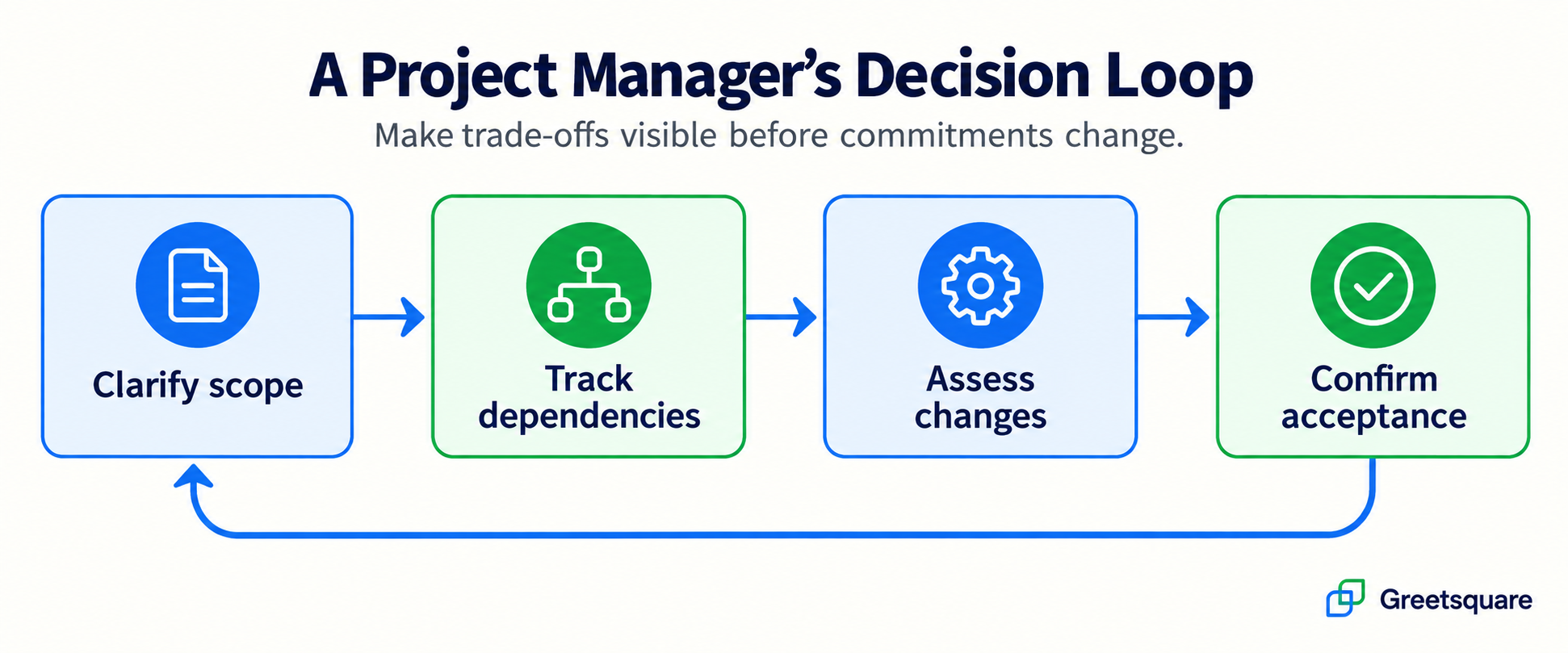
Before creating a detailed schedule, establish what the work must achieve and what lies outside its scope. Agree who can approve changes and how completion will be judged. A broad ambition such as “improve the customer experience” needs a defined deliverable and acceptance criteria before people can plan reliably.
For example, a fictional support-team project might aim to introduce a new enquiry process. The project needs to specify which teams and enquiry types are included, what training is required and who will accept the handover. Otherwise different stakeholders may expect different results from the same deadline.
Build a Plan Around Dependencies
A useful plan connects activities rather than merely listing them. If training materials depend on an approved process, and approval depends on a pilot, those relationships affect the delivery date. Identify assumptions about availability and external inputs before presenting a schedule as a firm commitment.
The manager should also clarify ownership. Assigning an activity to “the business” does not identify who will complete it or resolve an issue. Agree responsible people, decision dates and escalation routes, then check that the commitments are realistic alongside their other work.
Track Progress, Risks and Issues
Progress reporting should show what has been completed, what has changed and which decisions are needed. An activity described as nearly finished can still hide an unresolved approval or dependency. Ask for evidence tied to the agreed output rather than relying only on a percentage estimate.
Separate a risk that might happen from an issue that already exists. Record the owner, potential effect and planned response in language stakeholders understand. A long register is not a sign of control if significant items receive no attention or action.
Manage Changes and Complete the Handover
When someone requests additional work, assess the effect on time, cost, capacity and the intended benefit. Present options to the authorised decision-maker rather than quietly adding tasks. Changes may be sensible, but the resulting commitments should be understood and recorded.
Completion involves more than announcing that a task list is finished. Confirm acceptance, operational ownership, required documentation and any remaining actions. A project can meet its build deadline yet leave the receiving team unable to use or support what has been delivered.
Skills and Requirements Employers May Assess
Planning, analysis and clear written communication support the technical side of the role. Employers may also look for familiarity with scheduling, collaboration or reporting tools. Explain how you used a tool to coordinate work or expose a problem, rather than treating software proficiency as proof of delivery capability.
People skills become visible when priorities conflict. Describe how you sought input, handled disagreement and escalated a decision with useful context. The goal is not to claim that you kept everyone happy. It is to show that people understood the trade-off and knew what would happen next.
The BLS profile identifies a degree as a typical entry route in its U.S. classification and notes that certification can be helpful without always being required. Individual vacancies differ. Read the employer’s qualification and industry requirements directly instead of assuming that one credential qualifies someone for every project.
If the role requires technical knowledge, show enough depth to understand constraints and ask good questions. Be precise about where specialists made technical decisions. Claiming expertise you do not have makes it harder to explain your actual contribution and can undermine an otherwise strong example.
Project Manager, Product Manager or Programme Manager?
A project manager coordinates defined delivery. A product manager generally focuses on the value, direction and priorities of a product over time. Responsibilities can overlap, but the titles should not be treated as interchangeable. Ask who owns discovery, prioritisation, delivery commitments and ongoing outcomes.
A programme manager may coordinate related projects and the wider changes needed to realise benefits. Our programme manager versus project manager comparison explores that distinction. Larger scope should be assessed through dependencies and accountability, not the title alone.
For compensation research, use the project manager salary guide for Singapore alongside current vacancies with comparable scope. Check the guide’s data period and whether figures describe senior roles. Salary comparisons need the same geography, industry and compensation basis to be meaningful.
Demonstrate Delivery Judgement in Your Application
Choose an example that shows a decision under constraint. Explain the project’s objective, your responsibility, the problem and the options. Then describe what was agreed and what happened, including any result that fell short. A credible recovery example can reveal more than an unexplained success claim.
Here is a fictional interview structure: “A supplier delay threatened training readiness. I mapped the affected dependencies, proposed a phased rollout and obtained sponsor approval before changing the plan.” The next sentences should explain why that option was chosen and how the actual outcome was checked.
Prepare for follow-up questions about your personal authority and contribution. Use our guide to difficult interview questions to practise a disagreement or missed target. Avoid speaking entirely in “we” when the interviewer needs to understand your decisions.
Add a Focused Video Introduction Where Appropriate
A short introduction can show whether you explain a complicated situation clearly. Follow the video resume guide and focus on one relevant project decision. Keep customer names, private budgets and internal project material out of the recording unless you have permission to share them.
Where the employer accepts video, Greetsquare’s job-seeker video-profile features offer a way to introduce your experience. Follow the requested format and retain the written evidence. A polished recording cannot replace domain knowledge, references or an assessment of how you manage delivery.
Prepare Around the Employer’s Delivery Problem
Summarise the project’s outcome, constraints and decision structure before choosing your examples. Show how you clarify work, coordinate dependencies and surface trade-offs early. That gives the employer a clearer reason to consider you than a resume filled with project names, acronyms and tools without context.
Frequently Asked Questions
What Does a Project Manager Do Day to Day?
A project manager reviews progress, coordinates people, resolves or escalates issues and keeps stakeholders informed about decisions. Daily priorities change with the project phase. Planning may dominate early work, while testing, acceptance and handover become more prominent near completion. The role should keep attention on agreed outcomes throughout.
Does a Project Manager Need Technical Skills?
The level of technical knowledge depends on the project and employer. Some roles require deep industry expertise; others rely on specialist leads. You still need enough understanding to recognise dependencies, ask useful questions and explain constraints. Be clear about which technical decisions you made and which belonged to others.
Can You Become a Project Manager Without Certification?
Some employers hire project managers without certification when candidates demonstrate relevant delivery experience and meet the role’s other requirements. Other vacancies explicitly request a credential. Read the stated criteria and prepare evidence of planning, coordination and judgement. A qualification can support an application but does not replace practical examples.
How Do You Describe Project Management Achievements on a Resume?
State the project’s objective, your responsibility, the constraint you addressed and the result you can support. Add scale or timing when accurate, and distinguish your contribution from the team’s work. Explain a useful decision or improvement instead of listing tools or claiming that every project finished perfectly.



