

The soft skills employers want are the behaviours that help someone use their knowledge effectively with other people and under changing conditions. Communication, collaboration, problem solving, adaptability and self-management are useful starting points, but their importance depends on the role. Choose the behaviours behind the vacancy’s responsibilities, then show examples of using them.
A list of adjectives cannot do that work for you. A hiring manager needs to understand how you handled a difficult task, what you personally contributed and why the outcome mattered. This guide helps you turn an abstract skill into evidence an employer can assess.
What Employer Research Says About Human Skills
The World Economic Forum’s Future of Jobs Report 2025 skills outlook identifies analytical thinking as a core skill for roughly seven in ten surveyed employers. Resilience, flexibility and agility, alongside leadership and social influence, also feature prominently. This is a global employer survey, not a ranking of Singapore vacancies or proof that every employer wants the same profile.
Its practical implication is to connect human skills with actual work. An analyst must evaluate an uncertain finding; a supervisor must explain a changed priority; a service employee must resolve a customer’s concern. The useful question is which behaviour would make someone more effective in your target position.
Which Soft Skills Employers Want in Your Target Role
Communication That Helps Someone Act
Clear communication means selecting the right information for the audience. A finance professional might explain a forecast risk without unnecessary accounting detail. An engineer might document a fault so another person can reproduce it. These are different demonstrations of the same broad capability.
Use examples that show understanding as well as speaking. Asking a clarifying question, checking a misunderstanding and summarising a decision can be stronger evidence than delivering a polished presentation. Our guide to what employers can assess in a short video resume explains the limits and value of an introduction.
Collaboration With Clear Ownership
Teamwork does not mean agreeing with every suggestion. It means coordinating responsibilities, sharing relevant information and addressing disagreement without losing sight of the work. Describe the point where your contribution helped the team make progress.
Separate team results from individual actions. You might say that the team completed a migration, while you created the handover checklist and resolved conflicting deadlines with two departments. That distinction makes your example both credible and easier to discuss.
Adaptability Supported by Judgement
Adaptability is a reasoned response to new information. Explain what changed, which assumption you reconsidered and how you protected quality while adjusting the plan. Working longer hours is not, by itself, evidence of adapting effectively.
Self-management supports this behaviour. Employers may want to see how you prioritise, flag a capacity problem and ask for help before a deadline fails. A reliable update about a risk can reveal more than saying you thrive under pressure.
Build a Small Evidence Bank Before Applying
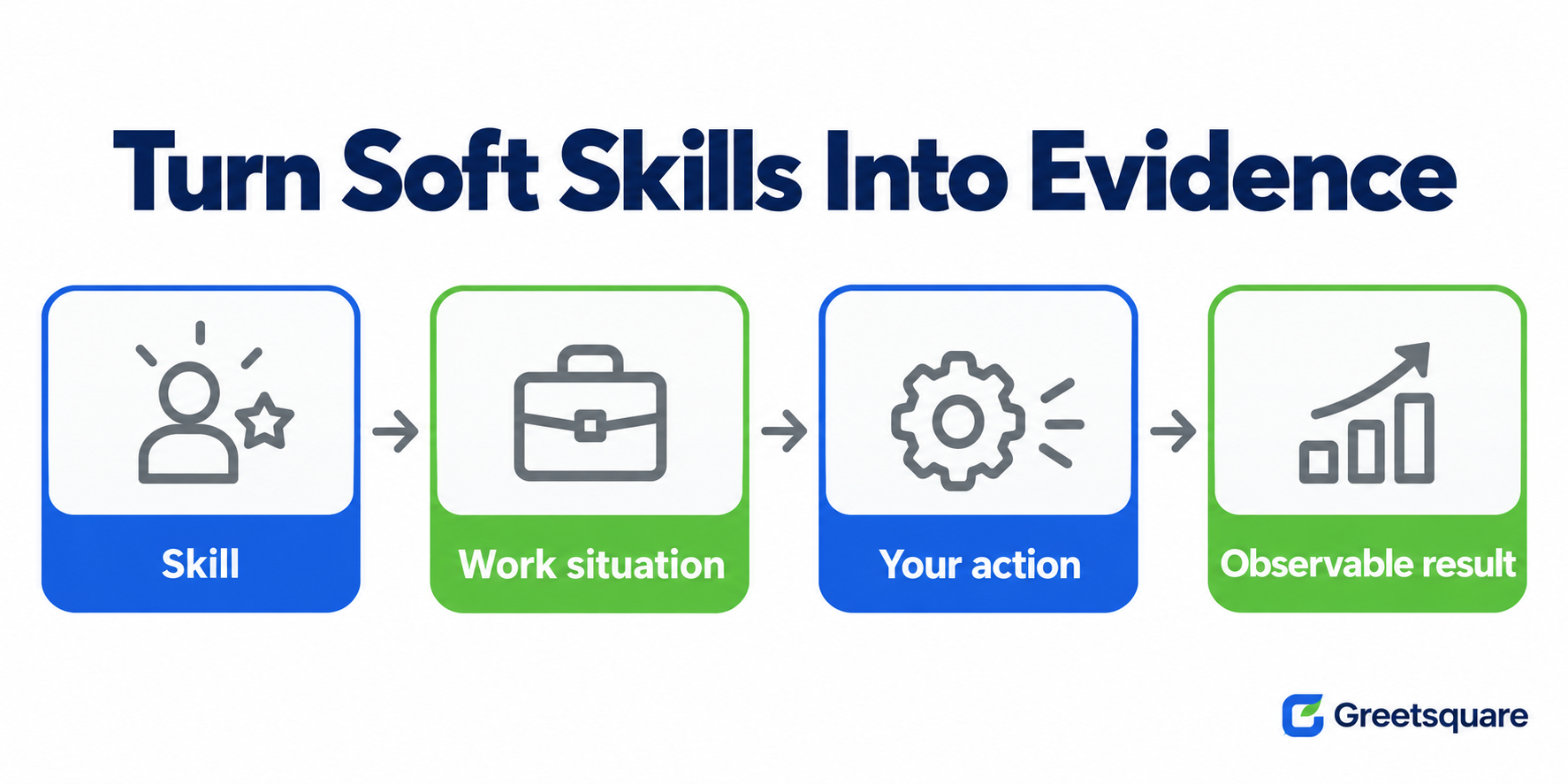
Start with three responsibilities from the job description. For each, identify the behaviour needed to deliver it and one situation where you used that behaviour. This gives you a focused preparation sheet instead of an oversized list of strengths.
| Role Task | Useful Behaviour | Possible Evidence |
|---|---|---|
| Coordinate a deadline | Prioritisation and collaboration | A plan that resolved competing dependencies |
| Explain a finding | Communication and judgement | A brief that supported a clear decision |
| Resolve a service issue | Listening and problem solving | A documented resolution and follow-through |
These are illustrative examples, not results you should copy. Your evidence can come from paid employment, volunteering, study or a community project, provided you identify the setting honestly. Do not relabel a classroom exercise as commercial experience.
For role-specific expectations, compare the responsibilities in our job roles and hiring guide. A skill that matters across many roles can still require a different level of judgement at different seniorities.
Write Evidence That Survives a Follow-Up Question
A useful structure is situation, action and result, followed by what you learned. Keep the background short enough that the reader can see your decision. If someone asks why you chose that action, you should be able to explain the alternative you considered.
For example, a candidate could describe receiving inconsistent requirements, asking each stakeholder to confirm priorities and recording the agreed scope before work resumed. If the outcome was qualitative, say so. An agreed decision or reduced confusion can be valid evidence without an invented percentage.
Use numbers only when you can explain their source, timeframe and meaning. Protect client information and confidential documents. You can describe the nature of an improvement without publishing internal figures or naming a customer who has not agreed to disclosure.
Use Each Application Format for a Different Job
On your resume, attach the behaviour to an achievement or responsibility. During an interview, explain your judgement and answer follow-up questions. A portfolio can show a permitted work sample, such as an anonymised process note or a project retrospective.
A short video is useful for a concise explanation of one relevant example, when the employer accepts it. It cannot establish every skill, and it does not replace technical assessments or the requested application. If appropriate, use Greetsquare to prepare a professional video introduction that adds context to your written evidence.
Practise One Behaviour and Review the Result
Choose a small action you can repeat this week. You might send a clearer meeting summary, ask a colleague to identify an unclear instruction or rehearse explaining a technical idea to someone outside your field. Seek feedback on whether the message was useful, not whether you sounded impressive.
Record what improved and what remains difficult. Soft skills develop through practice and reflection, rather than through collecting labels. Before your next application, select two strong examples that match the employer’s work and make your own contribution unmistakable.
Frequently Asked Questions
What Are Soft Skills in a Job Application?
Soft skills are behaviours that help you work effectively, such as communication, collaboration, adaptability and self-management. In an application, connect each skill to a real situation and your contribution. A specific example gives an employer more useful information than an unsupported list of positive personality traits.
Which Soft Skills Should I Put on My Resume?
Choose skills that match the responsibilities in the vacancy. Include them through achievement statements or examples of how you worked, rather than adding every skill you can name. Prioritise claims you can explain in an interview and support with honest details about your actions and results.
How Can I Prove Soft Skills Without Work Experience?
Use relevant examples from study, volunteering, clubs or personal projects, and identify the setting clearly. Explain the problem, your action and the outcome. Coordinating a group deadline or resolving conflicting requirements can demonstrate useful behaviour, provided you describe your actual contribution rather than the whole team’s work.
Can a Video Resume Prove My Soft Skills?
A video resume can show how clearly you explain a relevant example, but it cannot prove every soft skill or predict job performance on its own. Use it when the employer accepts the format. Support your introduction with written evidence, work samples where appropriate and answers to follow-up questions.



