
A software engineer job description sets out responsibility for designing, building, testing and maintaining software that meets user and business needs. The work includes understanding requirements, reviewing code, diagnosing failures and improving reliability. The balance varies across frontend, backend, mobile, platform and other engineering specialisms.
The title alone does not tell you what a vacancy expects. One team needs someone to deliver a well-defined feature; another needs an engineer who can identify the right technical approach across several services. Read the responsibilities as a description of ownership, then choose evidence at the same level.
What Employment Research Says About Software Work
The US Bureau of Labor Statistics projects 10% growth in software developer employment from 2025 to 2035. Its wider profile also covers quality assurance analysts and testers, whose work should not be confused with a developer’s exact responsibilities. The projection describes the US market, not Singapore hiring demand. Source: BLS software occupations profile.
For applicants, this context does not remove the need to prove practical capability. A team hiring for a production service needs confidence that you can investigate unfamiliar behaviour and deliver changes safely. A long technology list gives less insight than a clear account of how you solved a relevant problem.
Read a Software Engineer Job Description by Ownership
Look for the systems, users and constraints involved. A customer-facing web application may emphasise accessibility and response time. A payments service may emphasise correctness, auditability and failure recovery. An internal tool may prioritise a dependable workflow and straightforward maintenance.
Identify what happens after code is merged. Does the role include deployments, monitoring, on-call participation or incident reviews? These expectations affect both the skills required and the working arrangement. Ask how support is organised and how responsibility is shared across the team.
The job roles overview provides a broader way to compare responsibilities. For engineering, the essential distinction is between completing assigned implementation tasks and independently managing uncertainty, dependencies and technical consequences.
Responsibilities Through the Software Lifecycle
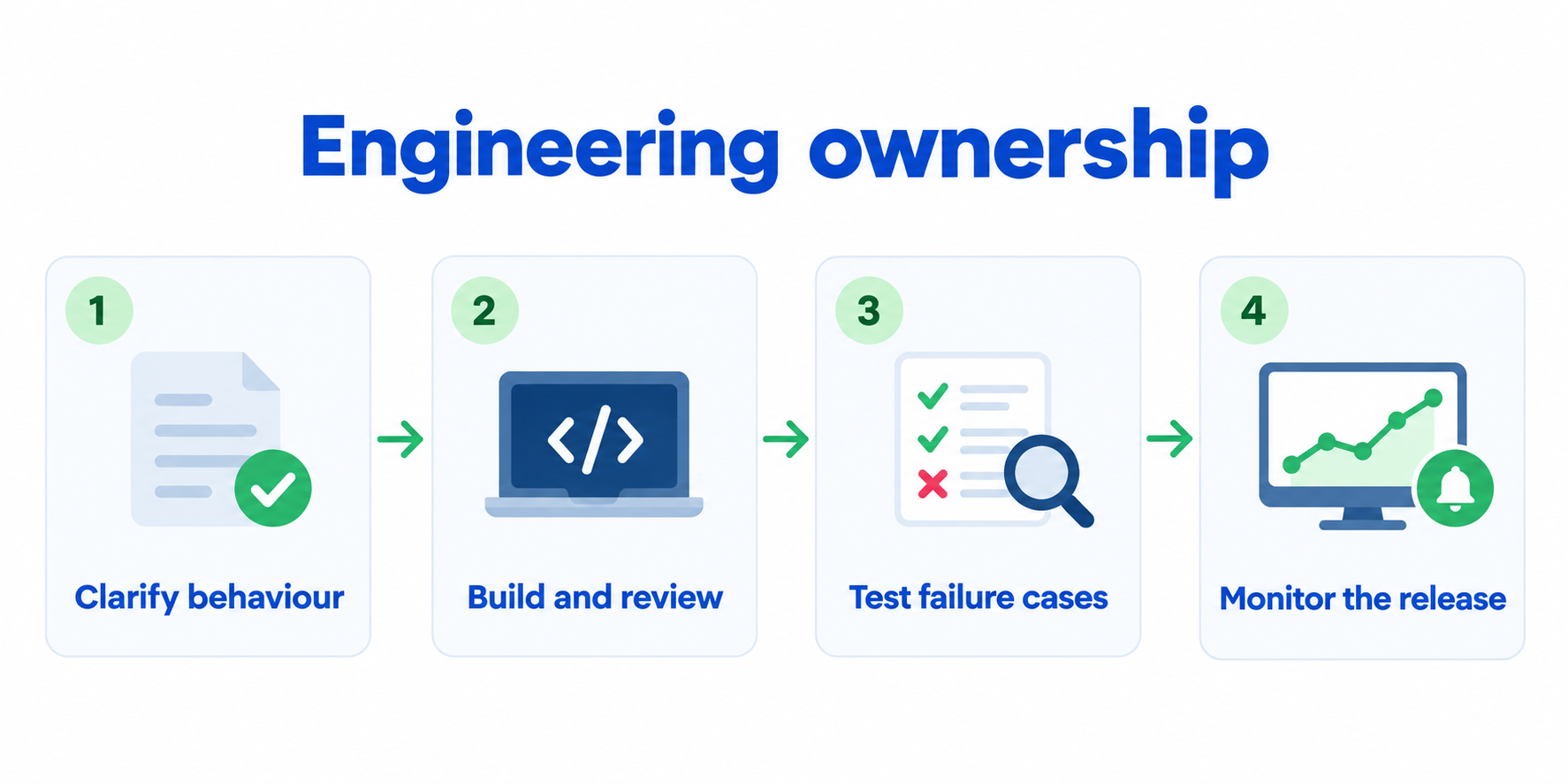
Clarify the Intended Behaviour
Before implementation, an engineer turns an ambiguous request into behaviour that can be discussed and tested. What should happen when the input is missing, the user lacks permission or another service is unavailable? Resolving these questions early prevents a polished interface from hiding an incomplete workflow.
The engineer collaborates with product, design and relevant domain specialists. They may suggest a smaller change that tests the requirement before a larger commitment. A technical proposal should make assumptions and trade-offs visible without requiring every stakeholder to read source code.
Build, Review and Test the Change
Implementation includes choosing suitable data structures, interfaces and error handling. Maintainability matters because other engineers will need to understand and change the code. Consistent naming, focused functions and clear boundaries can make a modest solution more valuable than an elaborate design.
Code review checks reasoning as well as style. Tests should cover meaningful behaviour and likely failure paths, with the mix depending on the system. An engineer also considers permissions, sensitive data and dependencies rather than treating security as a final checklist.
Release, Observe and Maintain
A successful build is not the same as a successful release. Engineers need a way to recognise whether the change behaves as intended in its actual environment. Logs, metrics and user feedback can reveal problems that were absent from test data.
Maintenance includes investigating defects, improving slow paths and retiring outdated assumptions. When something fails, a useful incident review explains contributing conditions and practical prevention. Blaming an individual or adding an alert without an owner rarely improves the system’s long-term reliability.
Technical Skills and Evidence of Judgement
Language and framework requirements depend on the vacancy. Java, Python, JavaScript or another language may matter because it is already used by the team. Show that you can work effectively in the relevant environment, but also demonstrate transferable reasoning about data, interfaces and system behaviour.
Version control, debugging and automated testing are practical foundations. Database knowledge may include understanding query behaviour and data consistency. An API-focused role may require clear contracts, validation and versioning decisions. Choose depth that matches the work rather than claiming equal expertise across every area.
When using AI coding tools, explain how you review generated output and verify its behaviour. Ownership still requires understanding the code you submit. A useful interview example describes a suggestion you rejected, the issue you found and the test or reasoning that exposed it.
Qualifications and Seniority Expectations
Employers may request a computer science degree, a related qualification or equivalent practical experience. Some positions impose specific educational requirements, while others place more weight on demonstrated engineering work. Follow the vacancy’s stated criteria and avoid implying that one route guarantees entry.
At junior level, evidence might show that you can complete a bounded task, ask useful questions and respond to review. At a more experienced level, employers may look for independent diagnosis, design choices and ownership across releases. Senior engineers may also help others make better decisions and reduce uncertainty across teams.
For an early-career overview, the computer science graduate careers guide discusses starting options. This job description guide focuses on the engineering responsibilities against which your evidence will be assessed.
Present a Project That Proves More Than Coding Speed
Choose a project with a real constraint and make your contribution explicit. Explain the intended user behaviour, the system boundary and the decision you owned. A small, well-explained project can provide stronger evidence than a large repository whose design you cannot discuss.
Consider a fictional booking service that occasionally accepts duplicate requests. A useful engineering story would cover how the issue was reproduced, where duplicate processing occurred and how the proposed fix preserved legitimate retries. The lesson is the investigation and verification, not simply the addition of a database field.
Keep a short evidence pack: a sanitised architecture sketch, a focused code change and relevant test results. Never share an employer’s private repository, credentials or customer records. If you use a personal reconstruction, label it clearly and explain which part reflects your experience.
Prepare for Technical and Collaborative Interviews
Practise explaining a trade-off aloud. Why did you choose that approach? What alternative did you reject? What would change if the workload or reliability requirement increased? Your answer should reveal how you think under constraints rather than recite fashionable architecture terms.
For a debugging exercise, describe what you know, what you suspect and the next observation that would distinguish competing explanations. For a collaboration question, explain how you resolved disagreement through evidence. The tough interview questions guide helps structure the behavioural side of that preparation.
Ask who owns technical priorities, how code reaches production and how the team allocates maintenance work. These questions help you assess whether the vacancy’s expectations match its engineering practices. They also give you a more concrete picture of the support available to new hires.
Build a Clear Application Around the Target Role
Tailor your resume to two or three responsibilities that matter most for the vacancy. State what you changed, why it mattered and how you checked the result. Describe shared work accurately without taking credit for an entire team’s output.
If you include a short demonstration, use the dedicated software engineer video resume guide for screen-recording advice. The broader video resume guide explains structure. A concise introduction on Greetsquare can connect your technical examples with the role you want.
Frequently Asked Questions
What Is the Main Responsibility of a Software Engineer?
The main responsibility is delivering software that meets an agreed need and remains understandable and dependable over time. That includes clarifying requirements, implementing changes, testing behaviour and maintaining the result. Exact ownership depends on the team, especially for deployment, infrastructure and support after a release.
Is Software Engineering Only About Writing Code?
No. Coding is one part of a lifecycle that also includes problem definition, design, review, testing, troubleshooting and communication. Engineers frequently spend time understanding existing systems and coordinating changes with others. Their value includes choosing an appropriate solution and checking that it works under realistic conditions.
Do Software Engineers Need a Degree?
Requirements vary by employer and role. Some vacancies require a relevant degree, while others accept equivalent experience supported by strong work samples. Read the stated criteria carefully. A qualification or portfolio can support an application, but neither automatically demonstrates all the skills required for a particular position.
What Makes a Strong Software Engineering Portfolio?
A strong portfolio explains a problem, your implementation choices and how you verified the outcome. Include clear setup instructions, focused examples and relevant tests. Show your own contribution and discuss limitations honestly. Avoid sharing confidential code, access tokens or customer information from previous employment or client work.



