
What should you say in a video resume? Introduce the role you are pursuing, connect your experience to a relevant requirement, explain one contribution and finish with a practical next step. The video resume script templates below give you a starting structure. They need your own evidence, natural wording and the correct length for the application.
What Interview Preparation Guidance Supports
Harvard’s interviewing guidance recommends preparation and practice so you can explain your experience clearly, rather than memorising answers. Recording yourself can help you review your delivery. Applying that communication principle to a video resume is an editorial recommendation here, not evidence that a particular script increases interview invitations.
A script should help you select information. It should not turn your introduction into a performance of qualifications you do not hold. Start with the job requirements and your actual work, then decide what the listener needs to understand. Greetsquare’s video resume guide explains where this format fits alongside a conventional application.
Build a Script in Four Parts
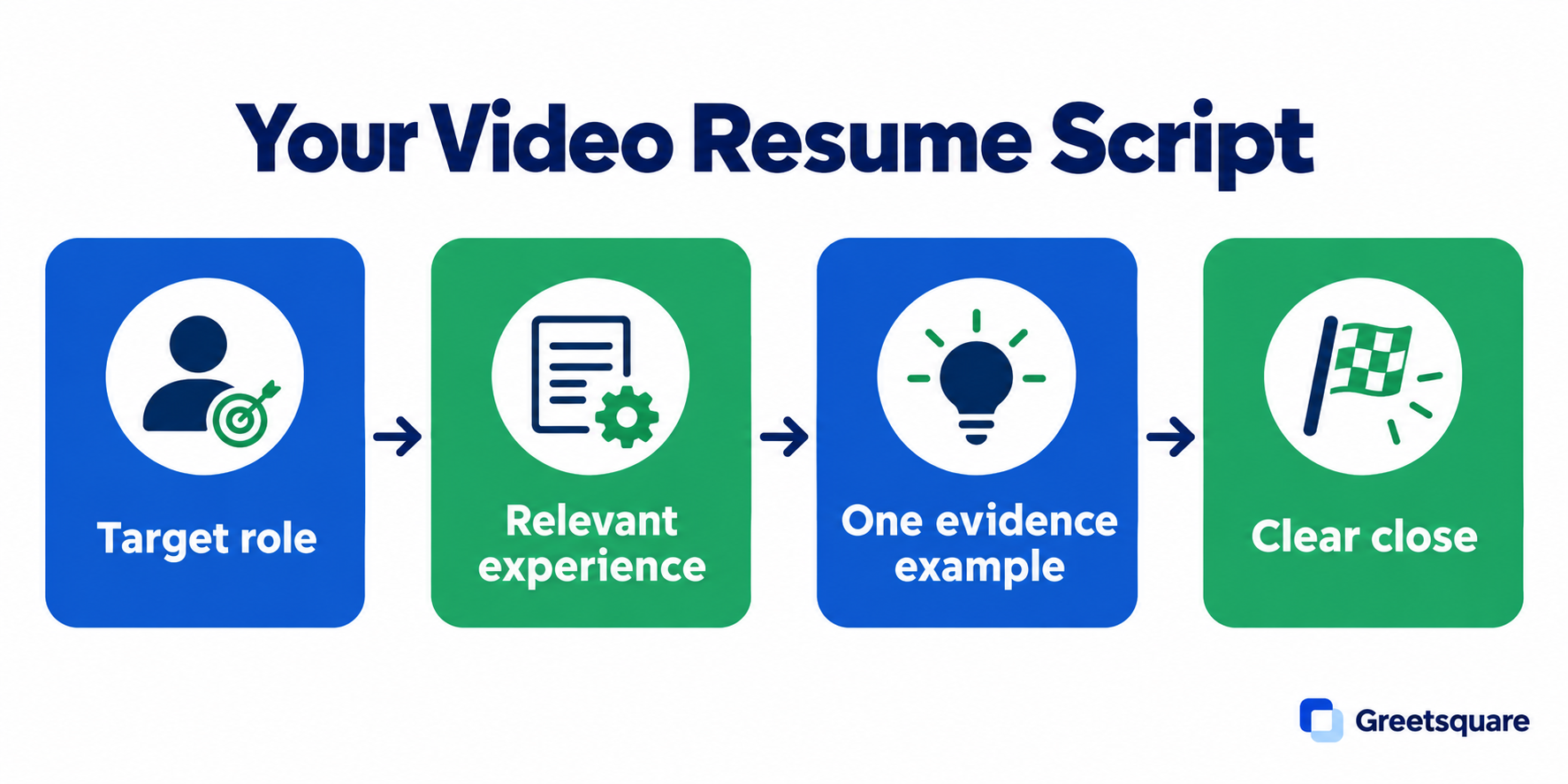
Use four parts: role, relevant background, evidence and close. The balance depends on the purpose of the recording. If an employer supplies specific questions, answer those questions instead of imposing this template. A public profile introduction also needs different wording from a recording addressed to one vacancy.
| Part | Question to Answer | Useful Content |
|---|---|---|
| Opening | What work are you seeking? | A specific role or function |
| Background | What experience matters here? | Relevant responsibilities or project context |
| Evidence | What did you personally contribute? | One action and a supportable outcome |
| Close | What should the reviewer do next? | Review your CV, portfolio or application |
Read the sequence aloud before polishing individual words. If the target role is unclear until the final sentence, move it forward. If your example needs several minutes of background, choose a simpler example or narrow the claim. A short introduction can leave room for an interviewer to explore the details later.
A Flexible Video Resume Script Template
Template: “Hello, I’m [name], and I’m applying for [role]. My experience in [relevant work or study] has involved [responsibility connected to the vacancy]. In [specific situation], I [personal action], which [supported outcome or learning]. I’m interested in this role because [specific connection to the work]. You can find more detail in my [CV or permitted portfolio]. Thank you for considering my application.”
This is a scaffold, not a finished answer. Remove the brackets, shorten unfamiliar phrases and verify every claim. You do not need to say your name twice, repeat contact details already visible in the application or include a generic slogan. Your example should carry more meaning than an adjective such as hardworking or passionate.
Replace a Claim with an Explanation
Instead of “I have excellent communication skills,” describe who needed information and what you did to make it useful. You might explain that you consolidated stakeholder questions into a weekly status update. If the result was clearer decision-making but you did not measure a numerical improvement, say that. Do not invent a percentage to make the script sound stronger.
Adapt the Template to Your Experience
For a Fresh Graduate
Hypothetical example: “Hello, I’m Mei, and I’m applying for a junior analyst role. In my final-year project, I worked with a team to investigate inconsistent survey responses. I checked the source files and documented the cleaning rules so our analysis could be reproduced. That experience strengthened my interest in reliable reporting. My CV includes the project scope and the tools I used.”
Use genuine coursework, volunteering, internships or projects. Identify your own contribution within team work. Completing a classroom exercise does not make you responsible for a commercial result. If you are unsure how to present those experiences, the guide to turning internships and projects into job experience helps you separate context, action and learning.
For an Experienced Professional
Hypothetical example: “Hello, I’m Daniel, an operations professional applying for a process improvement role. My recent work has included coordinating handovers between service teams. For one recurring issue, I mapped the steps, identified missing ownership and helped introduce a shared checklist. I’m interested in applying that practical approach to your service operations. My CV provides the responsibilities and project detail.”
The important point is the connection between past work and the vacancy. Do not squeeze your entire career chronology into the introduction. Choose the experience that helps a reviewer understand why a further conversation would be relevant. Leadership claims also need a clear distinction between what you decided, what you influenced and what the wider team achieved.
Choose Wording That Sounds Natural
Write short sentences with one main idea each. Say “I checked the figures” if that accurately describes the work, rather than “I operationalised numerical validation.” Use technical language when it is necessary for the role, then add enough context for a recruiter who may not share your specialism.
Rehearse from a few cue words after the full draft is clear. Reading every word from a screen can make your pace uneven and your eye line distracting. The goal is accurate explanation, not perfect recall. If an employer permits notes, keep them brief and position them where they do not interfere with delivery.
For the recording workflow, use the step-by-step video resume guide. It covers the production decisions that this script article leaves aside, including how to organise the recording and review the final file.
Tailor the Evidence to the Role
The structure can stay consistent while the example changes. An analyst might explain how they checked a data source. A sales applicant might describe identifying a customer’s needs. A finance applicant could discuss reviewing an exception. A marketing applicant might explain how audience feedback changed a campaign decision.
Use the vacancy as the filter. A technically impressive story is not automatically the most relevant story. Ask whether it demonstrates a requirement the employer actually lists, and whether you can explain the action without exposing confidential information. The software engineer job description and marketing manager job description provide examples of how responsibilities differ by function.
Review the Script Before Recording
Check the target role, the accuracy of names and dates, the distinction between your work and team work, and the consistency with your CV. Then time a spoken version. Follow the requested limit; do not assume a universal ideal duration. Remove repeated claims before speeding up your delivery.
Ask a trusted reviewer what they understood about your role and contribution. If they remember your enthusiasm but cannot explain your example, improve the content. Keep the required written application complete and submit a video only where it is accepted. A clear script supports communication; it does not override eligibility requirements or guarantee selection.
Prepare Your Own Introduction
Choose one vacancy, draft the four parts and replace every placeholder with a verifiable detail. Record a practice take, listen without watching and check whether the message still makes sense. Improve the weakest sentence, then record again. This gives you a repeatable process for producing a concise introduction without reusing the same generic script everywhere.
Once your script is accurate and ready to record, you can explore Greetsquare’s video profile tools for your job search. Check the employer’s submission requirements before sharing a recording.
Frequently Asked Questions
Can I Use the Same Video Resume Script for Every Job?
You can reuse the structure, but change the target role, evidence and reason for applying. A generic introduction may miss the vacancy’s priorities. Keep a base draft, then check each sentence against the job requirements and replace examples that do not support the work being advertised.
Should I Memorise My Video Resume Script?
You do not need to memorise every word. Understand the sequence and practise explaining the example accurately. Short cue words can help if notes are allowed. Review the recording for clarity and pace, and avoid reading a dense paragraph that makes your delivery feel disconnected from the listener.
What Can I Say Without Professional Experience?
Use a real project, internship, volunteering activity or learning task that relates to the role. Explain the setting, your own action and what you learned or produced. Identify classroom work honestly. You do not need to invent commercial achievements to make an entry-level introduction useful to a reviewer.
How Long Should My Video Resume Script Be?
Follow the employer’s stated duration or platform requirements first. Time the script by speaking it naturally, because word counts alone do not account for pauses and explanations. If it runs long, remove repeated background and keep one relevant example rather than rushing several stories into the same recording.



