
Working in Singapore as a foreigner usually involves finding suitable employment and obtaining the appropriate permission to work before starting. The route depends on your situation and the job; for Employment Pass and S Pass applications, the employer or appointed employment agent applies. A job offer alone is not permission to begin work.
Plan the search and the immigration steps together without treating them as the same decision. An employer may consider you suitable for a role while still needing to assess the applicable pass requirements. This guide provides a planning framework; MOM’s current instructions govern the actual application.
What MOM Says About Employer-Led Applications
MOM’s Employment Pass application guidance states that an employer or appointed employment agent can submit the application and that candidates need not be in Singapore when it is submitted. This is useful for planning a search from overseas. It is not a promise of approval or a reason to relocate before the process is clear.
MOM’s Self-Assessment Tool guidance also distinguishes an indicative eligibility result from the actual outcome. Additional checks can affect the decision. Ask the employer which route it is considering and who will manage the process.
Start Working in Singapore as a Foreigner With a Suitable Role
Choose a target role family and level before applying widely. Show the experience and capabilities needed for the work, using examples that an employer can assess. An interest in moving to Singapore does not replace evidence that you can perform the job.
Read the vacancy’s location, responsibilities and application conditions carefully. Be accurate about your current location and work-authorisation position when asked. Do not imply that you already hold permission to work if you are relying on a future application.
Our comparison of Singapore job portals helps organise the search channels. Check employer career pages as well, and avoid counting the same vacancy on several platforms as separate opportunities.
Understand the Main Pass Routes Without Oversimplifying Them
Employment Pass
The Employment Pass is a route for eligible foreign professionals, managers, executives and technicians. Assessment includes the applicable qualifying salary and, unless exempt, COMPASS requirements. A job title or degree alone does not determine eligibility.
Check the current criteria for the candidate’s age, sector and intended application date. Published minimum figures should not be read as a universal threshold that applies to every applicant. Rules for new applications and renewals can also have different effective dates.
S Pass and Other Routes
The S Pass is another route for eligible skilled workers. Employer-side conditions matter as well as candidate criteria. MOM’s quota and levy guidance explains that employers face quota limits and levy obligations for S Pass holders.
Other passes serve particular circumstances and should not be treated as interchangeable alternatives. Use the official pass guidance for your situation. If the route is uncertain, obtain clarification from the employer and an appropriately qualified adviser rather than relying on informal comparisons.
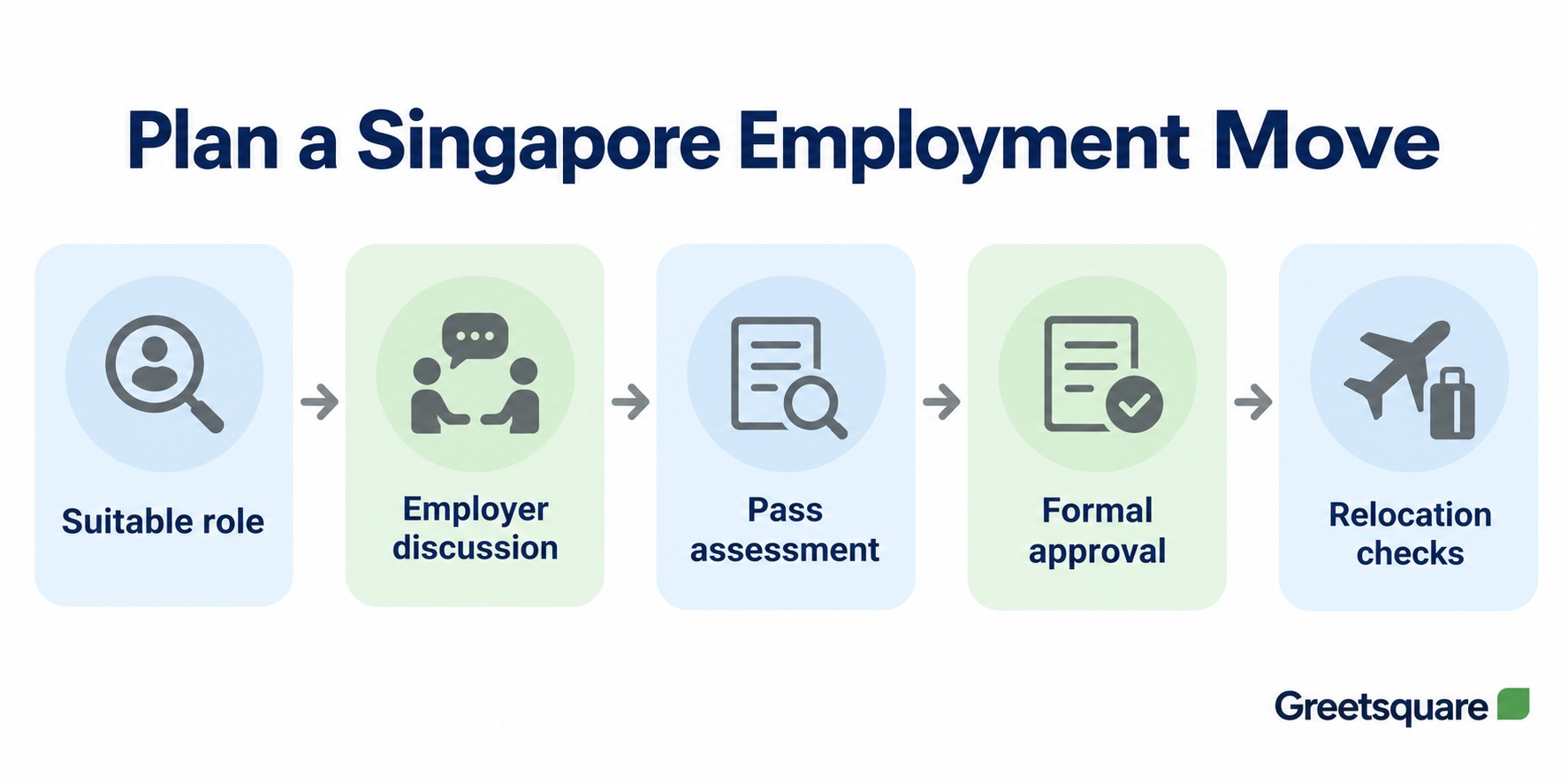
Ask the Employer Who Owns Each Step
Confirm who will assess the route, request documents, submit the application and communicate updates. Ask what must happen before a start date is confirmed. Do not assume a recruiter’s informal estimate is a guaranteed processing or approval date.
Provide accurate information through the agreed process and check documents before submission. Use secure channels for personal records. A request to correct an inconsistency is best handled promptly rather than by guessing which version will be more favourable.
Understand the difference between an application, an in-principle approval and the steps required to have the pass issued and begin work. Follow the instructions for the specific route. If you are already in Singapore under another status, do not assume that status permits the proposed employment.
Review the Offer and Relocation Plan Together
Confirm responsibilities, fixed and variable pay, probation, notice terms and the agreed work location. Ask which relocation costs, if any, the employer covers and whether repayment conditions apply. An allowance should not be assumed from a conversation about supporting your move.
Use our job offer comparison guide to separate confirmed terms from unresolved promises. Where a contract or immigration obligation is unclear, get suitable advice before relying on an interpretation.
Prepare a realistic budget using current housing, transport and household quotations for your circumstances. Distinguish one-off moving costs from recurring spending. Family arrangements, insurance and schooling can materially change the plan and may require separate eligibility checks.
Check the Workplace You Would Actually Join
Ask how decisions, feedback, workload and onboarding work in the team. A national reputation is not evidence about an individual manager. Our Singapore work culture guide provides questions that reveal practical expectations.
Clarify office attendance, client travel and working hours. A role advertised as hybrid does not automatically permit overseas remote work. Confirm the intended location and any changes with the employer before building your relocation plan around flexibility.
Prepare an Application That Makes Your Contribution Clear
Translate unfamiliar job titles and responsibilities into understandable scope without changing their meaning. Explain your own contribution to projects and provide relevant evidence. Keep confidential client or employer information out of public samples.
If the employer accepts a short introduction, use Greetsquare to explain your relevant experience alongside the requested documents. The video supports communication; it does not influence work-pass eligibility or replace official checks.
Make Commitments Only After the Key Details Are Confirmed
Keep a written checklist of the role, application owner, required documents, approval and issuance steps, start-date conditions and relocation commitments. Review it with the employer before making plans that depend on unresolved assumptions.
Recheck MOM’s current instructions when an application date or job arrangement changes. This is especially useful around announced policy changes. A careful move begins with clear responsibilities and verified information, rather than treating an offer as the end of the process.
Frequently Asked Questions
Can I Start Working in Singapore After Receiving a Job Offer?
A job offer alone does not establish permission to work. You must have the appropriate authorisation and complete the steps required for your situation before starting. Confirm the applicable pass route, approval and issuance requirements with the employer, using MOM’s current instructions rather than an informal promised start date.
Who Applies for an Employment Pass or S Pass?
The employer or appointed employment agent handles the application for these routes. The candidate supplies accurate information and documents through the agreed process. Ask who owns the assessment, submission and updates, and remember that an employer’s willingness to apply does not guarantee approval of the work-pass application.
Do I Need to Be in Singapore for an Employment Pass Application?
MOM states that candidates do not need to be in Singapore when an Employment Pass application is submitted. Confirm the employer’s process and follow any later arrival, issuance or registration instructions. Avoid making relocation commitments solely because an application is planned or because a recruiter estimates an approval date.
Does Meeting the Minimum Salary Guarantee a Work Pass?
No. The applicable salary requirement is only part of the assessment. Criteria depend on the route and circumstances, and employer-side or other checks can affect the outcome. Use current MOM guidance and the appropriate assessment process rather than treating one published salary figure as a universal approval rule.



