

A business analyst job description defines responsibility for understanding a business problem, analysing current processes and specifying what a useful change must achieve. Business analysts work with stakeholders to clarify needs, evaluate options and validate requirements. The role can support technology projects, operational improvements or wider organisational change.
This is not automatically a data analysis position or a project management role. Some jobs combine these responsibilities, but the central question is what the organisation needs to change and why. Understanding that distinction helps you select relevant vacancies and present the right work examples.
How the Professional Standard Defines Business Analysis
The International Institute of Business Analysis describes business analysis in terms of defining needs and recommending solutions that create stakeholder value. Its guidance recognises that the work appears under several job titles, not only business analyst. Source: IIBA’s explanation of business analysis.
This is professional guidance rather than a hiring forecast. Its practical value is a test for your evidence: can you explain the need behind a requirement and the benefit expected from meeting it? A document is a useful output only when it improves understanding or supports a decision.
What a Business Analyst Job Description Should Clarify
Identify the business area and type of change. A role improving a claims process requires different domain knowledge from one supporting an internal finance system. Both may involve workshops and requirements, but their stakeholders, constraints and evidence will differ.
Look for the expected deliverables. Process maps, business rules, user stories, impact assessments and acceptance criteria are common examples, but not every employer needs all of them. Ask how these outputs are used and who agrees that they are complete enough to support delivery.
Reporting lines may sit within technology, operations, a change team or a product organisation. The job roles overview helps compare these variations. Clarify whether you will lead analysis independently or work under a senior analyst on a defined part of the problem.
Responsibilities From Problem Definition to Validation
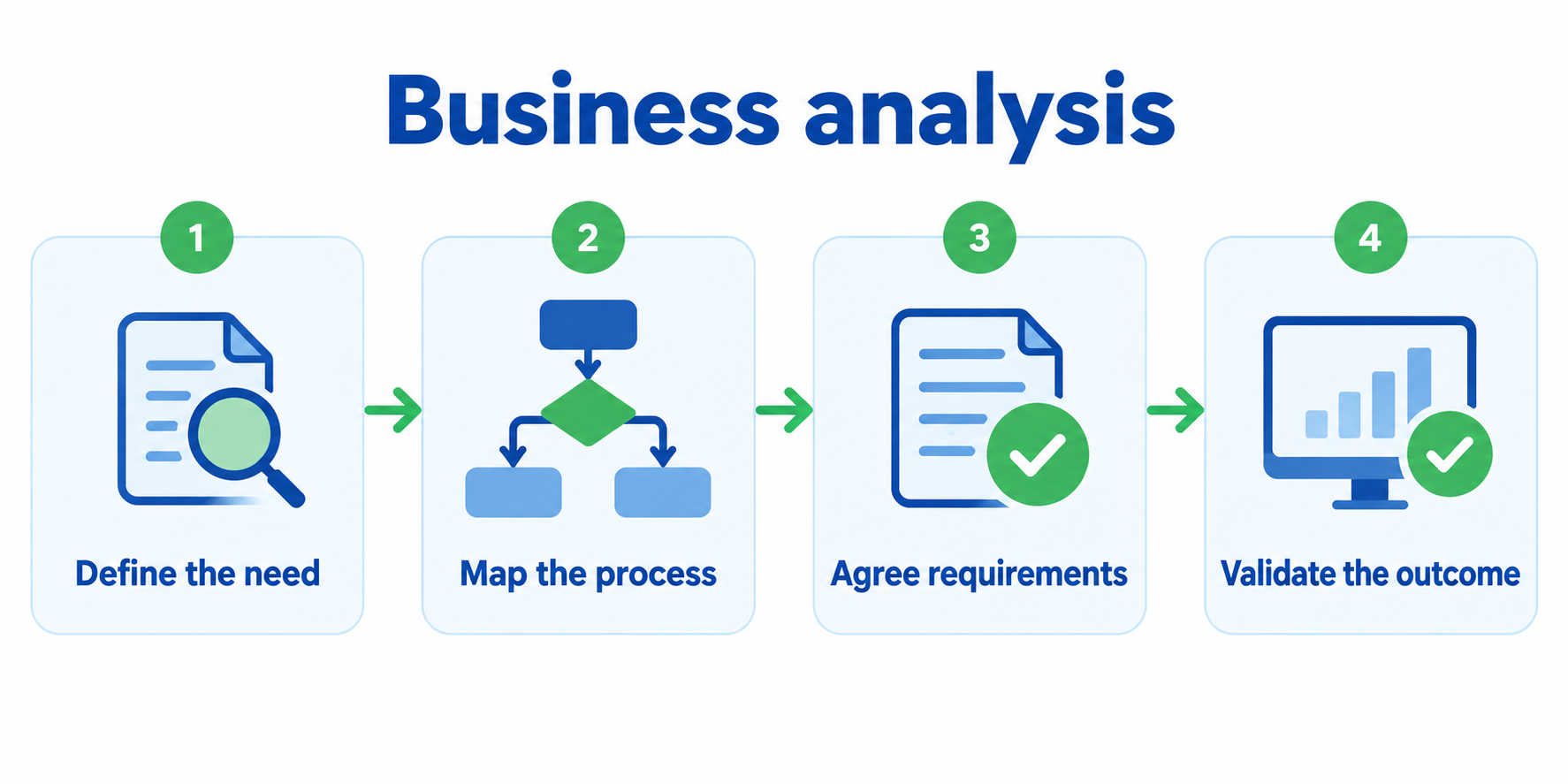
Establish the Current State and Underlying Need
Business analysts gather information from people who perform, manage and depend on a process. Interviews, observation and existing records can reveal differences between the documented workflow and the work actually happening. A useful current-state map includes exceptions and handoffs, not just the ideal path.
Separate the problem from the first suggested solution. “We need a new dashboard” might hide delayed decisions, inconsistent definitions or missing information. Ask what decision needs to improve and what prevents it today before treating a dashboard as the agreed answer.
Analyse Options and Agree Requirements
The analyst helps stakeholders compare feasible ways to address the need. Options might involve changing a process, adjusting responsibilities or modifying a system. The recommendation should explain the expected benefit, constraints and assumptions without pretending that all consequences are already known.
Requirements translate that agreement into clear expectations. They should be understandable, relevant and sufficiently testable for the situation. Where stakeholders disagree, document the unresolved decision and the person authorised to make it rather than burying the conflict inside ambiguous wording.
Support Delivery and Check the Outcome
During implementation, questions arise as teams encounter detail that was not visible earlier. Business analysts clarify intent, assess the impact of proposed changes and keep related requirements consistent. They help stakeholders understand what an adjustment means for the original business need.
Validation asks whether the delivered change meets agreed expectations. A feature can pass a technical test and still fail to support the real workflow. The analyst may help define realistic scenarios, coordinate business feedback and identify whether the expected benefit can now be observed.
Skills That Distinguish Useful Analysis From Documentation
Questioning is a core skill. You need to uncover assumptions without making stakeholders feel that their experience is being dismissed. Ask for a recent example, trace what happened and compare it with the stated process. Concrete cases often reveal issues that a broad workshop question misses.
Process modelling and structured writing help make complex work understandable. Tools such as spreadsheets, diagramming applications and issue trackers support the analysis; they do not replace it. A clear one-page process map can be more valuable than an extensive document that nobody can use.
Data literacy helps you test claims and identify patterns. Some vacancies require SQL or advanced analysis, while others need mainly domain expertise and facilitation. Check the actual tasks before assuming that every business analyst must be a programmer or statistical specialist.
Distinguish the Role From Adjacent Positions
A project manager commonly coordinates scope, schedule, resources and delivery risks. A business analyst investigates needs and clarifies the requirements that guide the work. The two roles collaborate closely, and smaller teams may combine them. Read the project manager job description to compare ownership.
A data analyst usually concentrates on extracting and interpreting information from data. A business analyst may use that evidence to assess a process or requirement, but can also work on changes where interviews and operational observation are central. Overlap in tools does not make the two jobs identical.
A product manager may own product priorities and outcomes over time. Business analysis can inform those decisions by making needs, rules and impacts explicit. In an interview, ask which decisions the analyst recommends, which they own and which require agreement from a sponsor or product leader.
Qualifications and Examples of Relevant Experience
Employers may seek a degree in business, technology or a relevant domain, along with analysis experience. A professional certification can demonstrate structured learning, but it does not replace evidence of managing unclear needs and stakeholder disagreement. Treat qualifications as one part of the vacancy’s criteria.
Experience can come from work performed under another title. An operations specialist who mapped a process and helped validate an improved workflow may have relevant evidence. Describe the analysis you actually conducted without inflating your authority or claiming ownership of the entire change programme.
Build a Case Study Around One Changed Decision
Use a simple chain: problem, evidence, options, requirement and validation. Explain what you learned that changed the team’s understanding. Include enough context for a reader to see why your analysis mattered without overwhelming them with every meeting and document.
Consider a fictional order process with frequent rework. Stakeholders initially request another mandatory form, but observation shows that two teams use different definitions of an approved order. The analyst helps agree a shared rule and tests it against exception cases before a system change is specified.
That case demonstrates more than workshop attendance. It shows how the analyst challenged an assumption and improved the decision. If you have a measurable result, explain the baseline and period; if implementation has not finished, describe the verified intermediate outcome honestly.
Prepare for Interviews and Your Next Application
Expect scenarios with incomplete information. Start by clarifying the business need, stakeholders and constraints rather than immediately proposing a tool. Explain how you would discover exceptions, prioritise uncertainty and decide whether a requirement is ready for delivery.
Prepare a disagreement example using the guide to tough interview questions. Describe how you made alternatives understandable and reached a decision, including any issue that remained unresolved. Employers need to see that you can support progress without manufacturing agreement.
Choose two relevant examples for your resume. If a video introduction suits the application, use the video resume guide to explain one problem and the insight you contributed. Present that evidence through Greetsquare’s jobseeker platform alongside your experience and qualifications.
Frequently Asked Questions
What Does a Business Analyst Actually Deliver?
A business analyst delivers clearer understanding and requirements that support a useful business change. Tangible outputs may include process maps, business rules, option assessments, user stories and acceptance criteria. The right output depends on the problem and how stakeholders will use it to make or validate decisions.
Does a Business Analyst Need Coding Skills?
Not every business analyst role requires coding. Some positions need SQL, technical system knowledge or familiarity with APIs, while others focus on operations, processes and stakeholder analysis. Read the vacancy’s tasks carefully. Technical fluency should support the analysis required rather than become a substitute for understanding business needs.
Can Someone Move Into Business Analysis From Operations?
Yes, operational experience can be relevant when it includes investigating problems, understanding workflows and helping implement improvements. Show examples of the analysis you performed and the decisions it informed. You may still need to develop structured requirements writing, modelling or technical knowledge to match a particular vacancy.
How Is a Business Analyst Different From a Project Manager?
A business analyst primarily clarifies needs, evaluates change options and helps define requirements. A project manager primarily coordinates delivery across scope, schedule, resources and risks. Responsibilities can overlap, especially in smaller teams, so confirm who owns analysis decisions and who manages the overall delivery commitment for the vacancy.



