
A product manager job description sets out responsibility for product direction, prioritisation and outcomes. Product managers investigate user needs, compare opportunities and align teams around useful changes. They work with design, engineering, commercial and operational colleagues, often without being those colleagues’ line manager.
The role continues beyond a single launch. A product manager needs to understand whether a change solves the intended problem and what should happen next. Before applying, identify the product’s users, business model and decision boundaries so that your examples match the actual position.
What Professional Guidance Says About Product Management
Atlassian’s product-management guidance describes balancing user, business and technology needs, with responsibilities that vary by organisation size. It also cautions against assuming that the role comes with unlimited authority over other teams. This is practitioner guidance, not a labour-market forecast. Source: Atlassian’s product manager guide.
For applicants, the useful implication is that judgement and influence need visible evidence. Completing a roadmap presentation does not show why the priorities were right. A stronger case explains the information available, the competing options and the reasoning that helped the team commit to a direction.
What a Product Manager Job Description Should Clarify
Start with the scope of the product. You might own a whole early-stage service, a customer journey within an established platform or an internal tool. Each requires different levels of domain knowledge, coordination and independence. Ask which users and outcomes fall within the position’s remit.
Next, identify the stage of work. A team seeking product-market fit needs different evidence from one improving a mature workflow. Growth, platform and business-to-business product roles can also carry different constraints. Avoid treating every vacancy as the same combination of interviews, backlog management and launches.
Decision authority matters. Clarify who chooses strategic priorities, approves investment and commits engineering capacity. Use the job roles overview to compare responsibility levels, then ask where this role can make decisions independently and where it must seek agreement.
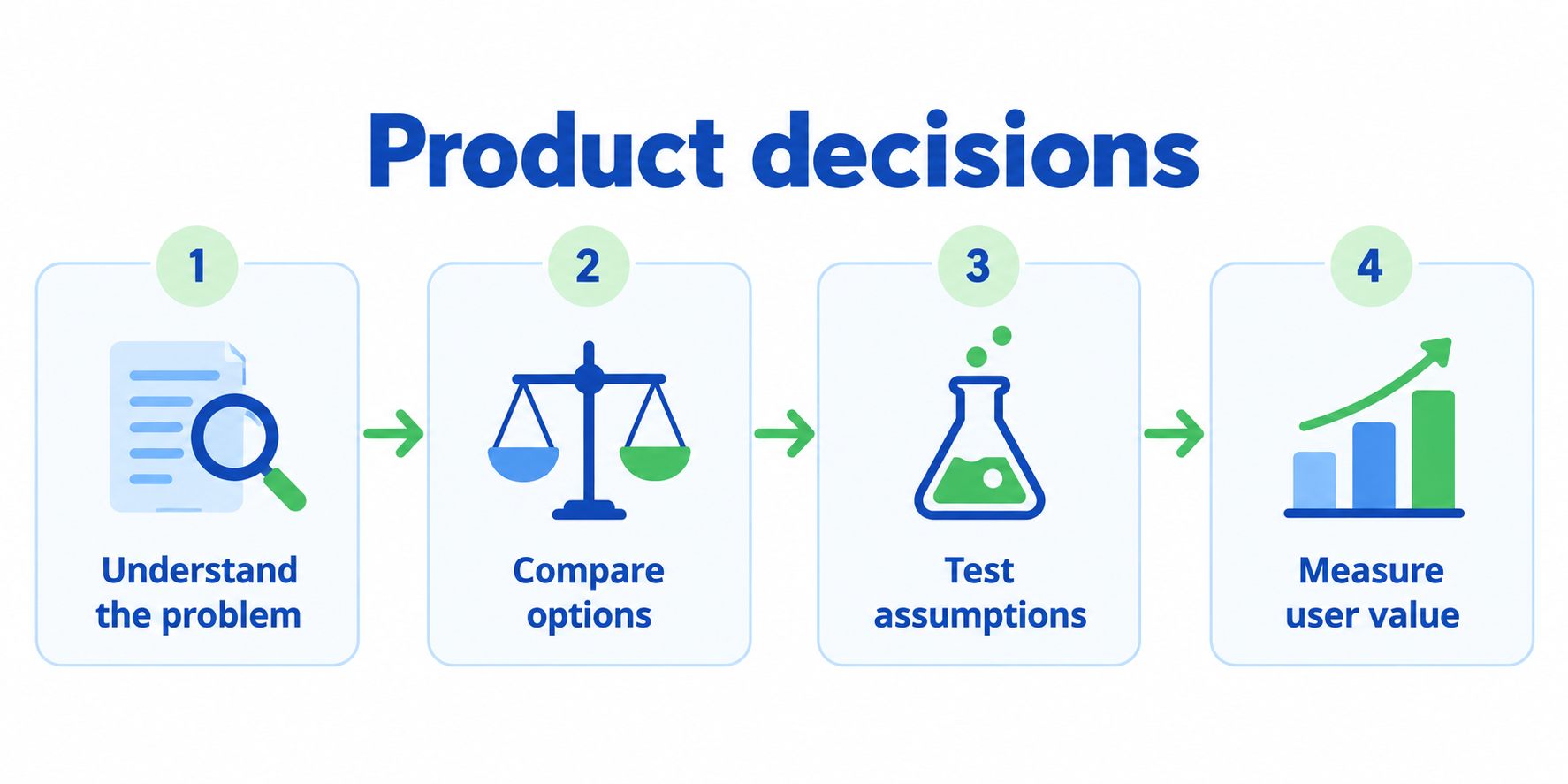
Core Responsibilities Through a Product Decision Cycle
Discover a Problem Worth Solving
Product discovery examines how people currently achieve a goal and what gets in their way. Customer conversations, behavioural data, support records and direct observation can all contribute. The manager looks for evidence of a meaningful problem rather than collecting requests as if every request should become a feature.
Distinguish the user from the buyer when they are different people. An enterprise customer may purchase a product that frontline staff struggle to use. Understanding both perspectives helps the team avoid improving a sales demonstration while making the real workflow harder.
Prioritise Options and Make Trade-Offs Explicit
Product managers compare opportunities against the product’s goals and constraints. A simple assessment of expected value, confidence, effort and risk can support discussion, but a scoring method does not make a weak assumption reliable. Record what remains uncertain and how that uncertainty affects the decision.
The roadmap should communicate direction and sequencing at an appropriate level of confidence. Some commitments have fixed dates; other opportunities need more investigation. Make that difference visible so that stakeholders do not interpret every idea as an unconditional delivery promise.
Work With Delivery Teams and Learn After Release
During delivery, the manager clarifies the problem and intended outcome while collaborating on scope. Engineers and designers contribute expertise about feasibility and experience. Product ownership works better when those perspectives shape the decision rather than arrive only after a specification is treated as final.
After release, check whether users can accomplish the intended task and whether the business outcome moved in a meaningful way. Review adoption, quality and unintended consequences together. A launch is a milestone; learning whether the change helped is a separate responsibility.
Skills Employers Assess in Product Candidates
Analytical thinking helps you distinguish a signal from an attractive number. You should be able to define a metric, recognise gaps in its interpretation and explain what action it supports. An increase in activity does not automatically mean users received more value.
Research and communication skills help you ask useful questions and explain priorities. Stakeholders need to understand why an option was chosen and why another was deferred. Clear reasoning is particularly valuable when several teams want the same limited capacity for different objectives.
Technical fluency means understanding enough about the product to discuss constraints and consequences with engineering. It does not mean pretending to be the technical authority on every implementation detail. The required depth varies between a developer platform, an internal service and a consumer application.
Product Manager, Product Owner and Project Manager
These titles can overlap, so treat job descriptions as evidence rather than assuming a universal hierarchy. A product manager commonly focuses on product direction and outcomes. Product owner responsibilities may concentrate on backlog decisions and the team’s value priorities, depending on how the organisation works.
A project manager usually coordinates delivery within an agreed scope, schedule and resource structure. The project manager job description explains that role in more detail. A product manager may make decisions about what should be pursued before a particular delivery effort is defined.
Ask how the employer separates discovery, prioritisation and delivery coordination. If one person performs all three, find out what support exists. A broad role can offer useful ownership, but unclear responsibilities can make it difficult to know what success should look like.
Qualifications and Experience That Support Role Fit
Employers may value experience in product work, a relevant domain, technology, design or commercial operations. A specific degree or certification may be requested, but requirements vary. The strongest evidence connects your background with the product problems this employer needs solved.
For a move into product management, identify decisions you already helped make. Perhaps you investigated a workflow, evaluated alternatives or worked with a team to test a change. Explain your contribution accurately and identify skills you still need to develop.
Longer-term development is covered in the product management training and progression guide. For this application, focus on the current vacancy’s scope rather than presenting ambition for an executive role as proof of readiness for day-to-day product ownership.
Build a Case Study Around a Decision You Can Defend
Structure the case around the user problem, evidence, options, decision and outcome. State what you personally owned. Include the limits of your evidence so the reader can judge whether the decision was reasonable under the circumstances.
Consider a fictional team asked to add a dashboard for new customers. Investigation reveals that customers abandon setup because they do not understand a required configuration step. The manager helps prioritise a smaller onboarding change and agrees how the team will test whether it reduces that barrier.
The important evidence is not that a small feature beat a large feature. It is that the team revised its understanding before committing resources. Explain what would have changed your recommendation and whether the eventual result supported the original assumption.
Prepare for Interviews and a Focused Application
Expect questions about conflicting priorities, incomplete data and unsuccessful decisions. Start with the objective and clarify assumptions before proposing a feature. Use the tough interview questions guide to practise a concise explanation of your reasoning and learning.
Ask how the team gains access to users, measures outcomes and revisits priorities. Then choose two examples that fit the vacancy. If a short introduction is appropriate, follow the video resume guide and present your experience on Greetsquare alongside your written evidence.
Frequently Asked Questions
What Is a Product Manager Responsible For?
A product manager helps define product direction, prioritise opportunities and evaluate whether changes create useful outcomes. The role involves understanding users and aligning colleagues across functions. Exact authority varies by organisation, so clarify ownership of strategy, investment, backlog decisions and delivery commitments in the particular vacancy.
Does a Product Manager Need to Know How to Code?
Coding is not required in every product manager role, but technical understanding helps with feasibility discussions and trade-offs. Some products require deeper technical knowledge than others. Check the vacancy’s scope and demonstrate that you can collaborate effectively with engineers without claiming expertise you do not have.
Is a Product Manager the Team’s Line Manager?
Often the product manager coordinates work with people who report to engineering, design or other functional leaders. Influence therefore depends on clear objectives, evidence and collaboration. Some roles also include direct reports, especially at senior levels. Ask the employer to distinguish product decision authority from people-management responsibility.
What Should a Product Manager Case Study Show?
Show a meaningful problem, the evidence available, competing options and the decision you helped make. Explain your personal contribution and what happened afterwards. Include uncertainty and lessons rather than presenting every launch as successful. Sanitise customer and commercial information before sharing examples outside your current or previous organisation.



