

How should you answer “Tell me about yourself”? Briefly explain your current professional or learning situation, select relevant past experience and connect it to the role you are discussing. Add one concrete contribution if it helps. The answer should orient the interviewer, not repeat every detail of your CV or introduce private information that is unrelated to the work.
What Interview Guidance Supports
Harvard’s interview preparation guidance emphasises research, practice and preparation for different interview formats. The answer framework here applies those principles to an opening question. It is a flexible writing tool, not an official scoring formula or a claim that one sequence works for every interviewer.
Prepare enough to choose relevant facts, then listen to the wording. “Walk me through your resume” may invite more chronology, while “Tell me about yourself and why this role” explicitly asks for motivation. If the interviewer narrows the question, follow that scope instead of delivering a rehearsed answer unchanged.
Understand the Purpose of the Introduction
An opening answer helps the interviewer understand the background you consider relevant. It also establishes points they may explore later. You can make the conversation easier by identifying your function, scope and connection to the vacancy without assuming the interviewer remembers every line of your application.
This is different from explaining a single behavioural example in depth. You are giving an overview, not proving your entire suitability at once. The existing tough interview questions guide covers broader question types. This article focuses on building and adapting the opening introduction itself.
Use Present, Relevant Past and Next Step
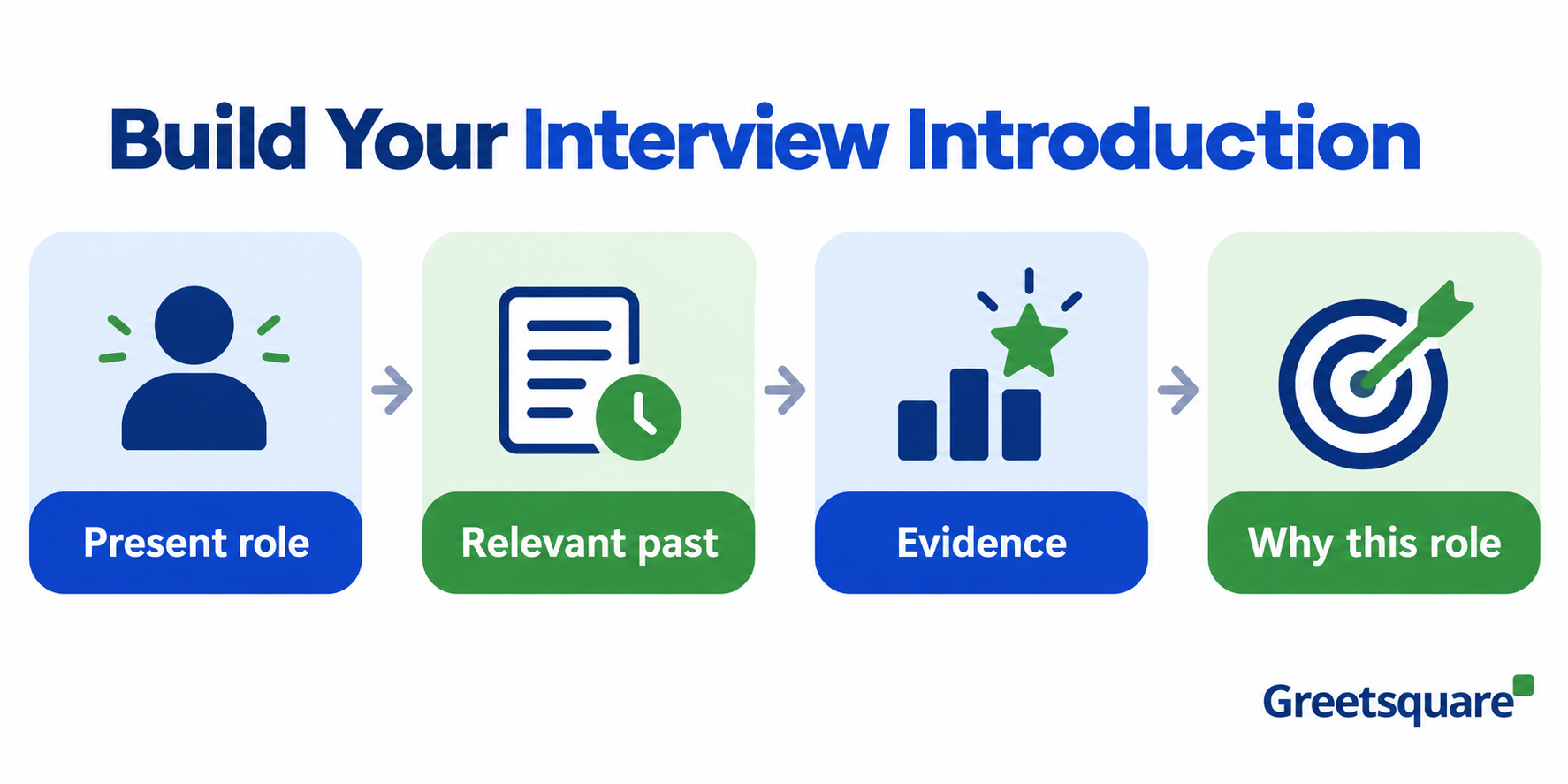
Start with your current work or learning context. Select one or two relevant experiences from the past. Finish with the responsibility or opportunity that connects you to this vacancy. You can change the order when another sequence makes the connection clearer, but keep the answer focused.
| Part | What to Include | What to Avoid |
|---|---|---|
| Present | Function, experience or current learning | An unrelated personal biography |
| Relevant past | Responsibility and one contribution | Every job in chronological detail |
| Next step | Specific connection to this role | Generic praise for any employer |
Choose facts before writing sentences. Underline the responsibilities in the vacancy, then identify which parts of your background address them. If a sentence could be copied into an application for an unrelated career, check whether it is specific enough to help this interviewer.
A Flexible Answer Template
Template: “I’m currently [role or learning situation], with experience in [relevant function]. In [previous role, project or activity], I [specific contribution], which helped me develop [relevant capability]. I’m interested in this position because [connection to the advertised work], and I would like to build on that experience in [relevant responsibility].”
Replace every placeholder with a fact you can explain. You do not need to use all four sentences. A shorter answer can be better when the interviewer asks for a quick overview. Avoid treating the wording as a speech you must recite exactly, especially if follow-up questions interrupt the sequence.
Example for an Experienced Applicant
Hypothetical answer: “I’m an operations coordinator working on service handovers and team scheduling. In my current role, I helped document recurring handover gaps and worked with the team lead on a clearer checklist. I enjoy work that connects process detail with reliable delivery. This position interests me because it combines coordination with improving the day-to-day service workflow.”
The example names the function, describes a bounded contribution and connects it to the next role. It avoids an unsupported claim to leadership or a numerical result that was not established. Your own answer should reflect the actual scope of your work, including whether you owned a decision or supported someone else’s decision.
Decide How Much Chronology Is Useful
If your career path directly explains your suitability, include a short progression. If it creates too much background, select only the relevant experience. The interviewer can ask for dates or earlier roles later. Keep the spoken overview consistent with the CV even when you choose a different order for the explanation.
Example for a Fresh Graduate
Hypothetical answer: “I recently completed my degree and am looking for an entry-level analyst role. In a final-year group project, I checked survey inputs and documented the cleaning decisions before we prepared the report. That work made me interested in reliable analysis and clear reporting. I’m applying here because the role includes supporting reporting tasks while developing those skills in a professional team.”
The applicant identifies the learning setting and their contribution without pretending to have commercial experience. Use a genuine internship, project or volunteering example where appropriate. The graduate interview guide covers wider preparation for early-career interviews, while this framework helps select the opening facts.
Example for a Career Switcher
Hypothetical answer: “My background is in customer operations, where I have documented recurring requests and coordinated responses across teams. That experience led me to explore business analysis. I have completed a practice project mapping a workflow and writing requirements, and I’m now seeking a junior role where I can develop that work further. This vacancy interests me because it combines stakeholder communication with structured analysis.”
The explanation connects prior activity with preparation and an appropriate next step. It does not describe a practice project as professional analyst employment. Name the new direction early, then give the interviewer enough context to understand the transition. Avoid spending the whole answer defending why you are leaving your previous function.
Make the Evidence More Specific
“I am adaptable and a strong communicator” gives the interviewer little to explore. A sentence about documenting a handover, explaining a finding or resolving an unclear request provides a more useful starting point. Choose one action that matters to the vacancy and describe it plainly.
Include results only when accurate and appropriate to disclose. A documented process, completed analysis or learning outcome can be valid evidence without a dramatic percentage. If you mention a team achievement, identify your own involvement. The job roles guide helps you compare responsibilities before choosing the example that belongs in the introduction.
Practise Without Over-Rehearsing
Speak the answer aloud and check whether the role connection is clear. Record a practice version if useful, then listen for long sentences and repeated information. Ask a trusted reviewer to describe your main experience and intended direction. Their summary can reveal whether the opening is doing its job.
Use cue words rather than memorising a paragraph. Prepare alternative versions for a quick overview and a more detailed walk-through. Follow any time request from the interviewer. You do not need to force the same duration in every setting, and an interruption is a cue to respond rather than rush through the remaining script.
Avoid Common Opening Errors
Do not begin with a long personal history unless it is relevant to the question. Avoid criticising former employers, exaggerating responsibilities or presenting a list of generic qualities. You can keep private circumstances private while still giving an honest professional explanation.
Do not end with vague praise such as “your company is prestigious.” Name a responsibility, product area or working problem you have actually researched. If you have not found enough information, ask thoughtful questions later in the interview. The introduction should show a reasoned connection, not imply knowledge of the team that you do not have.
Prepare One Answer for Your Next Interview
Choose the vacancy, write the three parts and add one relevant contribution. Read it aloud, remove repeated background and check the facts against your application. Keep the answer flexible enough to respond to the interviewer. A clear introduction creates a useful opening for discussion; the rest of the interview still needs evidence and informed questions.
You can use the video recording guide to organise a practice introduction. If a vacancy accepts a video profile, explore Greetsquare’s job-seeker platform while keeping the interview answer flexible and the application complete.
Frequently Asked Questions
How Long Should My Answer Be?
Follow the interviewer’s request if they specify a quick introduction or a detailed walk-through. Otherwise, give a concise overview that covers your relevant background and role connection, then allow follow-up questions. Time a practice version, remove repetition and avoid rushing a long biography into an arbitrary duration you found online.
Should I Talk About My Personal Life?
Include personal information only when you choose to and it is relevant to the professional question. An opening answer needs your work or learning background and interest in the role. You can keep private circumstances private. Do not feel obliged to share family, health or financial details to fill time.
Is This the Same as Walking Through My Resume?
The questions overlap, but a resume walk-through may invite chronology and explanation of career transitions. “Tell me about yourself” often allows a selective professional overview. Listen to the wording and adapt the sequence. Keep both versions accurate and consistent with your application rather than memorising one answer for every prompt.
What If the Interviewer Interrupts My Introduction?
Pause and respond to the question or instruction. An interruption may simply mean the interviewer wants more detail on a point. You do not need to finish a memorised script before engaging. Keep your facts and example clear so you can return to the role connection if it remains useful.



