

A cover letter for experienced professionals should explain why your background fits the vacancy and why this particular work interests you. Select one or two relevant examples, connect them to the employer’s stated needs and close clearly. The letter adds a narrative to your resume; it should not retell every role you have held.
Experience creates a selection problem. You may have enough material for several pages, but the reader needs the evidence most relevant to this decision. A focused letter makes that selection visible and gives context that achievement bullets cannot always provide.
What Career-Service Guidance Says About a Letter’s Purpose
Harvard’s resume and cover-letter guidance describes the letter as a narrative introduction that explains qualifications and interest in the organisation and job. That is a useful distinction from a resume’s summary of experience. It is guidance about purpose, not a promise that submitting a letter improves every application.
Check whether the employer requests, accepts or excludes a cover letter. If a form asks specific questions instead, answer those questions directly. Do not substitute a generic attachment for information the application explicitly requires.
Plan a Cover Letter for Experienced Professionals Around Three Questions
Ask what the employer needs, which evidence you can offer and why you want this role now. Write a short answer to each before drafting full paragraphs. If you cannot identify the employer’s needs, revisit the vacancy rather than filling the gap with praise.
Separate facts from assumptions. You can refer to responsibilities in the advert or a public service the organisation provides. Avoid asserting that the company has a particular internal problem unless the employer has described it.
Our resume writing guide helps organise the underlying evidence. The letter should explain the connection between that experience and the next role, rather than introduce claims that contradict your resume.
Open With the Role and a Useful Reason
State which position you are applying for and introduce your most relevant area of experience. Then give a specific reason for your interest, such as the work described or the opportunity to use a particular capability. Keep the opening proportionate to what you know.
An illustrative opening is: “I am applying for the operations coordinator role. My experience maintaining delivery records and coordinating handovers matches the scheduling and service responsibilities described in your vacancy.” Adapt the wording only if the claims are true for you.
Avoid broad declarations that the organisation has always been your dream employer unless you can explain them naturally. Specific relevance is easier to assess than enthusiasm expressed through repeated superlatives.
Use the Middle Paragraph to Explain One Relevant Example
Show the Situation and Your Action
Choose a task that resembles an important part of the vacancy. Explain the context briefly and make your contribution clear. An experienced applicant should show judgement as well as activity, especially when the role requires ownership or coordination.
For example, describe how you clarified inconsistent requests, confirmed priorities and created a shared record before delivery resumed. The example is useful because it reveals what you did when the work was unclear, not simply that you attended meetings.
Explain the Result Without Inflating It
Use a measured outcome when you have reliable evidence and permission to share it. Otherwise state the observable result, such as agreed ownership, a completed handover or a clearer decision. Do not invent a percentage to make ordinary work appear exceptional.
Connect the example back to the vacancy in one sentence. Explain which responsibility it prepares you to handle. This final connection prevents a good story from feeling unrelated to the employer’s hiring decision.
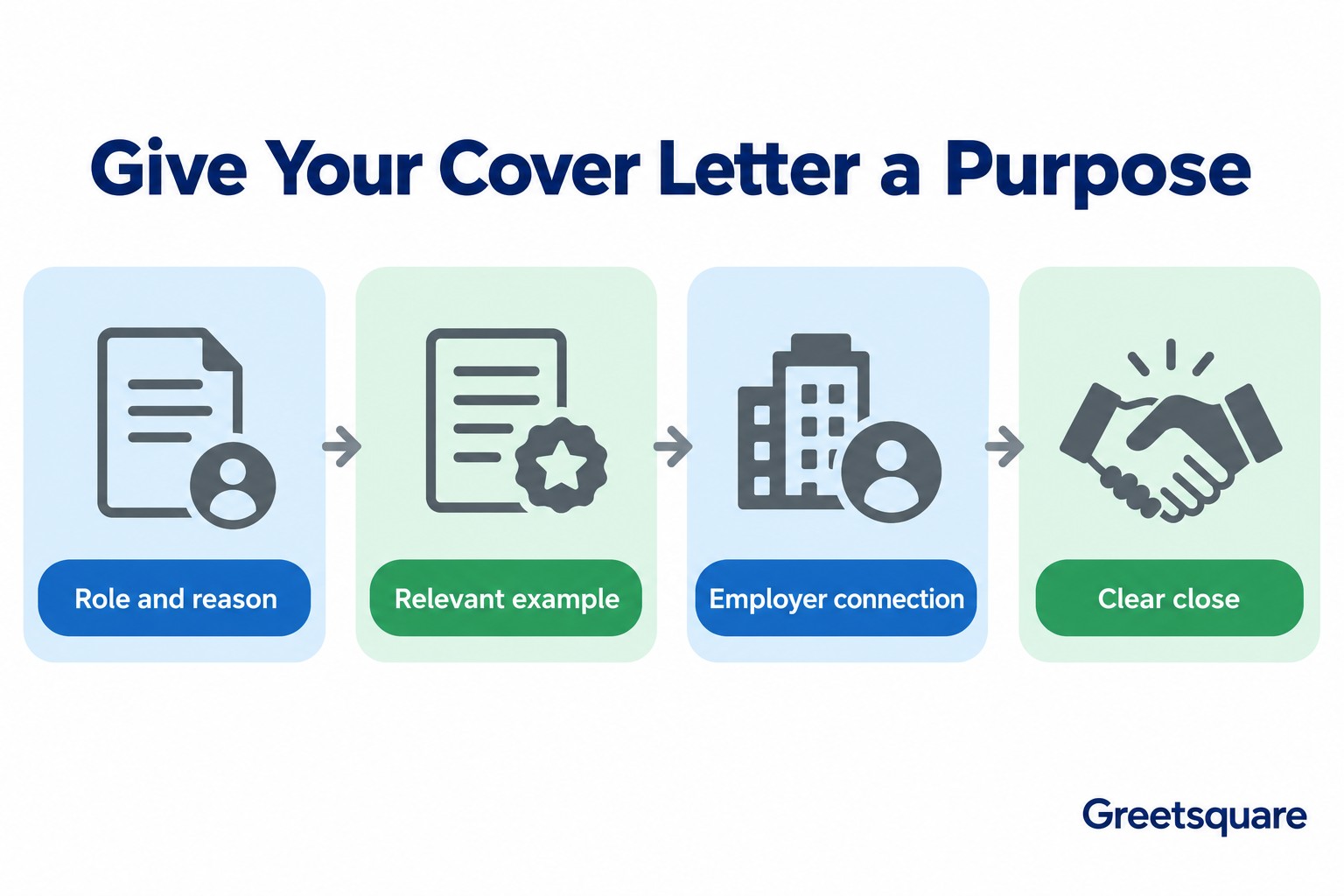
Use This Adaptable Example as a Structure
Dear Hiring Manager,
I am applying for [role]. My experience in [relevant area] has involved [specific responsibility], which connects closely with the [task] described in your vacancy.
In [accurately described setting], I [personal action] when [brief context]. This helped [verified or clearly described outcome]. I would bring the same approach to [relevant responsibility], while learning your team’s processes and priorities.
I am interested in this opportunity because [specific, researched reason]. I would welcome a discussion about how my experience could support the team. Thank you for considering my application.
Kind regards,
[Your Name]
This is a framework, not a finished letter. Replace every bracket with accurate detail and remove any sentence that does not add useful information. A shorter truthful explanation is better than a complete-looking template filled with vague claims.
Explain a Transition Briefly When It Matters
If you are changing role families, explain the transferable capability and the evidence that you have investigated the new work. Do not expect the reader to infer the connection from unrelated job titles. A relevant project or task can make the transition easier to understand.
Our career-change planning guide covers testing a move before committing. If you are applying as a new graduate instead, use the more appropriate fresh-graduate cover-letter guide rather than adopting an experienced applicant’s positioning.
Close Clearly and Remove Unnecessary Detail
Close with interest in a discussion and a professional sign-off. Do not promise an unsolicited phone call when the employer has provided a defined process. Follow any instructions about contact, references, availability and supporting information.
Review each paragraph for repetition. The reader does not need a second career chronology or a long explanation of every reason you are leaving. Keep attention on relevant contribution, motivation and the work you are applying to do.
Check Consistency Across the Whole Application
Confirm the role title, employer name, dates and achievements against your resume. Open the final file and check its layout. Test any links, remove leftover placeholders and read the letter aloud to identify sentences you would not naturally say.
If a video introduction is accepted, use Greetsquare to explain one relevant example rather than repeating the entire letter. For the wider sequence, see our application and interview process guide. Submit a letter only when it serves the employer’s process and strengthens the explanation of your fit.
Frequently Asked Questions
Do Experienced Professionals Still Need a Cover Letter?
Follow the employer’s instructions. A letter can help explain relevant experience, motivation or a transition when the application accepts it, but it is not always required. Use it to add a focused narrative rather than repeating the resume or substituting it for specific questions in an application form.
What Should an Experienced Applicant Put in a Cover Letter?
State the role, explain your interest and choose one or two relevant examples. Make your personal contribution and the connection to the vacancy clear. Use accurate outcomes, avoid retelling your full employment history and check that every claim is consistent with your resume and supporting application materials.
Should I Explain Why I Am Leaving My Current Job?
Include a brief explanation only when it helps the employer understand your application. Focus on the work you want to move towards and the relevant experience you offer. Avoid complaints, confidential details or an extended account of workplace difficulties that distracts from your suitability for the new role.
Can I Reuse the Same Cover Letter for Several Jobs?
Reuse an accurate structure and evidence bank, but adapt the selection and employer connection for each vacancy. Check the company name, role title and application instructions every time. A generic letter is less useful when it does not explain why your experience matches the specific responsibilities being advertised.



