
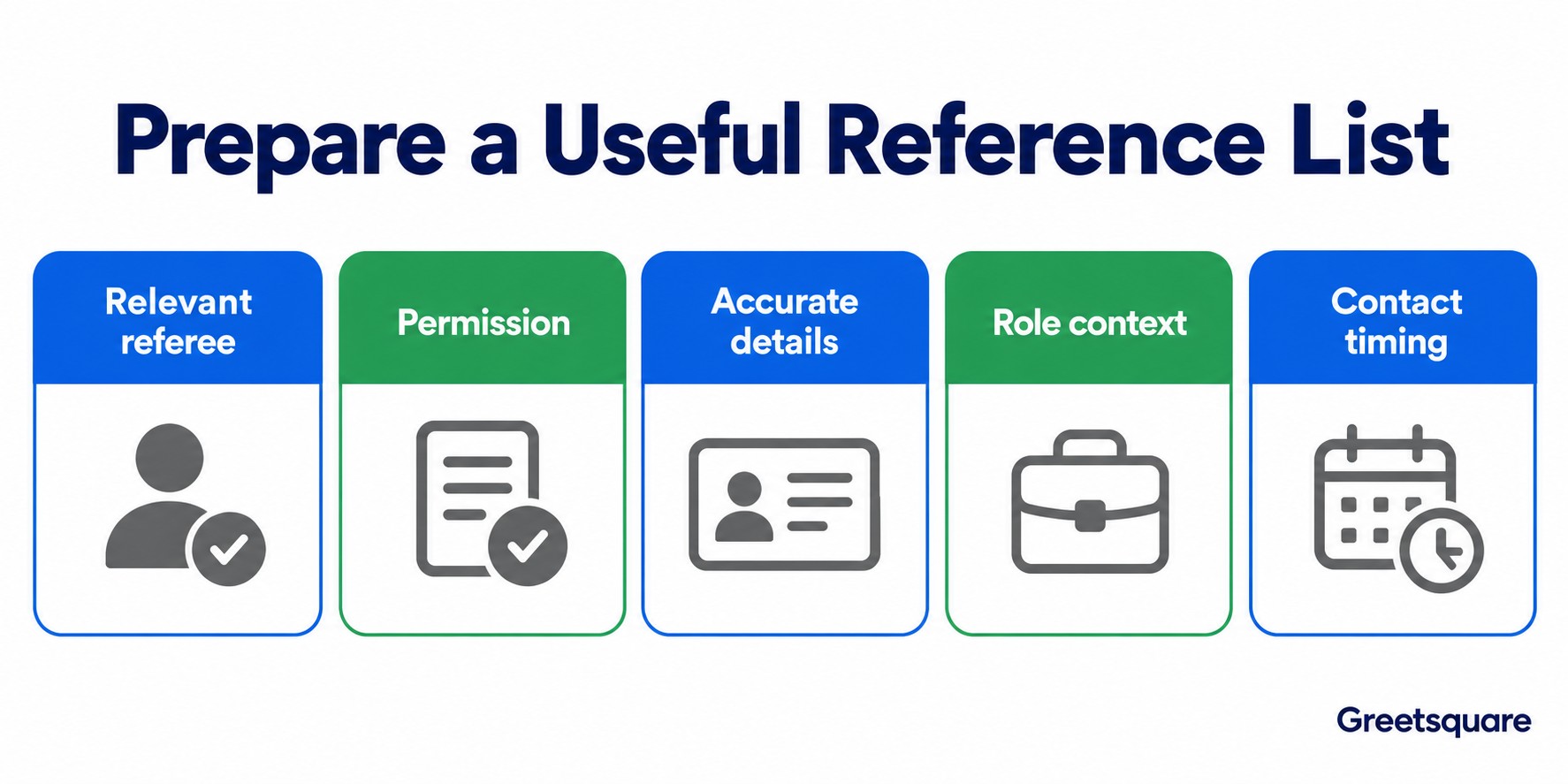
Job reference checks are easier to prepare for when you choose people who know your work, ask their permission and confirm how the employer plans to contact them. Provide accurate details and relevant role context. If your current employer does not know you are applying, discuss contact timing before supplying a current manager’s details.
Reference requirements vary, so use the prospective employer’s instructions as your starting point. This guide covers preparation and communication rather than legal advice or background-screening rules. For the surrounding hiring stages, see our interview and application guide.
What Career Guidance Says About Referees
Oxford’s guidance on references and referees emphasises choosing people who know your professional or academic abilities. Its guidance is a useful preparation resource, but individual employers set their own requirements. Confirm the number and type of referees requested instead of assuming one arrangement applies everywhere.
Find Out What the Employer Requires
Read the application instructions and any offer conditions carefully. An employer may request a particular relationship, a recent referee or an official organisational contact. Ask what is needed if the instructions are unclear. A reference check, employment verification and other screening steps can serve different purposes, so avoid treating them as interchangeable.
Clarify when checks are expected and how contact will happen. Do not assume that a request for details means an offer is guaranteed or that every employer waits until the same stage. If an offer is conditional, read the wording and use our guide to handling job offers to organise the wider decision.
- How many referees are required?
- Which relationships or periods of work should they cover?
- When does the employer expect to contact them?
- Will contact be by email, telephone or a form?
- What alternative is acceptable if a requested referee is unavailable?
Choose People With Relevant First-Hand Knowledge
A useful referee can explain work they have directly observed. Depending on the employer’s requirements, this might be a supervisor, project lead, academic adviser or another appropriate professional contact. A prestigious title is less useful if the person barely knows your contribution or cannot describe it accurately.
Think about the role you are applying for and the evidence each person can discuss. Someone who supervised your client work may be able to comment on communication and reliability. An academic supervisor may know your research and independent work. Match that knowledge to the application without asking the person to claim experience they did not observe.
For an early-career candidate, the strongest available evidence may come from study, placements, volunteering or a substantial project. Ask the recruiter whether those relationships meet the requirement. Do not invent a managerial relationship or substitute a personal friend while describing them as a professional supervisor.
Ask Permission Before Sharing Details
Contact the potential referee with a brief explanation of the role and why you are asking them. Give them an easy way to decline. Someone may be unavailable, restricted by an organisational policy or uncomfortable providing the kind of reference requested. A clear answer now is more useful than an unexpected silence during a check.
You could write: “I am applying for an operations role that involves coordinating deadlines and resolving customer issues. Would you be comfortable acting as a referee based on our work together on the service project? Please let me know which contact details you would prefer me to provide.” Adapt this wording to your relationship.
Once they agree, confirm their current title, organisation and preferred contact method. Check spelling and availability. Keep their details in a private reference document and share them through the employer’s requested channel. Avoid placing private contact information on a public portfolio or broadly distributed resume unnecessarily.
Give Helpful Context Without Scripting the Reference
Share the role description and a current resume if appropriate. Remind the referee of the projects, dates and responsibilities they directly know. A short factual note is usually easier to use than a large folder of material. Check that it is consistent with what you submitted to the employer.
For example, identify the project you worked on together and your responsibility for coordinating updates. Do not write an inflated account and ask the referee to repeat it. The purpose is to help them recall relevant facts, not to manufacture a performance story or control every answer they might give.
If your application needs clearer evidence, improve the application itself. Our guide to writing a resume can help you describe your own responsibilities accurately. A reference should support an honest account rather than repair claims you cannot substantiate.
Manage Current-Employer Confidentiality Early
If your current workplace does not know you are job hunting, tell the prospective employer before sharing a current manager’s details. Explain the concern and ask whether contact can wait until an agreed stage or whether another referee is acceptable. Get a clear understanding rather than relying on an unspoken assumption.
The employer may have a specific process or may need to discuss alternatives. Do not promise that all organisations will accommodate the same request. If the timing remains unresolved, pause sharing the details and clarify the arrangement. This protects the accuracy of the process and reduces avoidable surprises for everyone involved.
Keep the Reference List Accurate and Follow Through
Use a simple document with the referee’s name, current role, organisation, relationship to you and approved contact details. Include any context the employer specifically requests. Check that the attachment is the intended version and contains no unrelated private information before sending it.
Let the referee know when contact is expected and update them if the process changes. If a referee becomes unavailable, tell the recruiter promptly and ask about an alternative. Thank the person for their time without asking them to disclose a confidential exchange or pressure the hiring team.
Reference preparation belongs alongside a clear, consistent application. If the employer also invites a video introduction, Greetsquare can help you prepare a video resume that explains your own experience. Keep it aligned with the facts your application and referees can support.
Frequently Asked Questions
Who Should I Choose as a Job Referee?
Choose someone who can describe relevant work or study they have directly observed and who meets the employer’s requirements. A supervisor, project lead or academic adviser may be suitable depending on the situation. Ask permission first, and confirm that the person is comfortable and available to provide an accurate reference.
Can I Use an Academic Reference for My First Job?
An academic referee may be useful when they know your abilities and the employer accepts that relationship. Check the application instructions or ask the recruiter rather than assuming. Choose someone who can discuss relevant work in detail, such as a project or research assignment, and give them the role context.
What if My Current Employer Does Not Know I Am Applying?
Tell the prospective employer about the confidentiality concern before sharing a current manager’s details. Ask when contact would occur and whether an alternative referee or later contact stage is acceptable. Requirements vary, so clarify the arrangement explicitly rather than assuming that supplying details automatically prevents contact until you approve it.
Does a Reference Check Mean I Have the Job?
A reference request does not guarantee a job offer or confirm that all conditions are complete. Employers use different hiring sequences. Read any written offer and its conditions, ask the recruiter about the remaining steps, and avoid making an irreversible decision based only on a request for referee details.