

In-demand skills in Singapore include capabilities relevant to digital technologies, sustainability, care and the everyday work of specific industries. The best skill for you is one repeatedly needed in your target role, at a level you can realistically reach. Combine official skills information with current job descriptions before deciding what to learn.
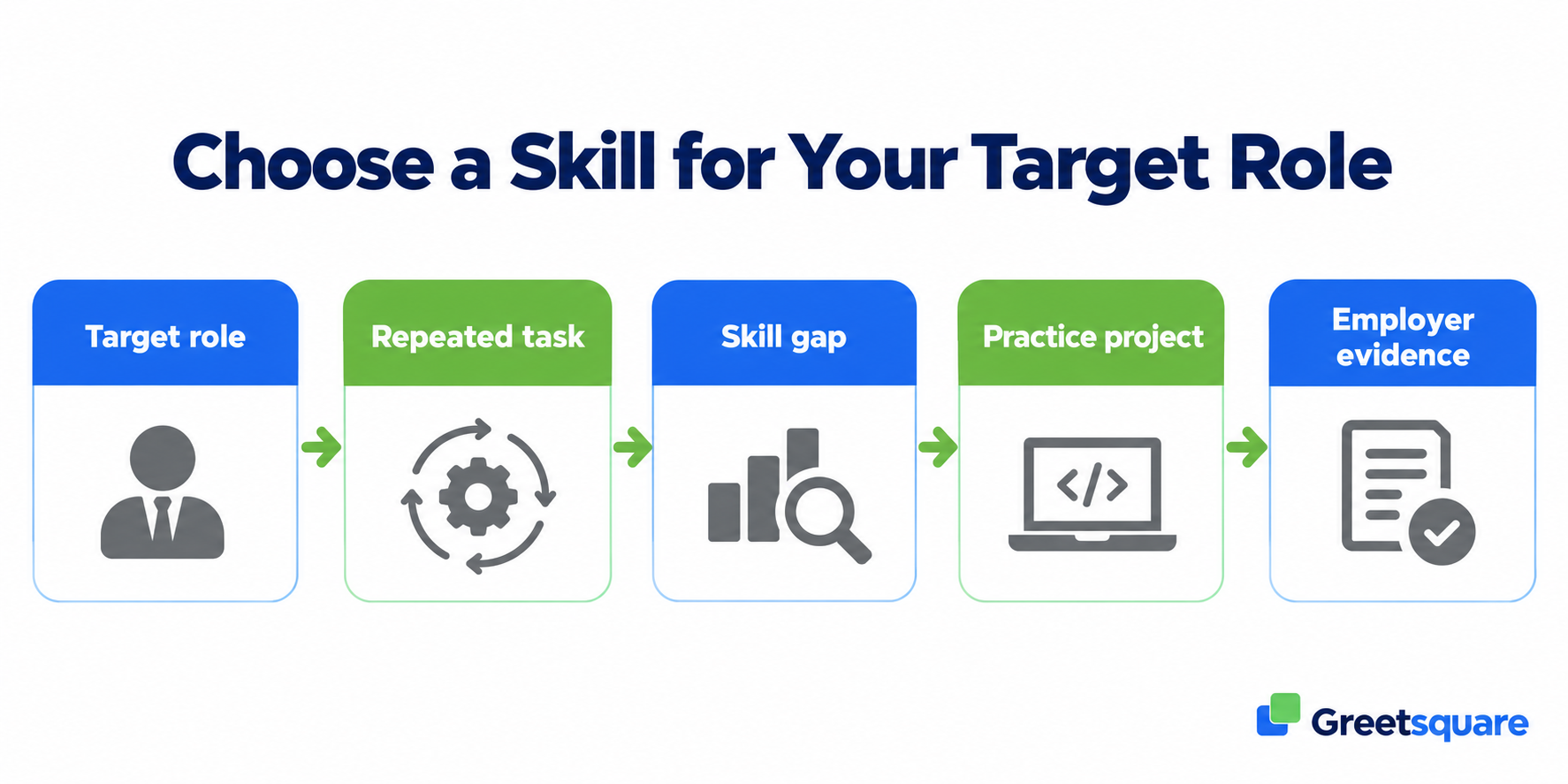
A national growth area is not a personal training plan. A data analyst, an operations manager and a care coordinator may all work with information, but they need different methods, responsibilities and evidence. Start with a role and a task, then choose the learning that closes a concrete gap.
What Official Skills Resources Can Tell You
SkillsFuture’s SkillsFuture Series overview covers emerging capabilities, including digital technologies and AI, sustainability and human development. These themes help identify areas to investigate. They are not a league table of the most common requirements in every Singapore vacancy.
Use the SkillsFuture individual learning and career resources to locate skills information and relevant learning options. Check each resource’s date and scope. A historical report can explain a trend, but an older number should not be presented as the current demand for a role.
Read In-Demand Skills in Singapore Through Actual Work
Digital and Data Skills
Digital fluency starts with using the systems your job depends on accurately and safely. For some roles, that means spreadsheet analysis, customer relationship management or workflow tools. For others, it means SQL, software testing, cloud operations or cybersecurity practices.
Tool familiarity is only part of the requirement. Someone preparing a dashboard must also understand the business question, validate the underlying data and explain the limits of the finding. Our data analyst responsibilities guide helps separate practical analysis work from a list of software names.
AI Literacy With Human Verification
Useful AI literacy includes knowing when a tool is suitable, how to protect information and how to check its output. A candidate who can explain a controlled workflow is offering more substance than someone who simply lists generative AI on a resume.
For an illustrative exercise, use a public dataset to draft a summary, then compare every numerical claim with the source. Record errors, corrections and the decisions that still required human judgement. Do not upload employer data into a service without appropriate authorisation.
Sustainability and Care Capabilities
Sustainability skills can involve energy efficiency, carbon information, procurement requirements or operational improvement. Their depth depends on the position. Reading about emissions does not make someone qualified to verify a company’s reporting or perform specialist engineering work.
Care-related capabilities can include service coordination, understanding user needs and supporting learning or wellbeing within the boundaries of a role. Regulated professional work has its own qualification requirements. A short course is not a substitute for required professional training or registration.
Check Demand Without Mistaking Repetition for Proof
Collect a small sample of current vacancies for the same role family and seniority. Record recurring tasks, named tools and whether a requirement is essential or preferred. Exclude duplicate adverts so one vacancy posted on several sites does not dominate your conclusions.
This is a practical personal sample, not a statistically representative survey. It can still reveal a useful pattern: perhaps several employers want someone who can reconcile data and explain exceptions, while only one asks for a particular dashboard product. The shared task deserves attention first.
Compare your findings with the scope and seniority of different job roles. A senior title may require stakeholder judgement and accountability alongside technical knowledge. Learning a tool alone may leave the main gap untouched.
Choose One Gap You Can Close With Evidence
Write the gap as a task you cannot yet complete independently. “Create a repeatable monthly report from inconsistent source files” is more useful than “learn data”. Define what successful completion would look like, including accuracy, explanation and documentation.
| Target Capability | Practice Output | What to Explain |
|---|---|---|
| Data analysis | A reproducible analysis using public data | Cleaning choices and limits |
| Digital marketing | A sample campaign measurement plan | Audience, metrics and assumptions |
| Operations improvement | A process map with a proposed change | Dependencies and trade-offs |
Label simulations as simulations. Do not claim a practice project increased a real employer’s revenue or reduced costs. Employers can assess a well-explained exercise without being given fictional business results.
Combine Technical Learning With Transferable Behaviour
Technical work often fails at the handover. A correct analysis that nobody understands, or a useful automation that nobody can maintain, creates a new problem. Include documentation and an explanation for the intended user in your learning project.
Our guide to choosing and proving soft skills explains how to make these behaviours visible. Select one technical capability and one supporting behaviour, rather than trying to learn an entire industry in a month.
Decide Whether a Course or Credential Adds Value
Check the syllabus, entry level, practical assessment and total commitment before enrolling. A course should help you perform the task you identified. A recognised assessment may add useful evidence, while an attendance certificate mainly records participation.
Use our framework for choosing a worthwhile certification if you are comparing paid options. Evaluate possible pay against actual role scope using the Singapore salary benchmarking guide, rather than assuming a credential automatically changes your market value.
Make Your Learning Easy for an Employer to Assess
Describe the task, your method and the evidence you produced. Link a permitted work sample and explain one limitation you discovered. This makes your learning more credible than a long list of unfinished courses.
If a short introduction suits the application, create a video resume with Greetsquare to explain the project clearly. Keep the written resume and requested assessment central. Review your learning plan against fresh vacancies regularly and change direction when the evidence changes.
Frequently Asked Questions
What Skills Are in Demand in Singapore?
Digital, data, sustainability and care-related capabilities are useful areas to investigate, alongside the technical requirements of your target industry. Demand varies by role and seniority. Check official SkillsFuture resources and a sample of current vacancies, then choose a specific task you can learn and demonstrate credibly.
Should I Learn AI to Improve My Job Prospects?
AI literacy can be useful where a role involves suitable tools or workflows. Focus on practical use, information protection and verification of outputs. Learn the underlying task as well as the tool, and show an example with clear limitations rather than claiming that AI knowledge alone guarantees employment.
How Do I Choose Between Several Skills to Learn?
Start with one target role and identify recurring tasks in current vacancies. Compare those tasks with what you can already do, then select a gap that blocks a realistic application. Prefer learning that produces a practical example you can explain, rather than choosing purely because a skill is fashionable.
Does an In-Demand Skill Guarantee a Higher Salary?
No. Pay depends on the role, experience, responsibility, employer and market conditions, as well as relevant skills. A newly learned capability may strengthen an application without immediately changing compensation. Compare roles of similar scope and build evidence that you can apply the skill effectively in the required setting.



